
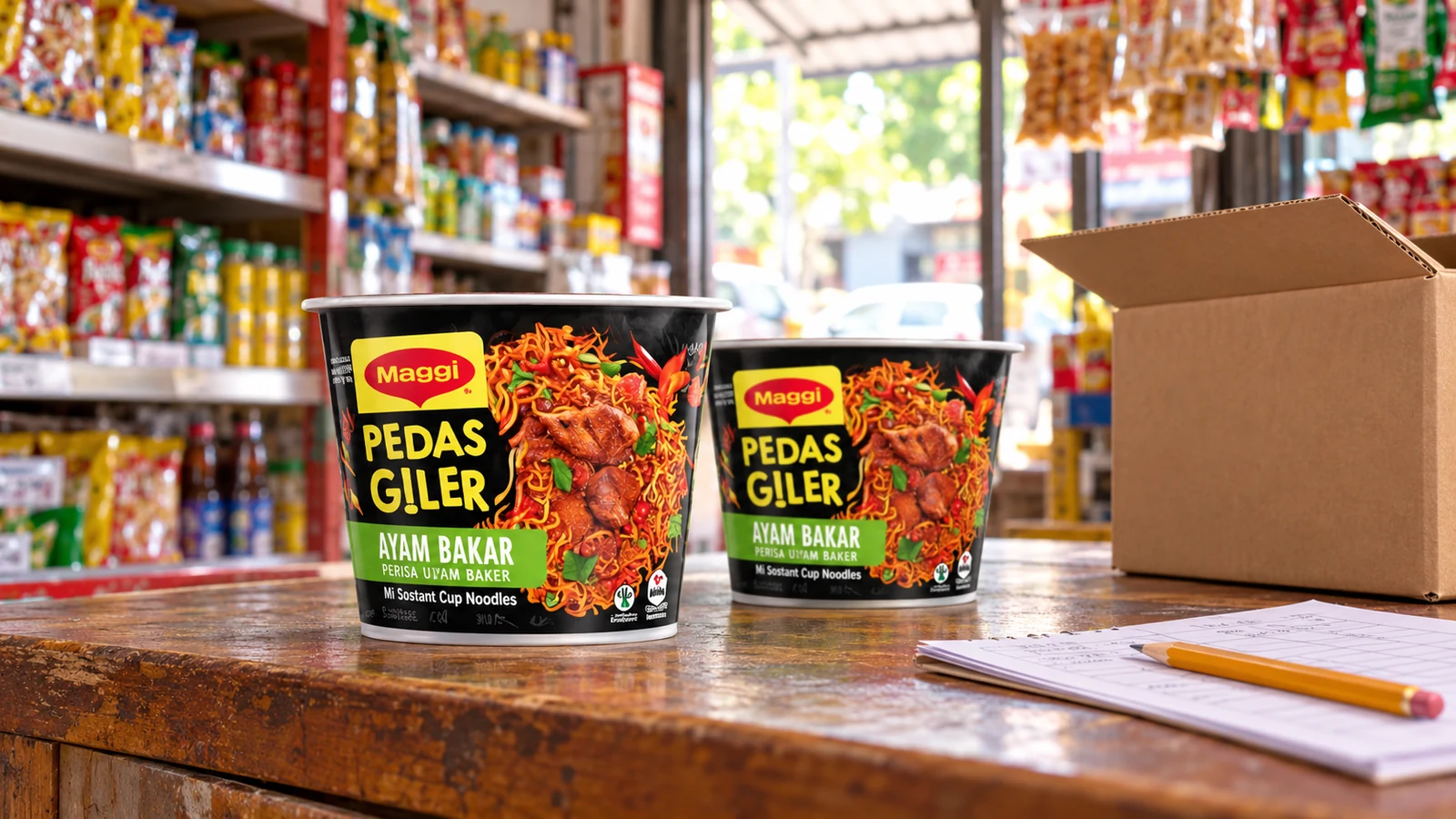
Before ordering Maggi instant noodles for a kedai runcit, confirm the exact flavour, individual pack weight, retail selling unit and number of selling units in the quoted carton. Read every level of a nested quantity separately. A title containing two multipliers needs a clear explanation of what each number counts before it becomes an inventory conversion.
This guide focuses on packaging decisions: comparing listed formats, turning confirmed counts into usable stock figures, and matching an order to shelf space and sales. It does not rank flavours or assume current prices, stock availability or delivery terms. Those details need confirmation for the particular products and quantities you want.
Start with the Maggi catalogue to identify the exact listings. Keep the product description with your enquiry so the supplier can confirm the offered format. A familiar brand name is not enough to distinguish two sizes or packing structures.
Separate the product from its packaging hierarchy
A purchasing line contains several decisions. The flavour identifies the variant. The weight identifies the listed individual size. The packaging structure explains how items are grouped. The quotation unit tells you what quantity the offered price covers. Keep these fields separate instead of compressing them into an unexplained abbreviation.
For example, a product with a 93g size and a stated count of twelve should not be entered under the same stock code as a 76g product with additional grouping in its title. Similar flavour names do not establish identical pack contents, shelf dimensions or order units.
Decide what your shop intends to sell: a complete multipack or another permitted retail unit. Check the actual packaging and relevant label information before splitting a grouped product. A mathematical count of individual packets does not establish that every inner packet is suitable for separate retail sale.
Use a readable description alongside the supplier’s identifier where available. Staff should be able to distinguish the intended product without relying only on a photograph or a shortened name such as “Maggi ayam.” That clarity helps during quotation review, receiving and shelf labelling.
What the current catalogue confirms
The Maggi Pedas Giler Ayam Bakar 93g × 12 listing states a 93g individual size and describes a carton of twelve units. The catalogue also lists Pedas Giler Tomyummz 93g × 12 with the same stated size and count. Confirm the actual supplied packaging and current quotation unit before ordering.
The catalogue contains Ayam Bakar and Tomyummz titles written as 76g × 12 × 5. Their descriptions mention an X5 format and a carton of twelve, but the grouping should be made explicit in the quotation. Record the title as a product identifier while asking what constitutes an inner group and an outer carton.
Another listing is titled “Maggi 2-minn Curry 12(5x79g).” Its description refers to five units per carton, which does not clearly reconcile the twelve in the title. Treat that conversion as unresolved. Ask for a current carton-label or packing confirmation rather than choosing whichever count produces the more attractive comparison.
| Listed product | Listed notation | Purchasing check |
|---|---|---|
| Pedas Giler Ayam Bakar | 93g × 12 | Page describes twelve units per carton; confirm supplied packaging |
| Pedas Giler Tomyummz | 93g × 12 | Page describes twelve units per carton; keep flavour separate |
| Pedas Giler Ayam Bakar | 76g × 12 × 5 | Confirm which grouping each multiplier represents |
| Pedas Giler Tomyummz | 76g × 12 × 5 | Confirm inner grouping, outer count and quoted unit |
| 2-minn Curry | 12(5 × 79g) | Resolve the title/description packing ambiguity before calculating |
These are catalogue observations, not a stock reservation or a promise that every format is available. Product names and counts help frame the enquiry. They do not establish prices, minimum quantities, product dates or a delivery arrangement for your shop.
Read nested quantities one level at a time
Start at the smallest clearly identified product unit and work outward. Ask how many units are inside a retail group, how many groups are inside the quoted outer unit, and whether that outer unit is the carton you intend to buy. Write the names of those levels next to the numbers.
Multiplication can give the same numerical result when the factors are reversed, but the grouping still matters. Twelve groups of five and five groups of twelve both total sixty individual units. They provide different numbers of complete groups for shelf display and retail sale.
Do not use the letter “x” to replace missing packaging information. Once the supplier confirms the structure, record it as a sentence: “one quoted outer unit contains twelve complete groups, each with five individual packets,” if that is the actual arrangement. This is clearer than a bare 12 × 5 entry.
Keep the quotation unit visible throughout the calculation. A price quoted for one inner group should not be compared directly with a price for an outer carton. Likewise, a stock count of three groups must not be entered as three cartons simply because staff use “pack” for both.
Illustrative unit-count calculation
Suppose a fictional noodle format is confirmed to contain twelve retail multipacks per carton, with five individual packets per multipack. One carton contains 12 × 5 = 60 individual packets, but it contains twelve complete multipacks. This example explains the calculation; it does not resolve the packing of any Maggi listing above.
If your shop sells the complete multipack, the starting inventory for one carton is twelve selling units. If another suitable product is sold as individual packets, its selling-unit record may be sixty. Choose the unit based on the actual intended retail format and packaging information, not on whichever number is larger.
For two cartons of the fictional format, the count is twenty-four multipacks or 120 individual packets. Those are two representations of the same goods. Recording both as additional stock would double-count the inventory. Use one base selling unit and retain the conversion as supporting information.
Counting a partly used carton
Imagine the shop has one full carton and three complete multipacks remaining from another carton. Using multipacks as the selling unit gives twelve plus three, or fifteen multipacks. Their individual-packet equivalent is 75, but the purchasing sheet should continue using multipacks consistently.
When the next quotation is expressed in cartons, convert the proposed purchase at the end. Keep shelf stock, reserve stock and incoming goods in compatible units before subtracting them. A correct multiplication cannot rescue a worksheet that mixes cartons and multipacks in the same column.
Compare formats for the purchase your customers make
A larger grouped format and a smaller individual format can serve different shopping occasions. Use your own transactions and repeated customer requests to decide which deserves a trial. Avoid assuming that a familiar flavour will sell equally well in every pack size.
Record the individual weight and the complete selling-unit weight separately where useful. If a fictional five-packet group contains 79g per packet, its combined stated packet weight is 395g. That arithmetic alone says nothing about price, value, ingredients or whether customers want the grouped format.
When comparing quotations, establish an equivalent basis first. Compare the same product and format where possible. If formats differ, keep the difference visible rather than treating cost per packet as a complete answer. Pack weight, grouping and the unit your customer buys can all affect the purchasing decision.
A trial should have a defined quantity, shelf allocation and review date. Record whether sales came from ordinary trading or a particular promotion. The result is evidence about your shop under those conditions, not proof of a nationwide bestseller or a guaranteed future sales rate.
Translate carton quantities into shelf and reserve space
Measure the actual packaging when available. Weight does not establish width, depth or height, and a catalogue title cannot tell you how many complete units will fit on your shelf. Check the display arrangement without compressing or damaging packs to make a planned quantity fit.
Separate display capacity from total holding capacity. A shelf may fit six multipacks while a carton supplies twelve. That can be workable if the remaining six have a clean, suitable reserve location and staff know when to refill. It is less useful if the reserve blocks access or disappears behind unrelated stock.
Give each flavour and format an identifiable position and a matching shelf label. Similar packaging should not make staff refill a 93g line with a different size. Keep any product-code or label changes consistent with the stock record and the unit charged at checkout.
For other items sharing the aisle, the catalogue currently places these noodle listings within Grocery. Plan their space alongside the goods already stored there rather than assuming a dedicated noodle category or additional shelf is available.
Choose an order quantity using selling units
Estimate expected sales over a stated period, add a justified reserve and subtract usable stock plus confirmed incoming quantities that will arrive in time. Calculate separately for each flavour and format. Then convert the requirement into the supplier’s confirmed order increment.
For a fictional example, a shop expects to sell eighteen multipacks during its planning period, chooses a six-multipack buffer and has nine usable multipacks available. With nothing incoming, the requirement is eighteen plus six minus nine, or fifteen multipacks.
If the confirmed fictional order increment is twelve multipacks per carton, two cartons supply twenty-four multipacks. That exceeds the calculated requirement by nine. Review whether those extra units fit the expected selling period, product dates, storage space and purchasing budget before accepting the rounding.
Do not turn carton rounding into an automatic instruction to buy. Ask whether other order units are offered, or reconsider the timing and range if the available increment is unsuitable. This guide does not promise mixed cartons, broken-carton orders or split deliveries from Trader Max.
Check product dates and rotate the correct batch
Ask about relevant date markings before committing to a larger quantity, especially for a new format without reliable sales history. Compare the offered product dates with your expected holding period. A fast-selling flavour in another shop does not establish how quickly your own stock will move.
At receiving, compare the physical product, flavour, weight and pack grouping with the accepted order. Check carton condition and relevant date or batch information before combining the delivery with existing stock. Keep any unclear or questionable goods identifiable while asking for clarification.
Arrange stock by the earliest relevant date, following the product’s storage instructions and your handling procedure. Newer deliveries can carry earlier dates, so arrival sequence alone may not produce the right rotation. Keep markings readable when cartons are opened or multipacks moved to the display.
Use the existing FEFO stock-rotation guide for a broader routine. For this purchasing decision, the key is to connect the actual batch dates with the number of selling units you are about to hold.
An ordering checklist for Maggi noodle formats
- Exact product name and flavour, with the supplier’s identifier if available.
- Individual stated weight and actual packaging format.
- Intended retail selling unit: complete multipack or another suitable unit.
- Number of individual packets in each group, where applicable.
- Number of groups or units in the quoted outer carton.
- Requested cartons and the equivalent confirmed selling-unit quantity.
- Current availability, applicable prices and order conditions.
- Relevant product dates and any requirements important to your shop.
- Storage and display space for the rounded order.
- Delivery location, requested timing and substitution preferences.
Keep unresolved fields marked as questions. If a title and description do not agree, request packing confirmation before accepting the quotation. The confirmed record should explain what will arrive without requiring staff to interpret ambiguous shorthand again.
Frequently asked questions
Does 12 × 5 always mean sixty retail selling units?
No. It may describe sixty individual packets, but your selling unit could be a complete group. Confirm the hierarchy and actual packaging. Twelve groups of five provide twelve complete groups, not sixty groups.
Can I compare the 76g and 93g listings only by carton count?
No. The individual weight differs, and the listed grouping may differ too. Compare exact formats, confirmed contents and the unit your customers will buy. A carton count by itself is not an equivalent quantity.
What should I do when a listing’s packing is unclear?
Keep the exact title with your enquiry and ask for a clear description of the supplied carton and inner groups. Request current packaging evidence when useful. Avoid making an inventory conversion until the ambiguity is resolved.
Should every flavour receive the same shelf space?
Use observed sales, complete-unit dimensions and a defined trial allocation. Review each format separately and adjust its space when the evidence supports a change. Equal space is a starting layout choice, not proof of equal demand.
Request the Maggi formats your shop needs
Prepare your product names, flavours, listed sizes and proposed carton quantities, then send Trader Max your Maggi product enquiry. Ask the team to confirm current availability, packing structure and a quotation for your location before finalising the order.
Cover: an AI-assisted Malaysian shop scene based on a Trader Max catalogue product reference. The plain carton is illustrative and does not establish supplied packing or carton contents.


Leave A Comment