
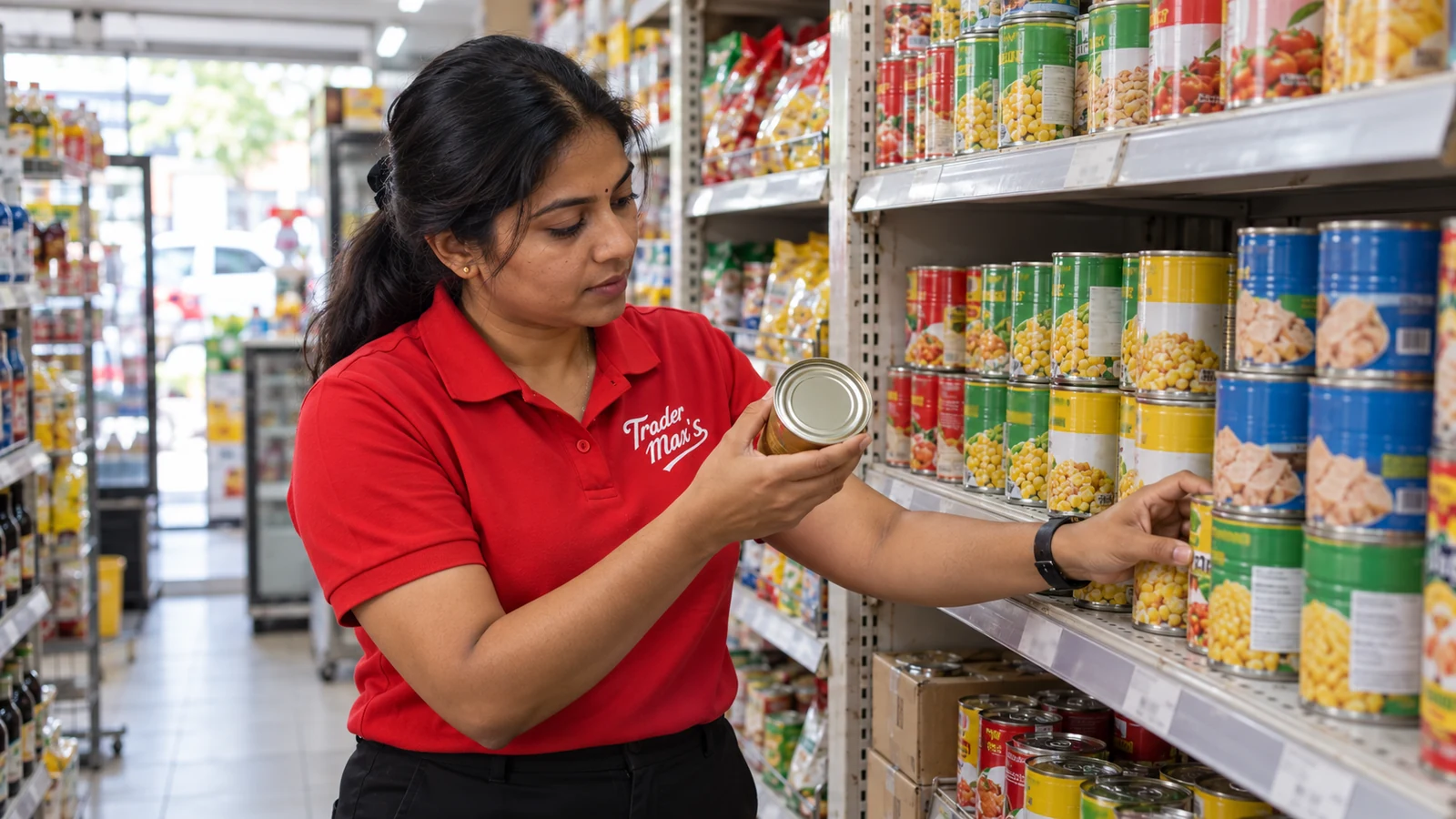
To reduce expired stock in a mini market, record the relevant dates when goods arrive, keep batches identifiable, and bring the earliest-dated suitable stock forward first. This approach is called first-expiry-first-out, or FEFO. Combine it with regular shelf checks and smaller, evidence-based replenishment decisions: moving stock forward cannot fix an order that is much larger than the shop can sell.
For Malaysian mini markets and kedai runcit, the practical challenge is connecting receiving, backroom storage, shelf refilling and purchasing. A date written in a notebook is useful only if the employee filling the shelf can find that batch. This guide provides a simple routine and an illustrative worksheet that a small team can adapt.
What FEFO means in everyday shop work
FEFO gives priority to the batch with the earliest relevant date, provided the goods are still suitable for sale under their label instructions and applicable requirements. Staff check the dates rather than assuming that the oldest delivery always needs to move first. The system needs a clear product identity, batch or lot reference where available, and a readable date.
First-in-first-out, or FIFO, follows arrival order. It can support rotation when delivery order and date order match. However, a later delivery may carry an earlier date than stock already in the shop. FEFO catches that difference because the printed date, not the delivery sequence alone, determines the rotation priority.
Imagine two fictional batches of the same biscuit. Batch A arrives first but has a later printed date. Batch B arrives afterwards with an earlier printed date. If both batches pass the shop’s checks, Batch B should be positioned for earlier sale. Putting every new delivery behind existing stock would give the wrong result in this example.
Rotation is a recognised food-waste reduction practice. The FAO’s food-waste guidance recommends bringing products that will expire sooner towards the front. The operational worksheets below are illustrative suggestions for organising that principle in a small shop, not a description of Trader Max’s warehouse procedures.
Read the wording on the label before recording a date
Do not put every number printed on a package into one “expiry” column. A manufacturing date, batch code and date marking serve different purposes. Record the wording next to the relevant date as well as the date itself. If the format or meaning is unclear, ask the supplier or manufacturer before deciding how to handle that stock.
Keep the original label readable. An internal shelf sticker can help staff locate a batch, but it should not cover, replace or alter the manufacturer’s information. Copy dates carefully and use an unambiguous internal format such as a written month, while retaining the original wording in the record.
This guide does not treat best-before and use-by wording as interchangeable or provide permission to sell goods after either date. Follow the product instructions and applicable requirements. Hold goods with unclear status away from sale while the responsible person obtains clarification. Appearance alone should not be used to override a date or storage instruction.
Start date control at receiving
Compare the delivered product, variant and pack size with the confirmed order. Similar packaging can conceal a different SKU, and different items must not share a batch record merely because their cartons look alike. Check the delivery documents against actual goods before entering quantities into usable stock.
Read date markings on the goods received and identify mixed batches. One delivery can contain several dates for the same product. If that happens, record each date group separately so the earliest batch remains visible in the stock record. Ask for clarification when an outer carton and its contents appear inconsistent.
Inspect visible packaging condition and follow the product’s handling requirements. Keep damaged, leaking or otherwise questionable goods separate while resolving their status with the supplier. A long remaining date does not make damaged or incorrectly stored stock suitable for sale.
Before accepting quantities for normal shelf use, compare the remaining selling window with the shop’s realistic sales pace. If the proposed batch does not suit your needs, raise the concern promptly using the agreed process. Do not assume that the supplier accepts returns, exchanges or credits without confirmation.
Make the backroom easy to rotate
Give each product a clear storage location and separate distinguishable date batches within that location. Place the batch selected for the next shelf refill where staff can reach it without moving several newer cartons. Keep access routes usable and follow suitable handling and stacking procedures for the packaging and space.
Label the location with the product identity and the next batch to pick. If cartons are opened, keep the remaining units identifiable. Loose packets in an unlabelled mixed box make it difficult to reconcile quantities or determine which date should move first.
For each batch, distinguish the quantity on the shelf from the quantity in reserve storage. The same goods should not appear twice in the total merely because staff moved them. Record transfers consistently, or use one total with clearly marked locations if a simpler system suits the shop.
FEFO also depends on suitable storage. Follow the label’s instructions and the shop’s appropriate procedures for temperature, cleanliness and protection from damage. Do not invent one temperature limit or shelf life for an entire grocery category. Products sharing an aisle can still have different requirements.
Check dates whenever you refill a shelf
Before adding stock, check what is already on the display and which suitable batch has the earliest date. Bring that batch into the selling position and arrange later-dated stock behind it where the display allows. Refilling from the front without checking can repeatedly hide the very stock that needs attention.
Check the whole product location, including the back of the shelf, nearby promotional displays and secondary positions. A product can be correctly rotated in its main bay but forgotten beside the checkout. Include those locations in the same review record.
Keep variants and pack sizes distinct. Mixing several flavours in one stack may make dates harder to inspect and can create misleading stock counts. Use shelf labels that help employees identify the correct product instead of relying solely on colour or packaging shape.
For assortment ideas, the biscuits catalogue can help identify product lines to review. Verify each selected product’s actual pack configuration and current availability with the supplier. A catalogue category does not establish a common date policy for every item within it.
Set review triggers that leave time to act
A review trigger is an internal reminder to inspect a batch before the situation becomes urgent. It is separate from the manufacturer’s date and does not extend it. Choose the trigger according to the product, sales pace, remaining quantity and time needed to make a replenishment or stock-handling decision.
A blanket rule such as checking every item only once a month can miss changes between reviews. Instead, make date checks part of receiving and refilling, then add a planned review of batches needing attention. Assign an owner and a next check date so an item does not remain on a list indefinitely.
Use plain status labels such as “normal rotation,” “review now” and “hold pending clarification.” Define who may change those statuses. A coloured sticker can support the system, but the date, product identity and required action should remain understandable without relying only on colour.
When a batch reaches the shop’s review trigger, recount it and check whether the sales assumption remains reasonable. Decide whether to reduce the next order, improve the display position or seek supplier guidance. Do not automatically order more simply because the usual purchasing day has arrived.
Example FEFO worksheet for a mini market
The following example is fictional. Product names, batch references, quantities and dates demonstrate record keeping only; they are not Trader Max stock, shelf-life commitments or recommended selling deadlines. Assume that all listed stock has passed the relevant checks at the time of the exercise.
| Product and batch | Received | Recorded label | Usable units | Next action |
|---|---|---|---|---|
| Fictional biscuit, A | 2 October | Best before 30 November 2026 | 24 | Keep identifiable behind batch B. |
| Same fictional biscuit, B | 8 October | Best before 31 October 2026 | 18 | Prioritise for rotation; review quantity on 14 October. |
| Fictional drink, C | 5 October | Best before 15 December 2026 | 36 | Check all display locations at the next refill. |
Batch B arrived after Batch A but has the earlier printed date, so it receives rotation priority. The review date is an internal management decision in this example. It is not a statement about when the food becomes unsafe or a replacement for the product’s instructions.
In your own worksheet, add the exact SKU, batch code, date wording, location, counted quantity, staff initials and action owner. Record both the shelf and backroom locations when a batch is split. Include a separate field for holds so uncertain goods do not remain counted as normally usable.
Update the worksheet when goods are sold, transferred, removed or otherwise adjusted. Keep a simple reason for each adjustment. Without that distinction, an apparent sales increase might actually be stock removed from sale, leading the purchasing calculation in the wrong direction.
Connect date risk to your next order quantity
Rotation and purchasing should use the same stock picture. Before ordering, count all suitable stock by SKU, identify batches needing attention and check confirmed incoming quantities. Then compare expected demand with what is already available, using a consistent unit such as individual packets or bottles.
Suppose a fictional line has 42 suitable packets available across two batches. The owner estimates ordinary sales of two packets per day. Dividing 42 by two gives 21 days of stock at that assumed rate. This is a planning estimate, not a guarantee that each batch will sell within its relevant window.
Review the earlier batch separately. Eighteen packets at the same assumed rate represent nine selling days if all sales come from that batch. Customers may choose differently, sales can vary and other display locations can interfere with rotation. Leave room for uncertainty rather than treating a simple division as certainty.
If the existing quantity is already difficult to justify, reduce or defer the proposed purchase and ask about available order increments. A carton discount should not conceal excess stock. Use the mini market restocking checklist to combine dates with open orders, storage and quotation details before approving the next purchase.
Give near-date and unsuitable stock different actions
Goods approaching a date require review; goods whose saleability is uncertain require a hold and clarification. Keep those situations separate. A review list should name the specific action, responsible person and next check, rather than simply labelling everything “old stock.”
If you consider a promotion, first establish that the goods remain suitable and that the proposed sale follows applicable requirements. Keep date information clear and avoid misleading presentation. A lower price changes the commercial decision; it does not change the manufacturer’s date or storage conditions.
For stock that must be removed from sale, record the product, batch, quantity and reason, and prevent accidental return to the shelf. Follow the appropriate disposal, return or other approved handling procedure. Do not assume donation is an acceptable destination for goods that are unsuitable or uncertain.
Ask suppliers about their actual reporting and return arrangements before relying on them. Keep the request and response with the batch record. An unanswered message is not confirmation of a collection or credit, so the stock remains under the shop’s control until the next step is agreed.
Keep responsibility clear across shifts
A small team can use a simple division of work: the receiver records dates, the shelf refiller checks picking order, and the owner or assigned purchaser reviews quantities. One person may perform several roles, but the checks should still occur at the relevant stage.
At shift handover, share the few batches that need action, where they are located and what remains unresolved. A short specific note is more useful than a general reminder to “check expiry.” For example, identify the SKU and batch requiring a recount before the next purchase.
Review recurring causes of loss as well as the total quantity removed. Separate over-ordering, hidden reserve stock, missed rotation, damage and unclear date records. Each cause points to a different correction, and better shelf rotation alone will not solve all of them.
A practical weekly review checklist
- Check the earliest relevant date for each batch needing attention.
- Count shelf, promotional-display and backroom quantities without duplication.
- Confirm that the next suitable batch is accessible for refilling.
- Keep original labels and batch references readable.
- Separate held goods from stock available for ordinary sale.
- Compare actual sales with the assumptions used for purchasing.
- Review confirmed incoming orders before requesting more stock.
- Assign a person and date to every unresolved action.
Adapt the frequency to the product and the shop’s circumstances; a weekly review is an organising example, not a universal safety interval. Receiving checks, shelf-refill checks and urgent exceptions still need attention between planned reviews.
Frequently asked questions
Is FEFO the same as putting the newest delivery at the back?
Not always. Compare the relevant dates first. A new delivery can have an earlier date than existing stock, so arrival order alone can produce the wrong rotation priority. Keep batches identifiable and check their suitability before arranging them.
Do I need special software to start?
A clear paper log or spreadsheet can support a small operation if staff keep it current. The essential fields are product, batch, date wording, date, quantity, location and action. Software helps only when the receiving and shelf records are accurate.
Will FEFO prevent every expired item?
No. It helps organise rotation, but oversized orders, weak sales assumptions, unsuitable storage and missed checks can still cause losses. Combine FEFO with realistic quantities and investigate the reason whenever stock has to be removed.
Discuss suitable order quantities
Prepare your exact product list, usable stock count and any date or packing questions, then discuss suitable order quantities with Trader Max’s. Ask the team to confirm current availability, pack configurations, relevant batch information and the terms for your proposed order before committing.
Featured cover: an AI-generated illustrative stock-rotation scene with Trader Max branding. The person and shop are fictional, not a photograph of an actual Trader Max employee or premises.





Leave A Comment