
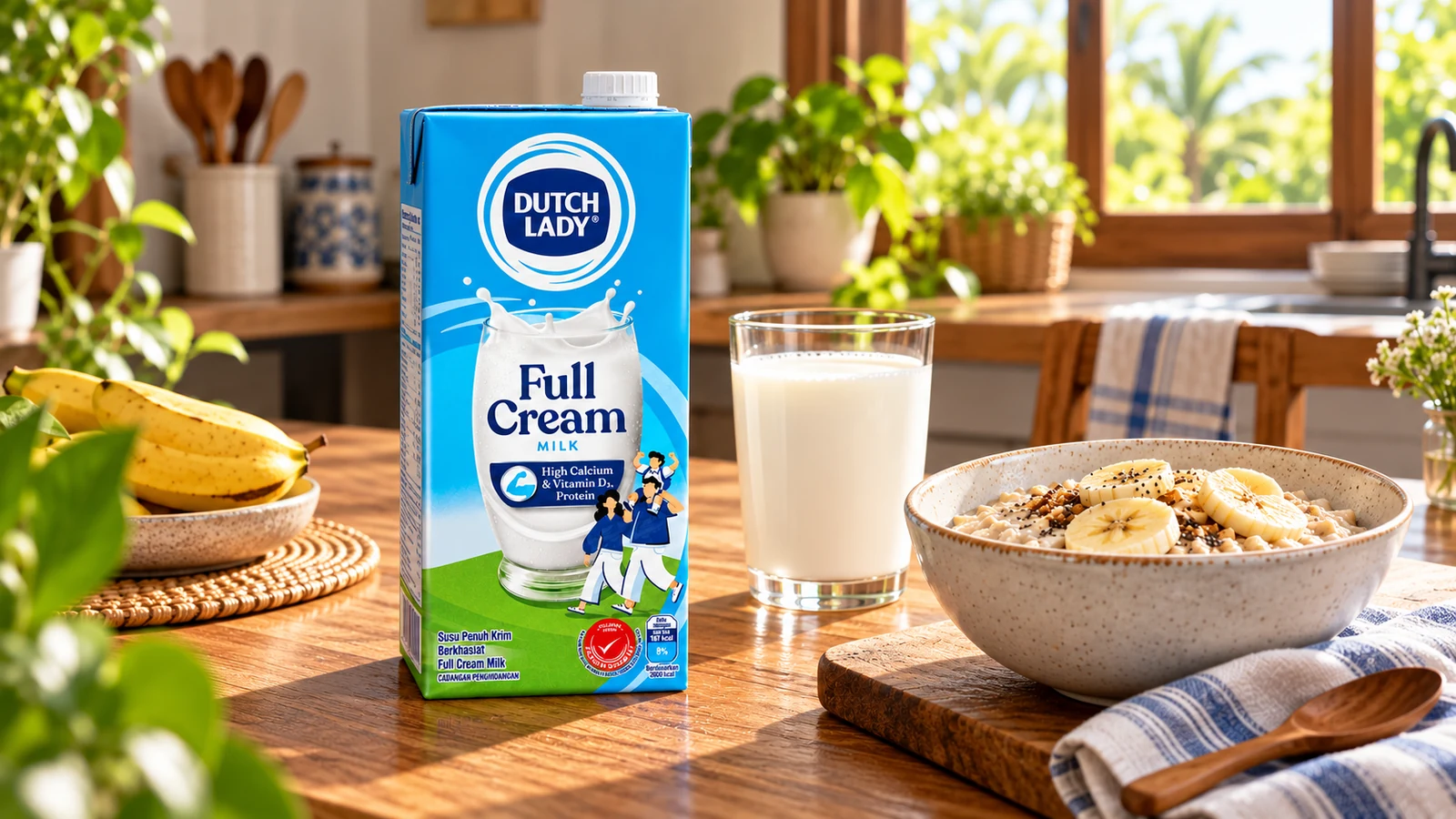
A carton of Dutch Lady Full Cream Milk offers a useful starting point for a much bigger Malaysian business story. Behind the familiar product is a dairy manufacturer whose local roots stretch back to 1963, and whose recent changes include a new production base, updated packaging and a planned renewable-energy project.
For shoppers, the immediate question may be which milk to put in the basket. For mini market owners, it is also worth understanding how a longstanding brand is adapting: what has already changed, what the company has announced next, and what those developments actually mean for the products on the shelf.
This spotlight follows Dutch Lady’s history in Malaysia through to developments available as of 19 October 2026. Full Cream Milk is our featured product; the factory, commercial and sustainability developments discussed below concern Dutch Lady Milk Industries Berhad’s wider business, rather than a separate investment plan for this single product.
The product on the shelf: Dutch Lady Full Cream Milk
Trader Max’s catalogue lists Dutch Lady Full Cream Milk 12 × 1L. That makes it a concrete product reference for this article, rather than simply a discussion of a brand name. Buyers should confirm the actual quotation unit, current stock and delivered packaging before placing an order.
Dutch Lady’s own Full Cream Milk product page describes it as plain whole milk and presents both UHT and pasteurised formats. The company suggests drinking it on its own, pairing it with breakfast foods, or using it in cooking and baking. Those are product-use suggestions, not evidence that every household or food-service recipe needs the same format.
The distinction between product name and processing format matters. “Full cream” and “UHT” answer different questions, so a retailer should not identify storage requirements from the words “full cream” alone. Use the precise pack description and follow its storage instructions. The brand’s product page says to refrigerate after opening and consume within three days; the instructions on the supplied pack should guide handling.
How Dutch Lady’s Malaysian story began
The company’s 2023 annual-report timeline records the formation of Pacific Milk Industries and construction of a sweetened condensed milk plant in 1963. It records a stock-exchange listing in 1968, followed by the start of UHT production and a company-name change to Dutch Baby Milk Industries in 1975. The Dutch Baby brand became Dutch Lady in 1984.
These dates describe the development of the company and brand. They do not establish that today’s one-litre Full Cream Milk carton, its artwork or its formulation has existed unchanged since 1963. That distinction is useful when discussing a familiar grocery product: a long corporate history and the history of an individual pack are related, but not identical.
The sequence also helps explain why a milk brand can have several identities in customers’ memories. Someone may remember a name from childhood, while a younger shopper knows a current carton. A retailer does not need to turn that history into a sweeping claim about everyone’s preferences. It is enough to understand the milestones and identify the product accurately.
A short timeline from origins to the current business
| Period | Documented milestone | How to read it |
|---|---|---|
| 1963–1984 | Company formation, stock-exchange listing, UHT production and the Dutch Lady brand name | The historical foundations of the business, not a launch date for the current carton |
| 2024 | DLMI@Enstek manufacturing facility inaugurated on 30 May | A change in production infrastructure |
| 2025 | Bandar Enstek Distribution Centre launched on 30 May | A further step in connecting manufacturing and distribution |
| 2026 | Liquid-milk packaging refresh and newer product ranges reported | Changes customers and retailers may encounter in the market |
| December 2026 target | Operations projected for the announced rooftop solar project | A planned milestone, not a completed result at this article’s date |
The historical dates come from the annual report; the later milestones are documented in the company announcements linked below. Keeping dates beside each development makes the story easier to follow and prevents an older announcement from being mistaken for fresh news.
The Enstek move: a new chapter behind the carton
Dutch Lady’s 30 May 2025 distribution-centre announcement dates the inauguration of its DLMI@Enstek manufacturing facility to exactly one year earlier. The new Distribution Centre forms part of the same 13-hectare site in Bandar Enstek, Negeri Sembilan. The release describes physical and digital integration with manufacturing and storage capacity of nearly 25,000 pallets.
For a product-focused reader, the significance is the connection between making goods and moving them. Manufacturing capacity alone is only one part of a supply chain. Finished products also need storage, accurate order handling and onward distribution. Our interpretation is that the Enstek development should be understood as investment in that broader operating system.
It would go too far to translate the investment into a promise that every retailer will receive every product more quickly. Delivery performance at a particular shop depends on the actual order, stock position and distribution arrangements. The company’s infrastructure announcement is useful background; an order confirmation remains the relevant evidence for a specific delivery.
What changed recently: packaging and new ranges in 2026
In its second-quarter 2026 report, Dutch Lady said its core liquid-milk range had been relaunched with a new pack identity during the quarter. It also identified contributions from Dutch Lady Omega 3*6 and the newly launched Dutch Lady Tealive range, alongside activity in the out-of-home channel.
Those are concrete recent developments, but they are separate from a claim that Full Cream Milk itself has acquired a new recipe. Packaging identity, product innovation and formulation changes are different things. When a customer asks whether a carton has changed, the useful response is to compare the exact label and product information, rather than infer the answer from a refreshed design.
For store teams, a packaging refresh is a reason to review product photographs, shelf labels and receiving references. Check the barcode, volume and variant against the delivered item. If old and new packaging overlap, keep date rotation clear and avoid treating appearance alone as evidence of a different product.
The Tealive collaboration shows a different product direction
The manufacturer’s current ready-to-drink product catalogue includes Dutch Lady x Tealive Signature Milk Tea Flavoured Milk, called MooTea, and Signature Matcha Flavoured Milk, called MeowCha, in 250ml formats. It also separately lists Full Cream Milk, other UHT variants, pasteurised milk and Omega 3*6 products.
Our reading of that range is that Dutch Lady is addressing more than one purchase occasion. A plain milk carton and a collaboration flavour are different propositions, even though they share a brand. A shopper buying milk for an established household routine may be making a different choice from someone trying a flavoured drink.
This is an interpretation of the published range, not a disclosed forecast for how individual products will sell. Nor does the manufacturer’s catalogue establish that every item is available from Trader Max. A retailer interested in a newer line should check supply, the specific product description and customer demand before adding it to a regular order.
What the latest business results tell us—and their limits
The Q2 2026 report records revenue of approximately RM386.6 million, up 2.9% year on year, and says the full transition to the Enstek manufacturing facility and Distribution Centre was complete. These are company-wide statements, not sales figures for the one-litre Full Cream Milk product.
The distinction is important for a retailer reading brand news. Company revenue cannot reveal how many cartons a particular neighbourhood shop will sell next week. It may provide context about the business, but it cannot replace local sales records, customer requests or an assessment of the available shelf space.
Likewise, a successful product launch at company level does not make every variant a suitable addition to every outlet. Start with the role a product will serve in your range. Then use actual transactions to decide whether its initial allocation should stay the same, expand or shrink.
The clearest announced future project: rooftop solar
On 12 May 2026, Dutch Lady announced a 15-year renewable-energy agreement with Pekat Solar for its Enstek site. Pekat is to install, own and operate the system, while Dutch Lady purchases the generated electricity. The announcement projected operations in December 2026.
The stated expectations were approximately 4.9 million kWh of renewable electricity a year and an offset of up to 24% of the plant’s electricity consumption. These are project forecasts. As of this article’s 19 October 2026 publication date, we have not verified a commissioning announcement, so the project is presented as a plan rather than an operating achievement.
For readers following the brand’s future, the next useful evidence would be confirmation that the system is operating, followed by reported performance. An announced generation estimate and a measured annual result answer different questions. Neither figure, by itself, establishes the environmental footprint of an individual carton.
Future growth also depends on how the new base is used
In its May 2026 AGM responses, management described expected maintenance and operational capital expenditure of RM15 million to RM30 million in a typical year after the Enstek transition. It also left room for investments in efficiency, digitalisation and possible new product lines.
This is a useful indication of priorities, but it is not a dated launch calendar for new milk flavours or another factory. No such calendar is being claimed here. The more grounded story is that the company has established a new operating base and is discussing how to improve and use it.
Our interpretation is that future progress should be assessed through specific evidence: products actually launched, improvements actually reported and projects actually commissioned. For a retailer, those developments become commercially relevant when they change the assortment available, the order terms or the service experienced by the shop.
A Malaysian community presence beyond the supermarket shelf
Dutch Lady’s 24 June 2026 announcement about Program Menutrisi Sarawak described initiatives at SMK (BM) Saratok combining student support, digital learning and nutrition education. It also discussed milk-carton collection and recycling through a partnership with Trienekens Sarawak.
That adds a community dimension to the recent brand story. It should not be used to claim that buying a particular retail carton produces a specific educational outcome, or that milk alone explains results from a programme with several forms of support. The announcement concerns an organised company initiative, not a performance guarantee for a product.
For readers interested in what comes next, community programmes are worth following alongside commercial launches. Look for named locations, delivery partners and documented activities. These details are more informative than general statements that a brand intends to help communities.
What this means for a Malaysian mini market
Brand history can help a shop explain a product, but a good buying decision still starts with the exact item. Record the variant, volume, selling unit, quoted carton configuration and date information together. Do not replace those details with a broad entry labelled simply “Dutch Lady milk”.
Trader Max also lists Dutch Lady Chocolate Milk 12 × 1L. Keep that as a distinct stock line from Full Cream Milk. Different flavours should earn their shelf allocation through their own sales, rather than through an assumption that all products from the same brand turn at the same rate.
When discussing a new range or refreshed pack with staff, separate three questions: is it a new product, is it new packaging, and is it currently available to order? The answers may differ. A short receiving note with a verified product image can prevent confusion between the item a buyer intended and the item that arrives.
For quantity planning, use your own sales and confirmed replenishment timing. The mini market inventory and reorder-point guide explains that process. A company expansion story should not become a reason to order more milk than your outlet can sell within its storage and date constraints.
Questions customers and retailers may ask
Has this exact Full Cream Milk carton existed since 1963?
The verified 1963 milestone concerns the company’s origins. It is not evidence of an unchanged recipe, pack size or design for today’s product. Use the current pack for product details and the corporate timeline for the brand’s historical background.
Is the December 2026 solar milestone already complete?
It is presented here as the date projected in the May announcement. This article does not verify completion ahead of that date. A later company update would be needed before describing the project as operational.
Does a new factory mean lower wholesale prices?
No specific price reduction follows automatically from an infrastructure announcement. Prices depend on the actual offer and order terms. Compare current quotations for the same product and selling unit, including applicable charges, rather than estimating a saving from factory news.
Which development should a shop watch most closely?
Watch changes that affect the exact lines you buy: packaging, available variants, order quantities, date information and confirmed supply arrangements. Broader company developments provide context, but the practical decision is whether a product suits your customers and your store.
Explore the product for your next order
Dutch Lady’s Malaysian history provides the background; recent product updates and announced operating projects show how the business continues to change. For a buyer, the useful next step is to turn that interest into a precise shortlist rather than an assumption about future demand.
Contact Trader Max for a Dutch Lady quotation with your preferred variants, pack sizes, quantities and delivery location. Ask the team to confirm current availability, packing and applicable terms before finalising your order.
Editorial note: researched on 19 October 2026 using the linked company publications and current catalogue. Forward-looking statements are attributed plans, not guarantees. The cover uses a Trader Max catalogue product photograph as the reference for an AI-assisted poster; packaging supplied may differ.

Leave A Comment