
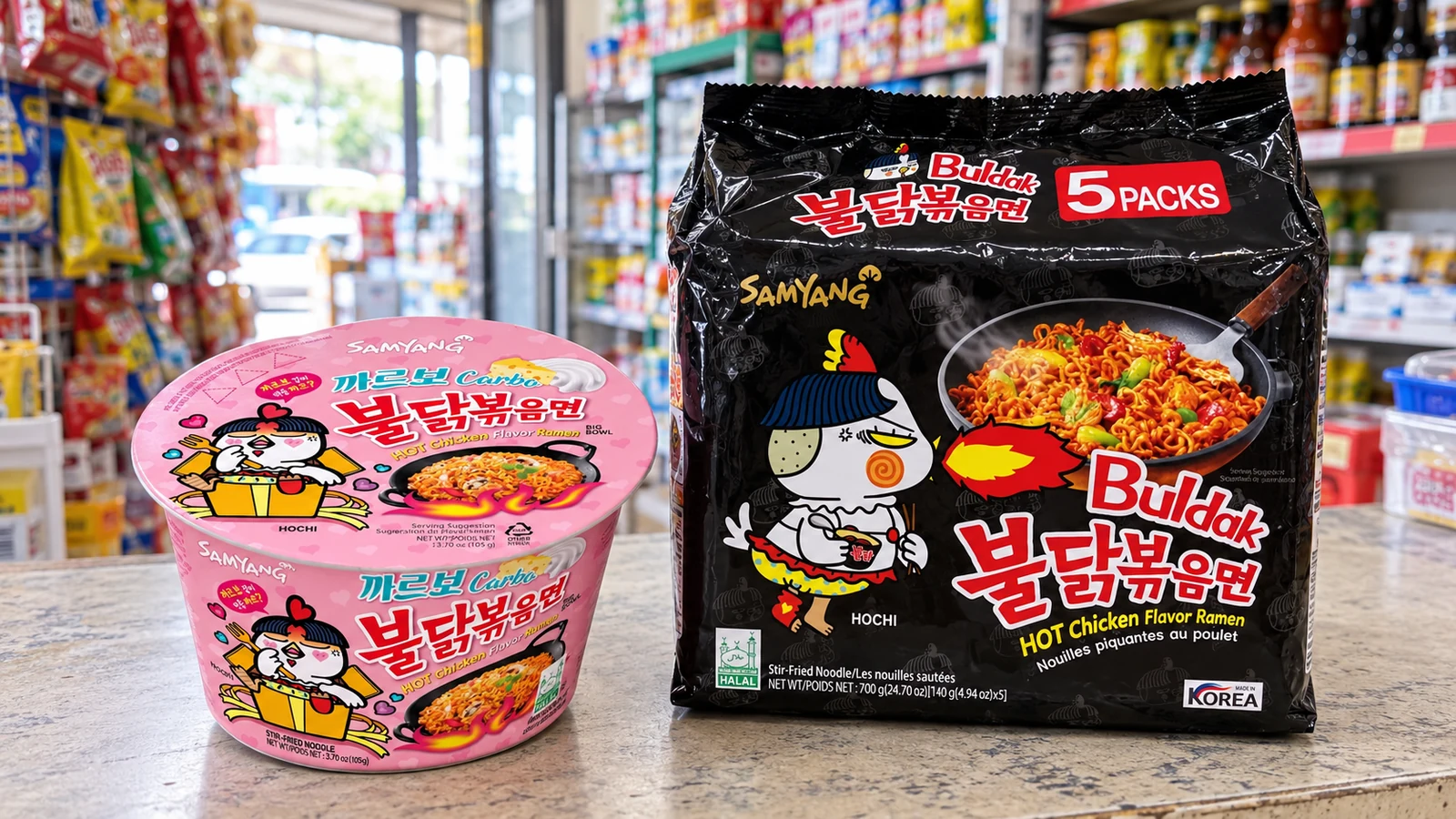
Choosing Samyang cup vs packet noodles for a mini market starts with a retail question: what will your customers buy, and how much stock can your shop carry comfortably? A cup and a packet can serve different shopping occasions, but the format alone does not decide which deserves more shelf space.
For kedai runcit owners and mini market buyers, the useful comparison covers the exact variant, selling unit, preparation requirements, shelf footprint and replenishment quantity. It also needs to separate flavour preference from packaging preference. A Carbonara cup and a black packet product are different items, so their sales cannot tell you only whether shoppers prefer cups or packets.
This guide uses Trader Max’s current catalogue as a starting point and explains what to confirm before ordering. Catalogue details were checked on 16 October 2026. Listings are product references, not confirmation of current availability, pricing or delivery arrangements.
Start with the exact Samyang product, not just the format
The Samyang product range gives buyers a place to identify the variants they want to discuss. Build a shortlist with the full product name and link beside every proposed quantity. A request for “two cartons of Samyang” leaves room for confusion about flavour, unit weight and packaging.
Two useful starting references are the Carbonara cup listing and the Hot Chicken Flavor Ramen black packet listing. They provide concrete examples for comparing purchasing questions, but they are not a matched flavour test. Keep each as a separate stock line from quotation through receiving and point-of-sale setup.
| Buying detail | Carbonara cup reference | Black packet reference |
|---|---|---|
| Catalogue name | Samyang Buldak Carbonara Cup 16 × 105g | Samyang Buldak Hot Chicken Flavor Ramen (Black Pack) 8 × 5 × 140g |
| Listed unit weight | 105g | 140g |
| Quantity evidence | Title and description both indicate 16 cups | Title and descriptive carton quantity conflict |
| Before ordering | Confirm quotation unit, available quantity and batch dates | Confirm outer carton, inner pack and individual packet counts in writing |
| Comparison limit | Different variants and weights; sales differences cannot be attributed to format alone | |
The Carbonara cup product page consistently identifies 105g cups in a quantity of 16. Still, have the quotation state what one ordered unit means. A clear quotation should let the person receiving the delivery reconcile the order without interpreting a product title.
The black packet product page needs additional clarification: its title says 8 × 5 × 140g, while its descriptive text refers to a carton of five. Do not treat either interpretation as a confirmed wholesale carton count. Ask for the current packing breakdown and check it against the quotation and delivered carton. Until that is resolved, leave any carton-to-packet calculation blank.
Match each format to an observed shopping occasion
Think about why people enter your shop. Some may buy food to prepare later at home; others may look for a single item during a work break. These are questions to investigate using your own sales and customer requests, not assumptions that every neighbourhood behaves the same way.
A cup format may be relevant to shoppers who want its container as part of the purchase. However, a cup is not automatically ready to eat, and its shape does not prove that hot water alone is sufficient. Check the exact package instructions before describing how a customer can prepare it.
A packet may fit shoppers who already have the equipment required by its instructions. That still does not establish whether they want one packet or a multipack. Record requests for both, and confirm the intended retail selling unit before setting up your shelf label and checkout barcode.
If you provide a preparation area, review what that area actually supports. Staff should be able to direct customers to the label, suitable equipment and relevant handling arrangements. Avoid putting a “just add water” sign over a mixed noodle display unless that statement is verified for every product it covers.
Separate flavour, weight and format in your sales records
A cup-versus-packet trial becomes misleading when several variables change at once. If the Carbonara cup outsells the black packet, shoppers may be responding to the variant, ticket price, position or availability. The result is useful for choosing those two stock lines, but it does not establish a universal preference for cups.
Record the full variant name, individual weight, package type, retail selling unit and selling price for each line. Keep the shelf location and days available in the same review sheet. This gives you a way to explain an apparent winner before increasing its next order.
Where a closer comparison is possible, select matching variants after verifying the actual products and labels. Even then, different weights and prices remain relevant. Compare performance in the context of the exact items sold rather than presenting the exercise as a scientific test of packaging.
Do not use package colour as the only identifier. Staff should match the printed product name, barcode and size when receiving and replenishing. Colours and artwork can change, and similarly styled products can be separate variants. A photograph of the current label can help an internal receiving sheet, provided it corresponds to the stock being ordered.
Measure usable shelf space before assigning facings
Measure your shelf depth, clear height and the width you are willing to allocate. Then test the actual selling units in that space. Product weight does not tell you package dimensions, and neither catalogue reference above establishes how many units will fit on your particular shelf.
Count both the visible facings and the units behind them. A facing is one product position visible from the front; it is not necessarily one unit of shelf capacity. Avoid comparing three cup facings with three packet facings as if they always hold an equal quantity.
Check how easily customers can read the variant and price without lifting several products. Make sure the chosen arrangement remains stable when a front unit is removed. Use the packaging’s handling guidance and your actual fixture constraints when deciding whether stacking is suitable.
Back-room space matters too. A display that looks small may be supported by more reserve stock than expected once the quotation unit is converted into selling units. Record shelf capacity and reserve capacity separately, and ensure the replenishment team knows which batch should be moved forward first.
Confirm preparation and label information accurately
Use the instructions on the exact pack supplied to your shop. Do not copy cooking times, water quantities, draining steps or microwave directions from another Samyang variant, a different market’s packaging or a customer video. Those details have not been verified for the two catalogue references in this guide.
Before preparing any customer-facing information, check the product label for ingredients, allergens, storage instructions and other relevant declarations. If a customer needs information that staff cannot confirm, show them the actual package rather than guessing from a flavour name.
The same discipline applies to certification and heat descriptions. Do not infer certification from the brand, and do not assign a heat ranking from the colour of the pack. Any claim on a shelf card should be supported by the exact product’s current label or an applicable primary source.
Keep the original information legible. If you intend to separate a multipack into individual sales, first establish that the intended units carry the necessary information and suitable retail identification. Do not assume every inner packet should be sold separately simply because the outer wrapping can be opened.
Build a small assortment worksheet before requesting a quote
A useful worksheet makes uncertainties visible. It should distinguish proposed demand from confirmed packing, and confirmed packing from available stock. This prevents an estimate in the planning stage from quietly becoming a purchase commitment.
| Worksheet field | What to record |
|---|---|
| Exact item | Full name, product link, variant and individual weight |
| Retail selling unit | One cup, one permitted individual packet, or a multipack |
| Supplier order unit | Written confirmation of carton and inner pack quantities |
| Space allowance | Measured shelf capacity plus separate reserve capacity |
| Demand evidence | Actual sales, customer requests and days in stock |
| Batch information | Dates and remaining shelf life to confirm before acceptance |
| Review decision | Keep, increase, reduce or investigate after the trial |
For a new line, choose a review period and a quantity that your business can assess without crowding out established products. There is no fixed cup-to-packet ratio that suits every mini market. The supplier’s confirmed order unit may also constrain how closely you can match your ideal starting quantity.
Agree who will record sales and who will make the next purchase decision. A worksheet helps only if someone updates stockouts, damaged units and replenishment. Write the review date beside the first order so the trial does not become an indefinite repeat purchase.
An illustrative two-week review
The following figures are invented solely to demonstrate record keeping. They are not Trader Max prices, sales forecasts, recommended order quantities or confirmed packet packing. Assume the shop has already confirmed its selling units and received separately identified stock.
| Measure | Example cup line | Example packet line |
|---|---|---|
| Opening selling units | 16 | 20 |
| Units sold during 14 days | 10 | 8 |
| Replenishment, damage or adjustments | 0 | 0 |
| Closing units | 6 | 12 |
| Simple sell-through | 10 ÷ 16 = 62.5% | 8 ÷ 20 = 40% |
These calculations describe only the invented starting stock. The 20 packet units are an arbitrary stock balance, not a statement about a supplier carton. In a real review, reconcile opening stock plus receipts minus sales and other recorded movements with the physical closing count.
Before increasing the cup allocation, check whether both lines were available for the entire period, whether one received a better position and whether a promotion changed demand. Also remember that the example lines could differ in flavour and weight. Higher sell-through is a reason to investigate replenishment, not proof of a higher profit.
If the packet line remains slow, investigate the actual cause before ordering more variants. A hard-to-read price, an unsuitable selling unit or repeated requests for a different flavour may call for different actions. Adding stock without understanding the issue can make the next review harder.
Compare commercial terms using the same unit
Ask for a quotation that states the product, order quantity, units per order unit and applicable charges. Convert the quoted amount into the cost of your intended retail selling unit only after the packing is confirmed. Comparing a cup carton price with an unexplained packet carton price does not produce a useful buying decision.
Include relevant charges in your cost calculation using your normal accounting treatment. If transport charges are shared across an order, use a consistent allocation method. Keep any estimate marked as provisional until the order terms are agreed.
A difference between selling price and product cost is not the same as final business profit. Discounts, damaged stock, expiry losses and operating costs can affect the result. Use your own approved figures and avoid assuming that either format guarantees a better margin because of its packaging.
Receive, rotate and review each variant separately
At receiving, match the delivered name, barcode, weight and quantity to the confirmed quotation. Inspect the packaging condition and date markings before mixing the delivery with existing stock. Resolve discrepancies while the affected cartons can still be identified clearly.
Use first-expiring-first-out rotation: place stock with the earlier relevant date where it will be picked first, while following the label’s storage instructions. Keep different batches distinguishable when their dates differ. Arrival order alone is not enough if a later delivery has an earlier date.
Review slow lines while there is still time to make a considered decision. Reduce the next purchase, adjust space or investigate customer demand using your own policy. Do not rely on an assumed future promotion to justify more stock than the shop can reasonably sell.
Turn the comparison into a clear purchasing enquiry
Before the next order, give each stock line one written decision and a reason. For example, retain the same quantity because sales were steady, reduce it because reserve stock remains high, or postpone the decision because the product was unavailable for part of the review. Keep the evidence with that decision so another staff member can follow it.
Repeat the review after any material change in selling price, display position or selling unit. A result from a different setup may no longer describe the current shelf. Over time, this creates a practical buying record for your own store, rather than a permanent rule that one noodle format must always outperform the other.
Your shortlist should now show the exact variants, intended selling units, available space and quantities you want quoted. Mark any unresolved packing detail prominently, especially the conflicting black packet carton description. Ask for current availability, packing confirmation, batch-date information and applicable order terms before finalising quantities.
Contact Trader Max with your proposed Samyang cup and packet list to request available formats and a quotation. Include the product links, requested quantities and delivery location so the team can clarify the order against the exact items you intend to stock.



Leave A Comment