
Choose canned-coffee carton quantities by estimating sales or planned servings over a defined period, adding a justified buffer, subtracting usable stock and confirmed incoming quantities, then rounding to the supplier’s verified order unit. Check the rounded amount against storage space, product dates and your actual replenishment arrangements before ordering.
For a café or food stall, ready-to-drink coffee can serve a different purchase occasion from freshly prepared drinks. Some customers may want a sealed takeaway option, while an event organiser may need a fixed number of cans. Neither situation tells you to buy the same number of cartons. Start with the way your business will use the product.
This guide explains how to build a small product shortlist, calculate an illustrative order and review the results. The sales rates, buffers and replenishment timing used below are fictional planning assumptions. They are not Trader Max’s sales figures, stock availability or delivery commitments.
Define the role of canned coffee in your business
A sealed takeaway option at a café
A café may offer canned coffee alongside prepared drinks for customers who want a sealed item to take away. Record these sales as their own product lines. Do not forecast canned-coffee demand from total coffee orders, because customers choosing a freshly prepared drink may not want a packaged alternative.
Consider where customers will see the cans and how staff will retrieve them. A small chilled display, a menu listing and a backroom carton each serve different purposes. Decide what the product is meant to do before assigning it valuable display space or assuming that additional stock will create demand.
A simple beverage choice at a food stall
A food stall may have limited storage and a busy service window. Count the cans sold during that window and note whether staff ran out of chilled stock while reserve cans remained elsewhere. A display-refill problem should not automatically become a larger supplier order.
If the stall operates only on selected days, calculate demand using those operating days. Keep that calendar separate from the time between supplier orders and receipts. A weekly market stall and a café open every day can have very different purchasing needs even if both sell the same daily quantity.
A planned event or staff allocation
For a planned allocation, start with the number of people receiving a can and the number of service occasions. A booking for 40 people does not necessarily require 40 cans of coffee if attendees have several beverage choices. Confirm the allocation rather than treating attendance as demand for one particular drink.
Keep event quantities separate from ordinary daily sales. Otherwise, one large booking can distort the following week’s forecast. Label any additional reserve explicitly and decide what you will do with unopened leftovers before buying another event batch.
Check the exact product and carton format
Trader Max’s catalogue lists Nescafé Original Can 240ml × 24 pieces. The product page identifies the individual volume and a carton of 24 cans. Use that listing to identify the product, then confirm the current quotation unit and availability for your order.
The catalogue also lists Ngupi White Coffee 240ml × 24 pieces. Its title provides a listed size and count for your enquiry. Ask the supplier to confirm the current packing arrangement, especially if a quotation uses an abbreviation or a different unit description.
Those two listings share a stated volume and count, but that does not make the products interchangeable. Keep their names and variants separate in your stock sheet. Confirm the label information relevant to your customers rather than making assumptions about ingredients, sweetness or other product characteristics from the word “coffee.”
For each candidate, record the exact description, individual size, pieces per quoted unit and proposed quantity. If you change a variant, check the conversion again. A familiar brand name or similar can design is not enough to establish that another item has the same carton structure.
Build a shortlist that fits your available space
Begin with a range your team can count and review accurately. Adding several similar variants immediately can spread demand across small quantities and make it difficult to tell which one earns its space. A limited trial gives you clearer information about actual purchases at your own outlet.
Choose the trial period and review date before ordering. Record the conditions of the trial: operating days, display position, menu visibility and any event allocation. These notes help explain results without claiming that a single good or poor day proves a permanent customer preference.
Use customer requests as one input, alongside transactions and available space. A requested product deserves investigation, but repeated purchases provide stronger evidence for ongoing replenishment. Do not convert general brand familiarity into an unsupported claim that a product will be a fast seller at your location.
For general brand background, the existing Nescafé explainer is a separate resource. Your carton decision should still come from the exact listed format and your outlet’s own demand records.
Estimate demand in cans before converting to cartons
Use one base unit throughout the calculation. If customers buy individual cans, record demand, stock and incoming quantities in cans. Convert the purchase requirement into cartons only at the end. Mixing cartons and pieces in the same subtraction is an easy way to order too much or too little.
A practical starting formula is: expected demand over the planning period, plus your chosen buffer, minus usable stock and confirmed incoming quantities for that period. If the result is negative, it indicates no additional quantity under those assumptions, not a negative purchase order.
Time the stock figures carefully. Use the quantity you expect to have at the start of the planning period, or explicitly account for sales before that date. An on-hand count taken several days earlier can overstate the cans available when your planned week begins.
Count only stock suitable for its intended use. Keep goods held for a condition or date check separate. Confirm incoming quantities and arrival timing; an order expected after your likely shortage does not cover the immediate gap simply because it appears in a spreadsheet.
Worked example: a six-day café order
Imagine a café expects to sell eight cans of one generic coffee product per operating day over six days. It chooses a twelve-can buffer, expects twelve usable cans at the start of the period and has no incoming stock. Assume a fictional order format of 24 cans per carton.
| Planning item | Example value |
|---|---|
| Expected daily sales | 8 cans |
| Operating days | 6 days |
| Expected demand | 8 × 6 = 48 cans |
| Chosen buffer | 12 cans |
| Usable opening stock | 12 cans |
| Confirmed incoming stock | 0 cans |
| Purchase requirement | 48 + 12 − 12 = 48 cans |
| Illustrative carton count | 48 ÷ 24 = 2 cartons |
After receipt, the café would hold 60 cans before the planned sales. If the assumed 48 cans are sold, twelve remain. That remaining quantity reflects the chosen buffer; it is not evidence that the forecast was wrong or that another twelve must automatically be added to the next order.
The calculation assumes the purchased stock is available before it is needed. If delivery occurs midway through the period, map expected sales before arrival separately. Check whether the opening stock covers that interval rather than relying only on the total weekly quantity.
When the requirement does not divide evenly
Suppose another outlet calculates a requirement of 50 cans and can order only full cartons of 24. Three cartons provide 72 cans, which is 22 more than the calculated requirement. Rounding up solves the pack-size calculation but creates an additional storage and sell-through decision.
Assess whether those extra cans fit the intended holding period and product dates. Ask about available order formats without assuming that broken cartons or mixed cartons are offered. If the smallest available increment is too large, revise the range or purchasing plan rather than hiding the excess in the worksheet.
Worked example: a food stall with two coffee lines
Consider a fictional stall operating four days in a planning period. It estimates six cans daily for Coffee A and three for Coffee B. It chooses buffers of six and four cans respectively. Opening usable stock is six cans of A and four cans of B, with no confirmed incoming stock.
Coffee A needs 24 + 6 − 6 = 24 cans. Coffee B needs 12 + 4 − 4 = 12 cans. If both can be purchased only in fictional 24-can cartons, the proposed order becomes one carton of each. That gives B twelve more cans than its calculated requirement.
Do not combine the two products into a 36-can requirement and round the combined number. Customers choosing one variant may not substitute the other, and the supplier’s order increment applies to the individual item unless a mixed format is explicitly offered.
The owner could review whether the second line justifies its extra holding, ask about permitted order formats or plan a different purchase interval if feasible. Each option needs confirmation against actual supply arrangements. The example does not promise smaller orders or split deliveries from Trader Max.
Separate reserve storage from chilled display stock
Calculate how many cans need to be ready for the next service window, then determine how staff will replenish the display. The quantity in the refrigerator and the quantity purchased from the supplier answer different questions. A nearly empty display can coexist with adequate reserve stock.
Measure usable space rather than judging from an empty shelf. Allow for other drinks, access and the equipment’s operating instructions. Avoid overcrowding or arranging stock in a way that interferes with normal equipment use. Follow the product label’s storage instructions for both reserve and displayed stock.
Set a simple refill responsibility. For example, one employee can check the coffee display before service and record reserve cans moved into it. That is an illustrative shop routine, not a temperature or storage-duration recommendation. Product labels and suitable handling procedures remain the reference for storage conditions.
If you move stock between outlets or take it to events, record the transfer. Otherwise, a missing carton may look like strong sales and inflate the next purchase. Keep sales, transfers, staff allocations and damaged stock as separate movements wherever practical.
Check dates and condition when receiving cartons
Match the product, variant, individual volume and pack count against the accepted order. Count received quantities before mixing them with older stock. Check visible packaging condition and investigate affected or questionable cans through the supplier’s agreed process rather than treating every delivered unit as available to sell.
Read the date wording on the actual label and keep batch information visible. Different batches may have different relevant dates even when they arrive together. Arrange stock so earlier appropriate dates receive attention first, following your handling procedures and the product instructions.
Compare remaining product life with your planned rate of sale before accepting a large holding as sensible. There is no universal number of remaining days that fits every outlet and product. State any important requirements when requesting the quotation and confirm whether they can be met.
Record discrepancies with the order reference, exact item, quantity and relevant evidence. Keep affected goods identifiable while seeking clarification. A replacement, credit or other outcome should be recorded only when agreed and completed, so the next stock figure remains accurate.
Review the trial before increasing carton quantities
At the planned review date, compare opening stock, receipts, sales and other stock movements with the closing count. Investigate differences before adjusting the forecast. A recording error can make demand appear higher or lower even when the physical stock has a straightforward explanation.
Note stockouts separately. Sales of zero while the display was empty do not prove a lack of demand. Equally, a one-off event does not establish a new ordinary daily rate. Use representative operating days and record why unusual days were included or excluded.
Review each coffee line independently. If one variant moves slowly, changing its display or reducing the next order may be more useful than increasing the overall coffee range. Make a specific change, record it and observe the next period so the result can inform your purchasing decision.
Questions to include in your supplier enquiry
- What exact canned-coffee variants and formats are currently available?
- How many cans are supplied in each quoted order unit?
- What quantity can be supplied for the requested timing?
- What prices, minimum quantities and applicable charges apply to this order?
- Can the supplier meet any stated product-date requirements?
- What delivery arrangements are available for the exact location?
- How should unavailable lines, substitutions and discrepancies be handled?
Keep the reply with your proposed quantities and identify anything still pending. Do not turn an unanswered question into an assumption. If the pack format or arrival timing changes, update the worksheet before accepting the quotation.
Frequently asked questions
How many cartons should a café buy for its first trial?
Estimate cans over a defined trial period, subtract usable stock, add a reasoned buffer and check the available order increment. There is no universal starting carton count. The rounded quantity must fit your space, product dates and willingness to hold unsold stock.
Can I forecast canned coffee from freshly brewed coffee sales?
Use prepared-drink sales only as background context. Measure canned-coffee purchases separately because the products serve different preferences and occasions. Label an initial estimate clearly until you have representative sales records for the canned line.
Do two 240ml coffee products need the same order quantity?
No. Equal can volume and carton count do not establish equal demand. Keep separate records for each variant and calculate requirements from its own sales or planned allocation, then review the space and stock tied up in each line.
Enquire about canned-coffee formats for your outlet
Prepare your shortlisted products, estimated cans, preferred carton quantities and business location, then ask Trader Max about currently available canned-coffee formats. Confirm the packing, current quotation and supply arrangements before finalising the order for your café or food stall.
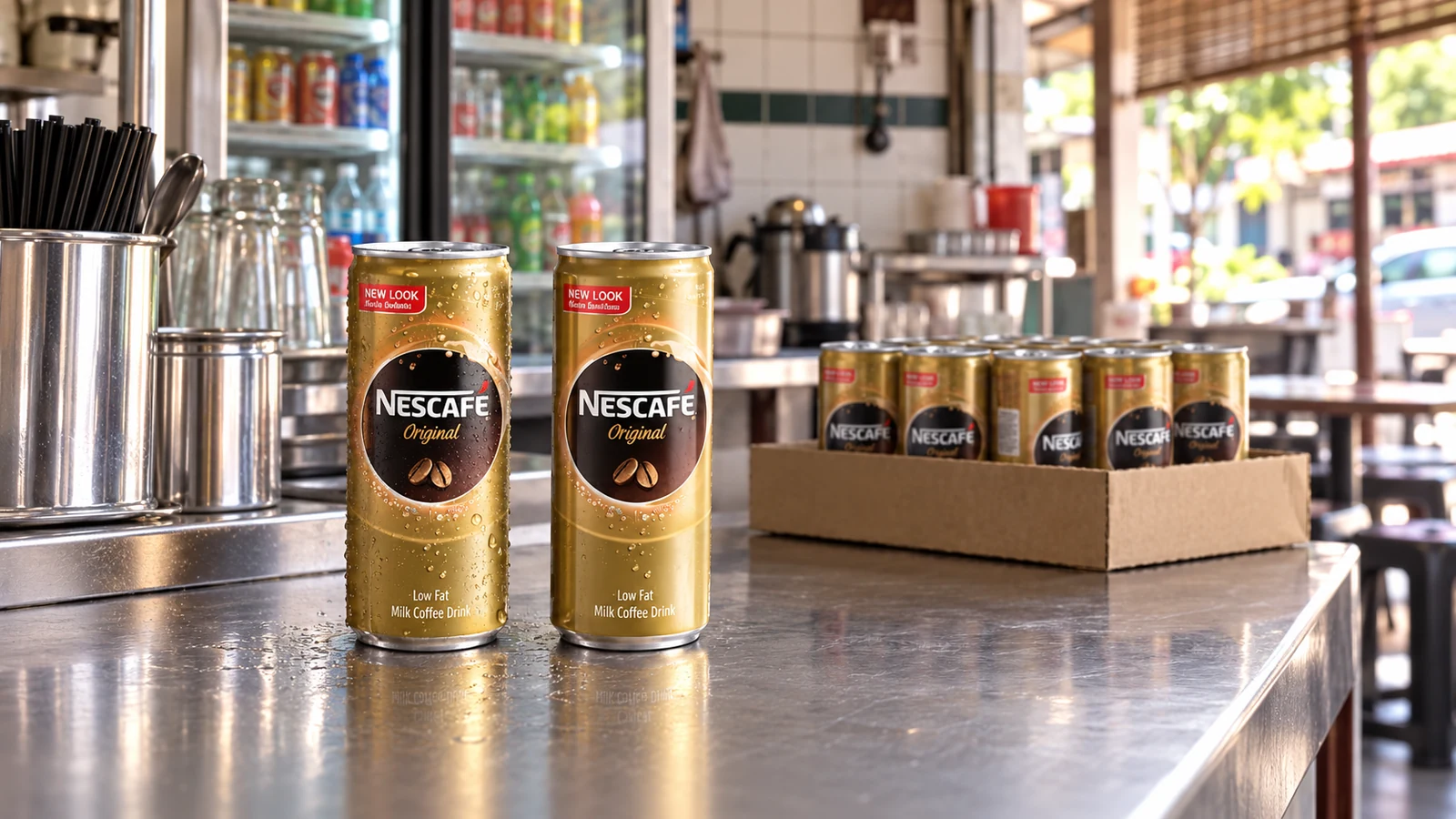
Cover: an AI-assisted Malaysian kopitiam scene based on a Trader Max catalogue product reference. The stock tray is illustrative and does not establish supplied carton contents. The scene does not depict Trader Max’s premises.




Leave A Comment