
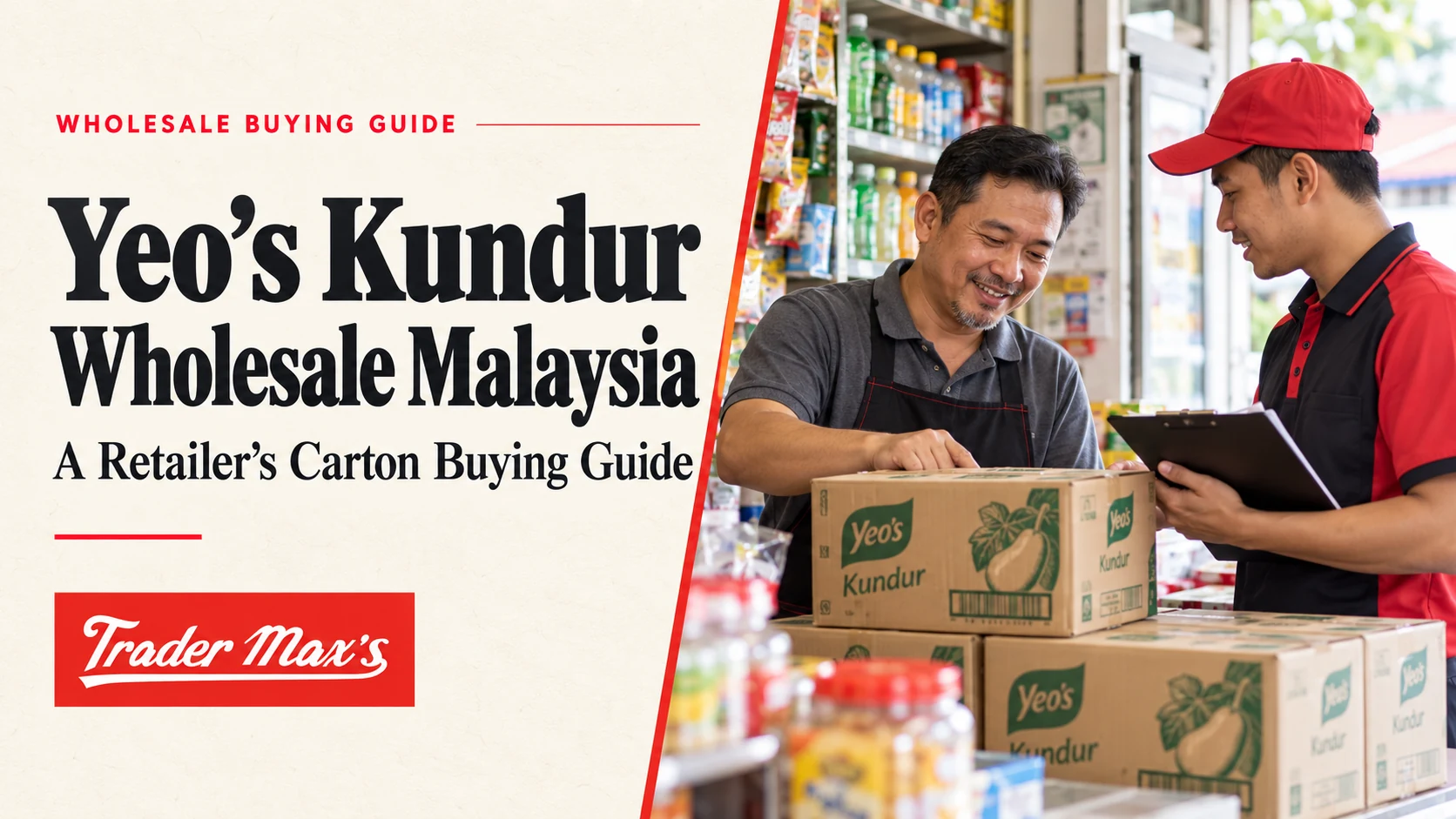
Buying Yeo’s Kundur wholesale in Malaysia starts with three decisions: which pack your customers want, how many units your shop can sell, and what the confirmed carton quotation includes. A low-looking price is only useful when it applies to the exact product and quantity you need.
This guide helps mini markets, kedai runcit, cafés and bulk buyers compare winter melon drink formats, calculate an order, and prepare a clear supplier inquiry. It focuses on purchasing and replenishment; use the individual product pages for the current listing and contact Trader Max’s to confirm stock, pricing and delivery arrangements.
What is Yeo’s Kundur?
Kundur is the winter melon drink listed in Trader Max’s catalogue. Yeo’s Malaysia places Winter Melon in its Asian Drinks range. For the manufacturer’s current product information, see the official Yeo’s Winter Melon page.
For a retailer, the useful distinction is between the drink’s identity and the buying format. A customer asking for “air kundur” might want one chilled serving. Your supplier order needs the brand, packaging, volume and units per case. Recording all four avoids confusion between a small drink box, a can and a larger sharing pack.
Check the actual pack label for ingredients, nutrition, storage instructions and date marking. Do not assume every format or batch has identical label information, and do not describe a sweetened drink as sugar-free simply because it tastes light.
Compare the listed 250ml packs and 300ml cans
Trader Max’s has separate listings for Yeo’s Kundur Kotak 250ml, 24 pieces and Yeo’s Kundur Tin 300ml, 24 pieces. These are catalogue formats, not a guarantee that your requested quantity is available today.
| Buying detail | 250ml kotak | 300ml can |
|---|---|---|
| Volume per unit | 250ml | 300ml |
| Listed units per carton | 24 | 24 |
| Total drink volume | 6 litres | 7.2 litres |
| Order description | Kundur Kotak 250ml × 24 | Kundur Tin 300ml × 24 |
The can contains 50ml more per serving. However, a larger serving does not automatically make it the better retail choice. Compare your customers’ preferred format, the selling price they accept, the space each pack occupies and the quoted cost per unit.
If the drink is new to your outlet, start with a quantity that fits a short trial. Keep results for boxes and cans separate. Combining their sales into one number can hide a slow format behind a faster one and lead to an unbalanced reorder.
Choose a format for the way you sell
Mini markets and kedai runcit
Decide whether you will sell individual drinks, complete cartons, or both. Individual sales need a visible unit price and enough accessible stock. Carton buyers need a clear case price and confirmation of how many pieces it includes. Keep the shelf label close to the correct format so shoppers do not mistake the box price for the can price.
Reserve a modest amount of display space during a trial. Record whether sales come from the chiller, ambient shelf or carton display. If most purchases are chilled single servings, replenishing the chiller regularly may be more useful than expanding the ambient display.
Cafés, food outlets and workplace pantries
Match the portion to the service. An individually packed drink makes counting servings straightforward, while the choice between a box and can depends on your menu, storage and customer preference. List the format in your ordering sheet so different employees request the same item.
For a pantry, use actual consumption from a recent comparable week. Separate routine staff use from meetings or events. A one-off busy day should not become the permanent weekly order unless the higher demand continues.
Events and bulk purchases
Work backwards from the number of servings you intend to provide. Confirm the event’s drink selection first; attendance alone does not tell you how many people will choose winter melon. Add any reserve deliberately and check where unopened surplus can be used afterwards.
How many cartons should you order?
For a 24-piece carton, divide the units required by 24 and round up when you must buy complete cases. For example, 100 planned servings require five cartons: four cartons contain only 96 units, while five contain 120. The extra 20 are a consequence of case rounding, not a recommended consumption allowance.
For regular retail replenishment, calculate in individual units before converting to cartons. A simple planning method is:
Order units = expected sales until the following replenishment + chosen reserve − usable stock on hand − confirmed incoming stock.
Suppose your shop expects to sell eight units a day over seven days. That is 56 units. If you choose a 12-unit reserve, have 20 usable units and no incoming order, the calculation is 56 + 12 − 20 = 48 units, or two cartons. This is an illustrative shop scenario, not a Trader Max’s sales forecast or delivery promise.
If your supplier only confirms a later replenishment date, recalculate the period covered. If sales vary substantially by day, use separate weekday and weekend estimates. Also exclude damaged stock and any units you cannot realistically sell within their remaining usable period.
Compare wholesale quotations on the same basis
Ask for a quotation that names the exact SKU or product description, case count, order quantity and validity period. Confirm whether any delivery charge, applicable tax or other charge is included. Do not compare one supplier’s delivered total with another supplier’s collection-only carton price.
Cost per unit = confirmed carton cost ÷ units in that carton. Where a charge applies to the whole delivery, allocate it consistently across the order rather than silently treating it as free. For a mixed order, document whether you allocate by case, weight or another reasonable method.
Here is an example using invented figures solely to demonstrate the calculation. If a 24-piece carton costs RM36 and its allocated delivery cost is RM2.40, the landed cost is RM38.40, or RM1.60 per unit. Replace every figure with your actual quotation before making a buying decision.
At an illustrative selling price of RM2, that leaves RM0.40 gross profit per unit before other business costs. Gross margin is RM0.40 divided by RM2, or 20%. Markup is RM0.40 divided by RM1.60, or 25%. These percentages measure different things; using them interchangeably can distort your target selling price.
For your current Yeo’s Kundur wholesale price, request a confirmed quote. This article does not provide a live price list, promotional offer or credit arrangement.
Check stock dates and receiving details before payment
Ask how much remaining dated life the supplied batch has, especially if you plan a slow trial or a large purchase. A product’s theoretical shelf life is different from the time remaining on the carton delivered to your shop. Choose a quantity your outlet can reasonably clear.
Before the order is final, confirm the collection or delivery method, destination postcode, expected date and receiving contact. For a Klang or Shah Alam shop, include access details that might affect unloading, such as a narrow frontage or restricted receiving hours. Let the supplier confirm what can be arranged.
When goods arrive, compare them with the confirmed order. Check flavour, format, carton count, date markings and packaging condition. Record visible damage or a discrepancy promptly and ask the supplier about its resolution procedure. Do not assume a replacement, refund or return policy that has not been agreed.
Keep the invoice or delivery document with your stock record. For repeat orders, note the batch received and the date it entered your store. This makes it easier to investigate a discrepancy and distinguish older stock from a later delivery.
Store and display without creating avoidable losses
Follow the storage directions on the supplied packaging. Keep cartons in a clean, dry area, protect them from damage and avoid locations exposed to excessive heat or direct sunlight. Once opened, follow the individual pack’s instructions rather than applying a rule from a different beverage.
Use the earliest suitable dated stock first. Put older cases where staff can reach them and place newer deliveries behind them. If a later delivery carries an earlier date, rotate by the date marking instead of simply by arrival order.
For chilled sales, plan a small refill routine around your busiest periods. Check that the correct flavour is visible and that the price label is readable. Give one person responsibility for checking the shelf and chiller, so a full storeroom does not coexist with an empty display.
A mixed Asian-drink selection can offer shoppers alternatives, but each flavour still needs its own sales record. Browse the Yeo’s catalogue at Trader Max’s when planning a quotation request. Ask which listed items are currently available rather than assuming the entire range is ready for immediate dispatch.
Run a simple two-week stocking trial
For an outlet without reliable sales history, a short trial can help establish a sensible reorder quantity. Keep the product available during the trial and record days when it was out of stock, because those days understate potential sales.
- At the start: record opening units for each format, your confirmed buying cost, selling price and display location.
- Each day: record units sold, new stock received, damage and any period when the shelf or chiller was empty.
- After one week: check which format moved, whether the display was maintained and whether any promotion affected results.
- After two weeks: calculate average daily sales and stock remaining, then set the next order around the confirmed replenishment period.
A slow result is a reason to investigate before increasing stock. Check visibility, price clarity, chilled availability and whether local customers actually want the format. Change one factor at a time where practical, so the next trial tells you what helped.
What to include in a Trader Max’s inquiry
Trader Max’s supplies FMCG products and lists wholesale, cash-and-carry and shop-delivery services on its business services page. Its published coverage includes Klang, Shah Alam, Setia Alam, Meru, Bukit Tinggi and Kapar. Confirm your precise address and order arrangements with the team.
Send your shop name, postcode, preferred Kundur format, number of cartons and requested receiving date. If you need several beverage lines, include the full list so the quotation can address the combined order.
Hello Trader Max’s, I would like a quote for Yeo’s Kundur [250ml kotak × 24 / 300ml cans × 24], quantity [number] cartons. My shop is in [area and postcode]. Please confirm stock, carton price, remaining date life, minimum order if applicable, collection or delivery options, charges and expected receiving date.
Frequently asked questions
Is Yeo’s Kundur the same as winter melon drink?
Trader Max’s describes its Kundur kotak listing as winter melon drink, and Yeo’s Malaysia lists Winter Melon in its Asian Drinks range. Use the exact product description and pack size when ordering.
How many pieces are in a carton?
The linked Trader Max’s 250ml kotak and 300ml can listings each specify 24 pieces. Check the confirmed quotation for the supplied pack configuration.
Which format should a new retailer buy?
Choose according to your customers, display space and quoted unit cost. If you test both formats, record their sales separately and keep the first order manageable.
Can I get a current wholesale price and delivery date?
Yes—request confirmation from Trader Max’s for your quantity and postcode. The catalogue supports product discovery; a confirmed quotation establishes the price and arrangements for your order.
Ready to plan your order? Review the linked Kundur product formats, then contact Trader Max’s on WhatsApp with your carton quantity and location. A clear inquiry helps the team confirm the right product and the practical details before you commit.



Leave A Comment