
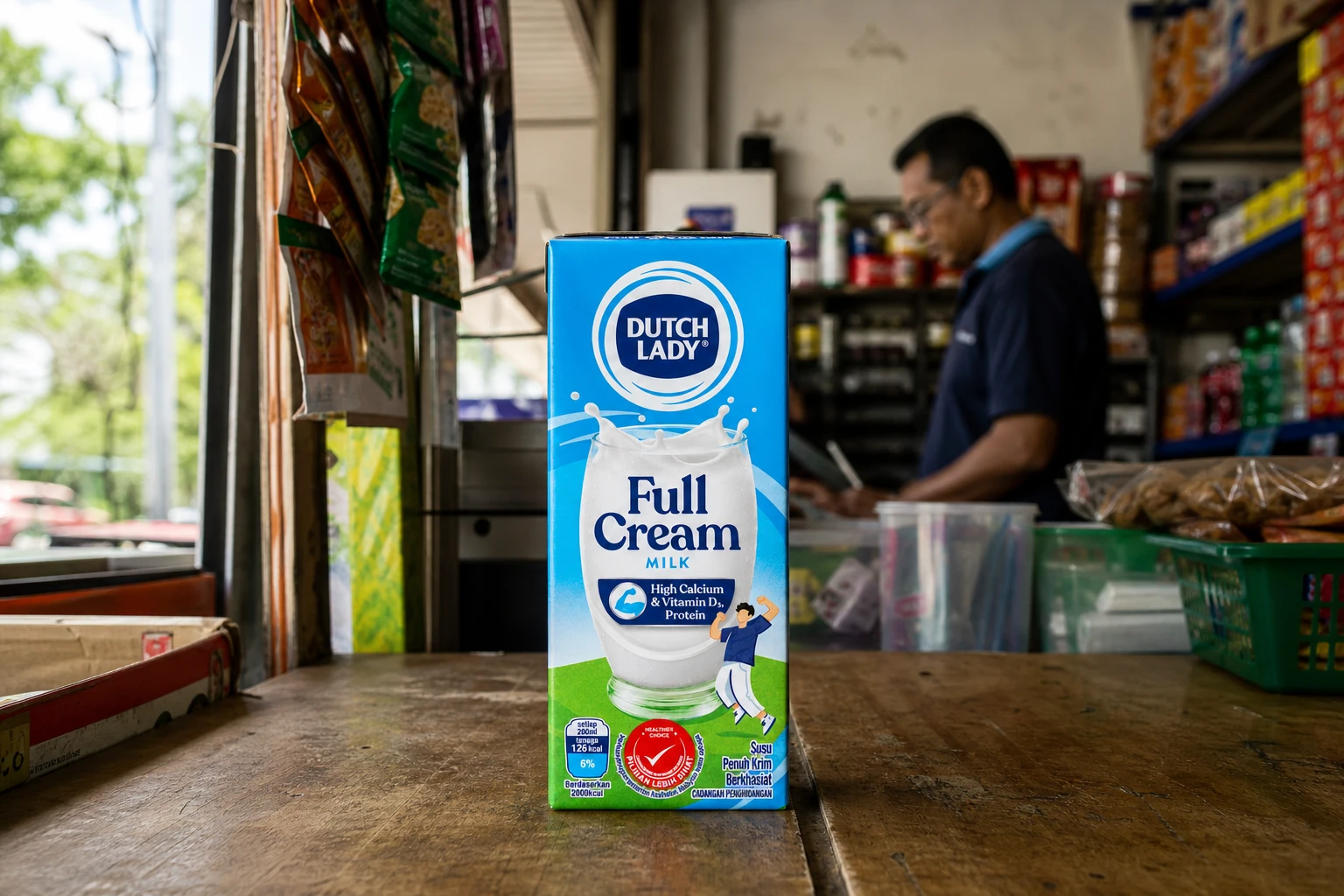
Dutch Lady full cream milk is available to Malaysian business buyers as a listed product category through wholesale enquiry channels such as the Trader Maxs catalogue, but exact pack formats, pricing, carton quantities and current stock cannot be confirmed here since no topic-specific product facts have been independently verified for this guide. If you came here looking for a price list, there isn’t one to give you — the practical path instead is a structured enquiry process: identify the exact SKU you want, request a written quotation, and confirm pack details directly with the supplier before committing to an order. This article walks through how to do that well, from identifying the right pack format to running a small trial and keeping proper receiving records.
Why Pack Selection Matters for Cafes and Office Pantries
Cafes and office pantries use milk differently, and that difference should drive your purchasing decision more than brand familiarity alone. A cafe pouring milk continuously through the day for coffee service has different handling, storage and rotation needs than an office pantry topping up a shared fridge for staff tea and coffee breaks. Before requesting a quote, it helps to be clear internally about which use case you are buying for, because this affects which pack format is worth asking about.
A high-volume cafe counter typically values consistency and ease of pouring during service, along with manageable storage in a small back-of-house fridge. An office pantry, by contrast, often prioritises convenience, portion control, and minimal wastage if usage is unpredictable from week to week. Both outlet types benefit from thinking through pack format before contacting a supplier, rather than defaulting to whatever is top of a catalogue listing.
Identify the Exact Milk SKU Before You Enquire
Wholesale buying mistakes often start with an unclear product request. “Dutch Lady milk” is not specific enough for a supplier to quote accurately, because the brand’s full cream milk line may be listed under different pack configurations in a given catalogue. Before reaching out, buyers should pin down:
- The exact product name as it appears in the supplier’s listing (for example, matching the wording used on a specific catalogue page).
- Whether the listing refers to a single-serve multipack format or a larger single-container format, since these serve different operational purposes.
- Any pack quantity or unit count shown on the listing page itself, which should be treated as the reference point for your enquiry rather than assumed.
The Trader Maxs shop catalogue, linked at tradermaxs.com.my/shop, functions as the enquiry point for checking what is listed, including pages such as the multipack and single-container listings referenced for this guide. Because specific product availability, pricing and stock levels are not confirmed in this guide, buyers should treat any catalogue listing as a starting reference for enquiry, not as confirmation that a given pack is currently in stock or priced at a particular level. A listing’s existence on a catalogue page does not by itself establish current price, stock, delivery timeframe, shelf life or storage requirements — these must be confirmed directly with the supplier for each order.
What to Check on the Product Label
Once you have identified a candidate SKU, the next step before placing any order is a careful label check, ideally against a sample unit or clear product photo provided by the supplier. For a business buyer, label verification is not optional paperwork — it directly affects whether the product matches what your outlet needs and whether your own internal records will be accurate for stock-keeping purposes.
Items to confirm on the label or packaging include:
- Product name and variant — confirm it reads as full cream milk and matches the SKU you intended to order, since dairy ranges often include multiple variants that can be easy to confuse at a glance.
- Pack configuration — the number of individual units per carton or box, and the volume of each individual unit, should be printed on the outer packaging and should match what was quoted.
- Manufacturing and expiry or best-before dates — these should be clearly legible and consistent across units in the same batch; illegible or inconsistent dates are worth raising with the supplier before accepting delivery.
- Storage instructions printed on the pack — these instructions, not general assumptions, should guide how the product is stored once it reaches your premises. Some shelf-stable formats specify room-temperature storage until opened, while instructions may call for chilling after opening or for different handling depending on pack type. Always follow the specific wording printed on the pack you receive rather than applying a blanket storage rule across all formats.
- Country of origin or manufacturing information, if printed. A brand’s country of origin and the country where a specific carton was actually packed are not always the same thing — an international brand name does not by itself tell you where a given batch was manufactured. If this matters for your own supplier documentation, check the printed manufacturing information on the actual pack you receive rather than assuming it based on the brand name alone.
Because no specific label content has been verified for this guide, treat the above as a checklist of what to look for on the actual product you receive, not as a description of confirmed label content for any particular Dutch Lady full cream milk pack.
Decision Checklist Before Requesting a Quote
A short internal checklist can save considerable back-and-forth once you contact a supplier. Before sending an enquiry, work through the following questions as a buyer:
- What is the primary use case? Decide whether the milk is mainly for coffee service, tea and coffee in a shared pantry, or a mix of both. This shapes whether a multipack of smaller units or a larger single-container format is more relevant to ask about.
- What is your realistic weekly or monthly usage? Even a rough estimate — based on headcount, cups served, or past purchase volumes — gives you a basis for comparing quoted pack sizes once you receive them.
- What storage space do you actually have? Chiller or fridge space in a cafe back room or office pantry is often limited. Confirm available chilled and ambient storage space before deciding how large a single order or pack format should be.
- Who will receive and check the delivery? Identify a specific staff member responsible for checking pack counts and expiry dates against the supplier’s delivery note on arrival, so discrepancies are caught immediately rather than days later.
- What documentation do you need for your own records? Some business buyers need delivery notes, invoices, or product information for internal stock systems or basic recordkeeping. Confirm what the supplier can provide before the order is placed, not after.
- Have you confirmed current price and stock directly? Because pricing, stock levels and promotional terms are not fixed facts in a catalogue listing, always request current written confirmation for the specific SKU, quantity and delivery timing you need, rather than relying on older quotes or general listing pages.
Working through this checklist before contacting a supplier through the Trader Maxs shop catalogue or the contact page at tradermaxs.com.my/were-here makes the resulting conversation far more efficient. You arrive with a clear SKU reference, a realistic quantity estimate, and specific questions about storage and documentation — rather than an open-ended request that the supplier has to clarify from scratch.
Comparing Pack Workflows: Small-Format Multipacks vs Larger Single-Container Formats
Catalogue listings referencing Dutch Lady full cream milk have been seen in two general shapes: a multipack format made up of several smaller individual units bundled together, and a larger single-container format sold as one unit per carton. Because exact volumes, unit counts and pricing are not confirmed in this guide, the comparison below focuses on the operational tradeoffs between these two general formats rather than on specific numbers tied to any listing.
Small-Format Multipacks
A multipack made up of individually sized units tends to suit outlets that want portion control and minimal waste per use. In a shared office pantry where usage is irregular — some weeks heavy, others quiet — individual units reduce the risk of an opened container sitting too long before it is finished. Staff can take one unit at a time, and there is less judgment required about how much to pour or how quickly an opened pack needs to be used.
The operational tradeoff is packaging volume and storage footprint relative to total milk content. Multiple small units generally take up more combined shelf or fridge space than a single larger container holding the same total volume, because each unit has its own packaging. For a cafe with limited back-of-house chiller space, this can matter more than it first appears, especially if deliveries arrive weekly rather than daily.
Larger Single-Container Formats
A larger single-container format is often more relevant for continuous-service environments like a busy cafe counter, where milk is poured repeatedly through a shift rather than dispensed in single servings. Fewer individual packages to open and discard can simplify service during peak hours, and storage efficiency per unit volume is typically better than an equivalent multipack.
The tradeoff here is wastage risk if usage doesn’t keep pace with the volume once opened, and the pack’s own storage instructions must be checked and followed for how the product should be handled after opening. A larger format also commits more inventory and shelf space to a single SKU, which can be a disadvantage for outlets with inconsistent demand or multiple milk products rotating through the same fridge.
Matching Format to Outlet Type
Neither format is universally better; the right choice depends on usage pattern, storage space and staff handling discipline. A cafe with steady, high-volume coffee service may lean toward the larger single-container format for efficiency, while an office pantry with irregular, smaller-scale use may find the multipack format reduces waste and simplifies staff handling. Buyers running both a cafe counter and a back-office pantry under one business may reasonably decide to order both formats for different locations, rather than assuming one format fits every setting.
Building a Quotation Comparison Worksheet
Once you have requested written quotes for one or more SKUs through the Trader Maxs shop catalogue, a simple worksheet helps you compare them on equal footing rather than by gut feel. The following is a template structure, not a record of actual quoted figures:
- SKU name exactly as quoted
- Pack configuration (units per carton, volume per unit, as stated in the quote)
- Quoted price per carton
- Minimum order quantity, if stated
- Delivery timing or lead time, if stated
- Any documentation offered (invoice, delivery note, product information sheet)
- Date the quote was issued, since prices and stock can change
Recording the quote date matters because a verbal or emailed quote from one week may not hold the following month. Business buyers who keep a simple log of quote date, SKU and quoted figures avoid confusion later about which price applied to which order.
Calculating Cost per Serving — A Hypothetical Worked Example
To illustrate how a buyer might compare two quotes once received, consider a fully hypothetical example using invented figures. These numbers are not real prices or confirmed pack specifications — they exist only to demonstrate the calculation method a buyer could apply to an actual written quote.
| Item | Hypothetical Quote A (multipack) | Hypothetical Quote B (larger container) |
|---|---|---|
| Hypothetical carton price | Hypothetical RM60.00 per carton | Hypothetical RM12.00 per container |
| Hypothetical units/servings assumed | 24 individual units (1 serving each) | 8 estimated servings per container |
| Hypothetical cost per serving (theoretical) | Hypothetical RM60.00 ÷ 24 = RM2.50 per serving | Hypothetical RM12.00 ÷ 8 = RM1.50 per serving |
| Hypothetical cost per serving (if only 5 of 8 servings are usable before waste) | Not applicable — individually sealed units | Hypothetical RM12.00 ÷ 5 = RM2.40 per serving |
On these invented numbers alone, Quote B appears cheaper per serving when calculated on a theoretical maximum basis. But a buyer should not stop at this single figure. The multipack in Quote A may reduce wastage to near zero, since each unit is sealed and used individually, while the larger container in Quote B depends on accurately estimating servings per container and on staff actually using the full volume before it needs attention per the pack’s storage instructions. As the table shows, if only 5 of the estimated 8 servings are realistically used before the rest is wasted, the hypothetical effective cost per usable serving rises to RM2.40 — much closer to Quote A’s figure. This is why cost-per-serving math should always be paired with a realistic estimate of actual usable servings, not just the theoretical maximum, and why every figure here is clearly a hypothetical placeholder rather than a quoted price.
Two Distinct Hypothetical Purchasing Scenarios
Hypothetical scenario — for illustration only, not a confirmed order or pricing. A small cafe owner serving flat whites and lattes through a 10-hour daily shift wants a format that minimises interruptions during service. After drafting a checklist of usage estimate, chiller space and staff handling capacity, the owner requests quotes for both formats through the Trader Maxs shop catalogue, asks specifically about the larger single-container SKU, and records the quoted carton price, unit count and quote date on a comparison worksheet before deciding.
Hypothetical scenario — for illustration only, not a confirmed order or pricing. An office manager restocking a shared pantry for roughly 15 staff with inconsistent tea and coffee habits is more concerned about wastage than service speed. The manager requests a quote for the multipack SKU, asks the supplier directly about carton unit count and whether a smaller trial order is possible before committing to a larger standing order, and uses the resulting quote to estimate cost per serving against actual staff usage over a two-week period.
Both scenarios follow the same underlying discipline: identify the SKU precisely, request a written quote, record the figures on a worksheet, and calculate cost per serving using realistic usage assumptions rather than theoretical maximums.
Running a Small Stock Trial Before Committing to a Standing Order
Before converting a one-off quote into a recurring order, it is worth running a small, time-boxed stock trial. A trial period gives you real usage data instead of estimates, and it tests whether the pack format you chose on paper actually works in daily operations. A trial does not need to be complicated — a two to four week window is usually enough to see a realistic pattern of usage, wastage and staff handling.
To measure a trial properly, decide in advance what you are tracking. Useful measurements include: the number of cartons or units consumed over the trial period, the number of units or containers discarded unused or partially unused, any days where stock ran out before the next delivery, and any days where unused stock accumulated past a reasonable point. Recording these figures against your original cost-per-serving estimate tells you whether the format and quantity you chose actually matches real demand, rather than the demand you assumed when requesting the quote.
It also helps to assign one person to own the trial record. If different staff members note down figures inconsistently, or not at all, the trial produces data that is too patchy to act on. A simple shared note or spreadsheet, updated at the same time each day or each shift, is normally sufficient for an outlet of cafe or office pantry scale.
Keeping Receiving Records for Every Delivery
Once you move beyond a trial into regular ordering, a basic receiving record for each delivery protects you from disputes and helps you reorder accurately. At minimum, a receiving record should note: the date of delivery, the SKU and quantity received, whether the quantity matches the delivery note or invoice, and the condition of the packaging on arrival.
Checking expiry or best-before dates at the point of receiving — not days later when the product is opened — is particularly important for a perishable or chilled-dependent product category. If dates are inconsistent across units in the same delivery, or if packaging appears damaged, this should be noted and raised with the supplier promptly rather than after the stock has already been partly used.
These records serve two purposes for a business buyer. First, they give you a factual basis for any query or correction with the supplier, since you can point to a specific delivery date and documented discrepancy rather than relying on memory. Second, they build a usage history over time that makes future reordering decisions more accurate, because you can see actual consumption and wastage patterns across multiple delivery cycles rather than a single trial period.
Storage Questions Governed by the Pack Itself
Storage decisions should always follow the instructions printed on the specific pack you receive, rather than a general assumption carried over from a different product or format. As noted earlier, some packs may specify room-temperature storage until opened, with chilling required afterward, while other formats may carry different instructions. Because exact storage requirements for any specific Dutch Lady full cream milk SKU are not confirmed in this guide, the pack instructions on the unit you actually receive are the only reliable reference.
When planning storage for your outlet, it is worth asking a few direct questions rather than assuming an answer: Does the pack specify an ambient storage period before opening, and does this match the shelf space you have available? Does the pack call for chilling after opening, and does your fridge have adequate space during peak stock periods? Is there a recommended window for using an opened pack, and does this realistically match your outlet’s pace of use? Answering these questions against the printed pack instructions, rather than against general dairy-handling habits, keeps your storage practice aligned with what the manufacturer has actually specified for that pack.
Reordering and Staff Handover
Once a trial period and a few delivery cycles have given you a reliable usage pattern, reordering becomes a matter of repeating the same disciplined process: confirm current price and stock through the Trader Maxs shop catalogue, request a written quote referencing the exact SKU, and compare it against your prior quote log to check for any changes in price, pack configuration or minimum order quantity.
Staff handover deserves specific attention, particularly in cafes and offices where personnel changes over time. A short written handover note — covering which SKU is currently ordered, typical order quantity, the supplier contact used, and where receiving records are kept — reduces the risk of a new staff member reordering the wrong pack format or missing a storage instruction that was previously handled correctly. This is especially relevant if your outlet uses both a multipack and a larger single-container format for different purposes, since a handover without this distinction can easily result in the wrong format being reordered.
Scope Note: What This Guide Does Not Confirm
This guide does not confirm current prices, stock levels, carton configurations, delivery timeframes, minimum order quantities, trial-order availability, shelf life or storage requirements for any specific Dutch Lady full cream milk SKU, including the multipack and single-container listings referenced on the Trader Maxs catalogue. These details vary by listing and change over time, so each point should be confirmed directly with the supplier at the time you place an order, rather than assumed from this guide or from a past quote.
Frequently Asked Questions
How do I confirm the current price for a specific pack?
Request a written quote directly through the Trader Maxs shop catalogue for the exact SKU you have identified. Catalogue listings do not confirm current price or stock on their own.
Can I order a small trial quantity before a standing order?
This depends on what the supplier can offer for a given SKU and is worth asking about directly when requesting your quote, since trial quantities are not confirmed as a standard option here.
What should I check when a delivery arrives?
Match the quantity and SKU against the delivery note, check expiry dates for consistency, and inspect packaging condition before accepting the delivery as complete.
How do I know how to store an opened pack?
Follow the storage instructions printed on the specific pack you receive, rather than applying a general rule across different formats.
Where can I check the country where a specific carton was made?
Check the printed manufacturing or country-of-origin information on the actual pack you receive. The brand’s origin and a specific carton’s manufacturing location are not necessarily the same, so the printed label — not the brand name — is the reliable source.
To check current availability and request a written quote for Dutch Lady full cream milk pack options, visit the Trader Maxs shop catalogue at tradermaxs.com.my/shop, or contact the team directly through tradermaxs.com.my/were-here to discuss your cafe or office pantry order.

Leave A Comment