
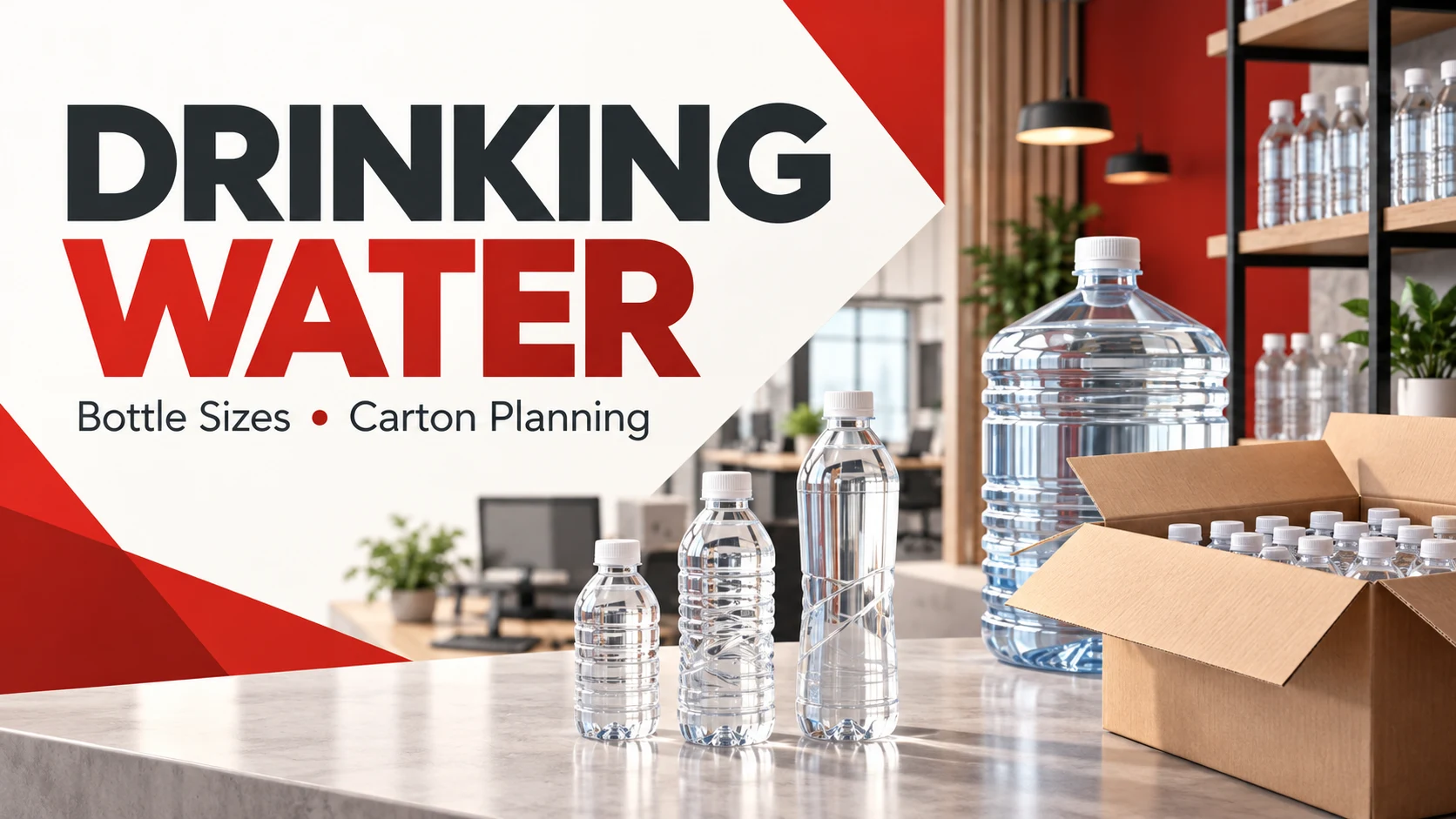
Choose drinking water for shops and offices by matching bottle size to how it will be used, estimating demand in bottles or litres, and converting that demand into the supplier’s confirmed carton quantity. Small sealed bottles suit individual service; larger bottles suit shared use where clean pouring, storage and handling are practical. The right order also depends on existing stock, replenishment timing and the space available.
For Malaysian mini markets, kedai runcit operators and office purchasers, “one carton” is not a standard quantity. Different formats contain different bottle counts and total volumes. This guide explains how to build a sensible shortlist, calculate an illustrative order and manage receiving and replenishment without assuming prices, minimum orders or delivery terms.
Separate retail demand from office consumption
A shop buys water to resell, so demand is measured mainly through transactions for each product and bottle size. An office buys water for use, so demand depends on attendance, meeting arrangements, visitors and other drinking-water options. Combining these purposes into one estimate can produce an order that looks adequate in litres but has the wrong packaging.
For a shop, record the bottles sold by size rather than only the total beverage revenue. A large bottle sold for home use does not necessarily replace demand for a small bottle bought during a journey. Check whether a missing format attracts repeated customer requests, and give unfamiliar lines a defined trial quantity.
For an office, start with actual stock issued during ordinary working days. Attendance alone cannot establish consumption: some staff bring their own drinks, some use another water source, and meetings vary. Track what leaves storage, what remains unopened and what is discarded so that the next estimate reflects your workplace.
Browse the drinking-water category as one starting point for a shortlist. Mineral water is listed separately on the site. Identify the exact product and label description instead of treating all bottled water listings as interchangeable.
Match bottle size to the use case
Smaller bottles for individual service
A smaller sealed bottle can suit a short meeting, visitor reception or an individual retail purchase. Compare the number of bottles required with the expected service occasions. If each attendee receives one bottle, a headcount calculation is appropriate for that specific provision; it does not represent the person’s full daily water needs.
Consider the practical handling too. Reception staff may need to carry several bottles at once, meeting rooms may have limited table space, and a mini market may need clear shelf labels or chilled display capacity. Trial the format in the actual setting before committing to a large quantity.
Medium bottles for portable use
A medium bottle may be useful where people carry it between locations or customers want a single larger serving. Assess its shelf footprint, the available refrigerator space and how it fits the intended purchase occasion. Do not assume that a larger serving will reduce waste or improve sales without observing the result.
The current catalogue lists Spritzer Mineral Water 550ml × 24 pieces. This gives a verified example of a named bottle size and listed pack count. Confirm the current quotation unit and packing arrangement when ordering; catalogue details are not a promise of immediate availability.
Larger bottles for shared use
Large bottles can suit a pantry or another shared setting when staff can lift and pour them safely and maintain a clean serving arrangement. Think through where the bottle will sit, how water reaches a cup or personal container, and who takes responsibility for the opened bottle. Follow the product label’s directions.
The site also lists Spritzer Mineral Water 6L × 2 pieces. Do not infer compatibility with a dispenser from the bottle size or image. Check the equipment requirements and the product’s actual opening and handling format before choosing it for that purpose.
Read the carton configuration before comparing offers
Write three separate numbers for each candidate: bottle volume, bottles per quoted order unit and total volume per order unit. Verify whether the supplier quotes a carton, shrink-wrapped pack, pair of bottles or another unit. A product title containing a count helps identify the listing, but the written quotation should establish what will be supplied.
Convert millilitres to litres consistently. A listed 550ml bottle contains 0.55 litres; 24 such bottles represent 13.2 litres. Two 6-litre bottles represent 12 litres. These volumes are calculated from the listed formats, not measurements of warehouse stock or estimates of how long an opened bottle lasts.
The two formats are not direct substitutes for every buyer. Twenty-four individually sealed bottles create twenty-four separate service units, whereas two large bottles require a shared serving arrangement. Total volume is useful for comparison, but it cannot decide convenience, retail demand or equipment suitability on its own.
Use a quotation worksheet with fields for product name, volume, count, order unit, price, applicable charges, proposed quantity and requested delivery location. Keeping these fields separate prevents a common mistake: comparing a price for one bottle with a price for an entire pack.
Estimate quantities with explicit assumptions
State the purpose, time period and unit before calculating. For meeting service, use attendee occasions and bottles per occasion. For shared pantry use, use observed litres issued per working day. For a retailer, use ordinary sales by product. Label estimates clearly and revise them after actual use rather than treating a first calculation as a permanent rule.
Illustrative office-meeting example
Suppose an office plans four meetings during a week, with 15 attendees each, and provides one sealed bottle to each attendee. The planned requirement is 60 bottles. If the purchaser chooses a fictional format of 24 bottles per carton, three cartons supply 72 bottles, leaving twelve unopened bottles after the planned allocation.
This example assumes every attendee receives one bottle and the office has no existing stock. If twelve suitable bottles are already available, the net requirement becomes 48 bottles, or two cartons in that fictional format. Separate contingency stock from planned use so that unused reserves do not become an automatic extra purchase every week.
These figures describe a procurement exercise, not a recommended drinking allowance. Actual needs and provision vary. Check the event arrangements and other water sources; do not use a meeting-service calculation to make a medical claim about sufficient hydration.
Illustrative shared-pantry example
Suppose measured pantry use averages nine litres per working day and the office plans for five working days. Expected use is 45 litres. An additional six litres chosen as a buffer gives a target of 51 litres. With twelve usable litres already on hand and no confirmed incoming stock, the calculated purchase requirement is 39 litres.
In a fictional order format supplying twelve litres per unit, four units provide 48 litres. Stock after receipt would total 60 litres before use. Assess whether that rounded quantity fits storage and the product dates. All consumption and buffer figures here are illustrative assumptions, not claims about a typical Malaysian office or Trader Max’s terms.
Plan retail quantities by bottle size
For a shop, estimate each line separately. An average of ten medium bottles sold daily and two large bottles daily means the two products need different replenishment quantities. Combining them into a single litre total can hide a shortage of the format shoppers actually request.
Use several representative days or weeks and note unusual events. Stockouts reduce recorded sales, while promotions or local gatherings can temporarily increase them. Ask whether a sales change reflects ordinary demand before increasing the next order. Maintain a manageable range while gathering evidence on a new product.
Calculate expected sales over your planning period, add a justified buffer, and subtract sellable stock plus confirmed incoming quantities. Then round to the supplier’s available order increment. The rounded amount should still be checked against cash, shelf space, backroom storage and product dates.
Keep the purchasing decision separate from display replenishment. A nearly empty chilled shelf does not prove that the shop needs another supplier order if unopened packs remain in the backroom. A clear storage location and refill routine can resolve the display shortage without tying up additional cash.
Compare cost per bottle and cost per litre
Cost per bottle helps with individual retail pricing or meeting service. Cost per litre helps compare volume for shared use. Use both where relevant, while keeping product identity and pack format visible. Different water products may have different label descriptions, so a volume calculation does not establish that their characteristics are identical.
Include relevant allocated delivery charges and other applicable charges when assessing landed cost. Where a shipment includes several products, use a consistent allocation method and state it. Ask whether taxes or other charges are already included rather than assuming the catalogue price represents the final delivered amount.
Illustrative cost calculation
Imagine a fictional carton contains 24 bottles of 500ml and has a landed cost of RM24. Its cost is RM1 per bottle and RM2 per litre, since the carton contains twelve litres. If another fictional format supplies twelve litres at a landed cost of RM21, its cost per litre is RM1.75.
The second format is cheaper by volume in this example, but may not serve individually sealed meeting allocations or the shop’s preferred retail unit. These amounts are invented solely to explain the calculation. They are not Trader Max’s prices, quotations or recommended selling prices.
Check storage capacity and receiving conditions
Measure the actual space for the proposed order and keep access routes clear. Account for existing stock and other products sharing the storage area. A carton that fits physically can still be inconvenient if staff must repeatedly move heavy stock to reach a frequently used line.
Follow the product’s storage instructions and protect stock from direct sunlight, unsuitable heat, contamination and damage. Use clean storage areas and avoid placing food or drink stock beside chemicals. Do not invent a universal storage temperature or safe stacking height; follow the packaging information and suitable site procedures.
At receiving, compare the exact product, bottle size and pack count against the confirmed order. Check seals, leaks, damaged packaging and readable date or batch markings. Keep doubtful stock separate while asking the supplier how to resolve the issue. Retain the order confirmation and delivery documents for reconciliation.
Large bottles and water packs can be heavy. Plan handling using the actual unit weight, route and staff capabilities. Use appropriate equipment where needed and follow workplace procedures. A format that is economical on paper may be unsuitable if moving it safely is difficult.
Rotate stock and set a replenishment trigger
Record the earliest relevant date for each batch and replenish from that stock first. Date-based rotation is more useful than arrival order alone when a newer delivery carries an earlier date. Keep batch information accessible and check the label’s wording rather than treating best-before and expiry terminology as identical.
Set a trigger using expected use during the confirmed supplier lead time plus a justified buffer. For example, if a fictional office uses two cartons per working day and the assumed lead time is three working days, expected lead-time use is six cartons. A separately chosen two-carton buffer would produce an eight-carton trigger.
That trigger tells you when to review an order, not how much to buy. Order quantity still depends on the next review period, stock already coming, storage and available order increments. Confirm actual delivery timing before applying the formula; the example does not describe Trader Max’s lead time.
For opened large bottles, follow label instructions and maintain a clean serving process. Do not transfer an unopened-stock rotation rule into an unsupported claim about how many days an opened bottle remains suitable. Make responsibility for checking and handling opened containers clear.
Information to prepare before requesting a quotation
- The exact product names, bottle sizes and preferred pack configurations.
- Whether the water is for resale, individual service or shared pantry use.
- Expected bottles or litres over a stated period, with assumptions recorded.
- Current usable stock and confirmed incoming quantities.
- Proposed order quantities and the available storage space.
- Your delivery address, access constraints and requested timing.
- Questions about current availability, price, applicable charges and minimum orders.
- Requests to confirm packing, batch dates and discrepancy-reporting arrangements.
Frequently asked questions
Which bottle size is best for an office?
Choose by service occasion. Individually sealed bottles can suit visitors or meetings; large bottles may suit shared pantry use with suitable handling. Compare observed use, storage and serving arrangements rather than applying one size to every office.
How many cartons should a mini market order?
Estimate demand separately for each size over the planning period, subtract usable and incoming stock, then round to the confirmed order unit. Check the rounded quantity against budget, dates and storage. There is no universal carton number for every shop.
Can I use a large bottle with any dispenser?
No compatibility should be assumed. Check the dispenser specifications and the exact bottle format with the relevant supplier. A listed capacity alone does not establish that a bottle can be mounted, connected or used safely with particular equipment.
Does a listed product mean it is currently available?
A catalogue listing identifies an offered product format, but it does not confirm stock for a particular order. Request current availability and the proposed packing and dates before approval. Also confirm substitutions rather than accepting a different size automatically.
Request a water quotation for your requirements
Prepare your product shortlist and estimated quantities, then request a quotation from Trader Max’s. Share your shop or office location, intended use and preferred timing, and ask the team to confirm availability, pack configuration, pricing, minimum orders and delivery arrangements for your order.
Featured cover: a newly designed AI-generated illustration of generic bottles and carton planning, not a photograph of Trader Max’s products or premises.


Leave A Comment