
Choose biscuits for mini markets by matching the sellable pack to your customers, measuring the shelf space it needs and ordering only what your shop can reasonably sell within the available product dates. Compare individual packs, multipacks and wholesale cartons separately: a carton is a purchasing unit, while the item your customer pays for may be a completely different unit.
For Malaysian kedai runcit owners and wholesale FMCG buyers, that distinction affects shelf labels, cash tied up in stock and replenishment work. This guide explains how to build a biscuit assortment, calculate display capacity and review quantities without assuming that the biggest carton or widest range is automatically the best choice.
Define the retail unit before choosing a biscuit range
Start with one question for every proposed product: what exactly will the customer take to the checkout? It might be a sealed small packet, a family pack or an entire multipack. Write that unit down before comparing prices or allocating space. Similar product names can hide different weights, counts and outer packaging.
Use a simple product record with separate fields for the consumer pack, inner display box and shipping carton. If a quotation says “12,” ask whether that means twelve packets, twelve multipacks or twelve inner boxes. Never turn a photograph into an assumed carton quantity; display images are useful for identifying a format but may not show the current supply arrangement.
Individual packs
Small sealed packs can suit customers buying a snack for immediate use or a single break. Assess the actual price point your customers accept rather than assuming that small always means affordable. Check whether the pack stands securely, lies flat or needs a display tray. Those details determine how many units remain visible after shoppers remove the first few.
Multipacks and larger packs
A multipack may serve a household purchase or several snack occasions. Treat it as one retail item unless the internal portions are appropriately labelled and confirmed as suitable for separate sale. Do not split a pack simply because its contents appear individually wrapped. Check the product information and any applicable requirements before deciding how to retail it.
Wholesale cartons
The carton determines how much stock arrives at once, not how much belongs on the shelf. Record both the carton count and the number of retail units inside it. A carton can fit comfortably in the backroom while still containing more stock than your shop needs. Conversely, a compact carton may hold enough small packs to require frequent display replenishment.
Build an assortment around different shopping needs
Allocate a role to each biscuit line before adding another flavour. Useful roles to test include a small everyday snack, a plain biscuit or cracker, a cream-filled option and a take-home sharing pack. These are assortment ideas, not claims about what sells best in Malaysia or at your shop.
Look for repeated requests and actual transactions. A brand that attracts attention may not earn repeat purchases at your location. Keep a short note of requested products, declined purchases and customers asking for another pack size. Together with sales records, those observations help distinguish a missing option from an unnecessary variation.
Give unfamiliar lines a defined trial allocation. Decide beforehand how much cash and shelf width you can spare, when you will review the result and what would justify replenishment. Where the supplier’s ordering terms allow smaller quantities, a limited trial can reduce exposure. Ask about those terms rather than assuming mixed cartons or loose units are available.
For current catalogue options, browse the Trader Max’s biscuits category. Catalogue inclusion is a starting point for your shortlist; confirm availability, exact packing and product dates for the intended order before committing cash.
Measure shelf capacity instead of guessing
Measure usable shelf width, depth and height. Allow for shelf supports, price strips and space needed to remove a packet without damaging its neighbours. Then measure the actual pack in the orientation you intend to display. A flexible pouch may need a tray, so its usable display footprint can differ from its printed dimensions.
A facing is one visible position across the front of the shelf. Depth tells you how many packs can sit behind that front position. Multiplying facings by units deep gives an approximate display quantity, provided the arrangement is stable and accessible. Do not assume that a mathematical fit is a safe stack.
Illustrative shelf-capacity calculation
Suppose a shelf has 90 centimetres of usable width and a fictional pack occupies 10 centimetres across the front. Nine facings would fit mathematically. If you reserve one pack-width for handling clearance and separation, you might plan eight facings instead. At four packs deep, the planned display holds 32 retail packs.
These dimensions are illustrative, not measurements of a Trader Max’s product. Test the arrangement with real samples. Check that labels remain readable and packets do not lean into adjacent products. If staff must dismantle the display to reach a date marking, the layout is too difficult to maintain even if it holds more stock.
Record a maximum display quantity and a refill trigger for each line. The maximum prevents staff from overfilling shelves; the trigger tells them when to bring stock forward. This separates shelf replenishment from supplier ordering, which is important when an almost-empty display still has plenty of backroom stock.
Compare formats on cost, cash and expected turnover
Compare like with like: the same brand, flavour, weight and retail unit. Dividing carton cost by retail units gives a starting cost per pack, but include relevant allocated delivery charges and other applicable costs when assessing landed cost. A smaller pack and a larger pack can both have sensible roles without being directly interchangeable.
Consider three questions together. How much cash must you commit to the minimum purchase? How long could that quantity remain in your shop? How much space does it occupy while waiting to sell? A low unit cost is less useful if the order crowds out other needed stock or creates date-related losses.
Illustrative comparison of two order formats
Imagine Format A contains 24 retail packs and costs RM48 before other charges. Format B contains 48 identical retail packs and costs RM91.20. Their purchase costs are RM2.00 and RM1.90 per pack respectively. Format B saves RM0.10 per pack but requires RM43.20 more upfront cash and doubles the incoming quantity.
If the shop sells six packs weekly, Format A represents four weeks of demand and Format B eight weeks, before counting existing stock. The larger format could be sensible if demand, dates and storage support it. The smaller format could be preferable during a trial. These figures are fictional examples, not quotations, recommended prices or guaranteed sales.
When configurations differ, calculate cost per retail pack and, where useful, cost per 100 grams. The weight comparison helps explain value but does not predict shopper preference. Keep the intended selling price, observed weekly sales and total cash commitment visible in the same worksheet.
Translate sales into an order quantity
Count sellable shelf and backroom stock together. Keep damaged, quarantined or otherwise unsellable packs separate. Include confirmed incoming units so that a second order does not accidentally duplicate the first. Use several ordinary weeks of sales where possible, noting promotions, closures and stockouts that distort the average.
Choose a planning horizon based on your next ordering opportunity and confirmed replenishment timing. Estimate demand over that period, add a justified buffer, then subtract sellable stock and confirmed incoming stock. Round to an available supplier order unit only after checking the resulting total against dates, cash and storage.
Illustrative ordering worksheet
Suppose a fictional biscuit line sells eight packs weekly. You plan for three weeks and choose a four-pack buffer, giving a target of 28 packs. With ten sellable packs on hand and six confirmed incoming, the calculated need is twelve packs. If the only available order unit is 24 packs, buying it would put projected availability at 40 packs.
That rounding decision deserves attention. Ask whether a smaller unit is available, reconsider the review interval or accept the larger quantity only if the evidence supports it. Do not describe the twelve-pack calculation as an instruction to buy a carton regardless of its size.
A simple worksheet can record product, retail unit, units per order unit, weekly sales, current stock, incoming stock, target quantity and nearest relevant date. Review the whole order using the mini market restocking checklist, especially when several categories compete for the same budget.
Check remaining shelf life and rotate by date
Ask about the date markings on the stock proposed for your order. The remaining shelf life of a particular batch matters more to your buying decision than a general statement about how long the product lasts from manufacture. Read whether the label says best-before or expiry and follow the applicable label instructions.
Compare expected sell-through with the remaining time and allow for slower demand. Do not rely on one busy week to justify a large quantity. If different batches have different dates, record them separately so that a newer delivery does not hide older packets at the back of the display.
Use first-expiry-first-out as a practical date-based picking routine: identify the earliest relevant date and place that stock where staff will replenish from it first. Arrival order alone can be misleading if a later shipment carries an earlier date. Preserve readable batch details and avoid covering important label information with price stickers.
Set an internal review point before the relevant date is reached. At that point, consider reducing the next order, moving appropriately labelled stock into a more visible display or evaluating a lawful markdown. Any action should follow product condition, label instructions and store policy; rotation never makes expired or damaged goods suitable for sale.
Protect biscuit packs during storage and receiving
Follow each product’s storage instructions rather than applying one universal temperature or shelf-life rule. Keep stock protected from moisture, direct sunlight, pests and crushing. Consider the conditions in the actual backroom, including areas near doors or equipment, instead of assuming the shelf and storage room behave alike.
At receiving, reconcile the order unit as well as the count. Twelve cartons and twelve packets are not the same delivery. Check the product variant, seals, visible damage and date markings before mixing the new stock with existing inventory. Record discrepancies promptly using the supplier’s agreed process.
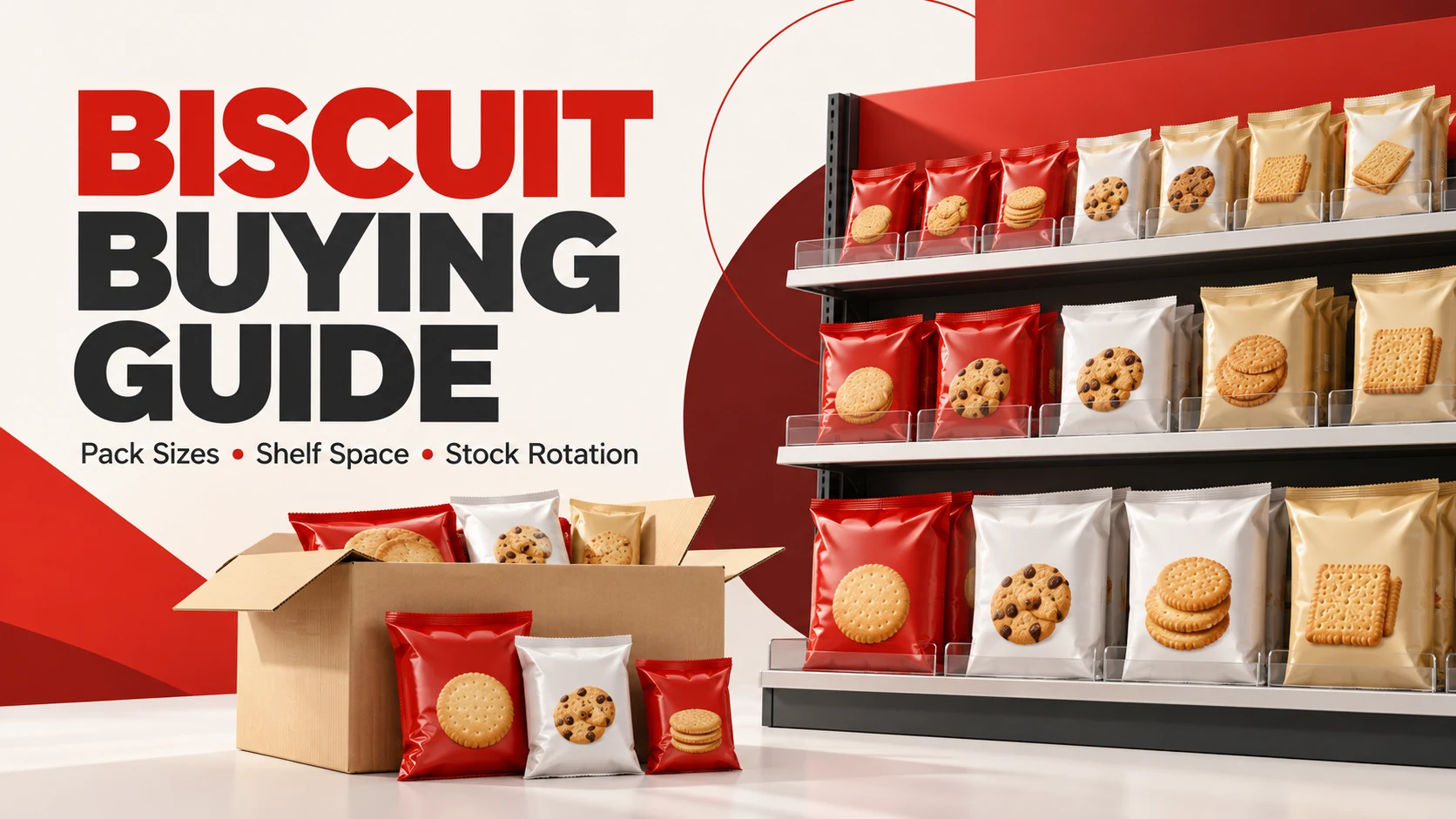
For a catalogue example, the site lists Nutella Biscuit T3 41.4g. Use the listing to identify the product, then confirm the current wholesale order unit and batch dates. The featured cover is an AI-generated illustration of generic biscuit packs and shelf planning, not a photograph of Trader Max’s products, carton contents or premises.
Review shelf performance without chasing sales alone
Evaluate each line over a consistent period. Record packs sold, realised gross profit, stock remaining, markdowns and space used. A product that sells many units at a low contribution may deserve a different allocation from one that sells fewer units but uses very little space. Neither result alone establishes a universal winner.
Check stock availability before interpreting poor sales. A line with no visible packs for several days has not had the same opportunity as a fully stocked neighbour. Also separate a temporary promotion from ordinary demand. Write down what changed so you can explain the result later.
Change one display variable at a time where practical: pack selection, facings or location. Otherwise, it becomes difficult to tell why performance changed. Keep reliable sellers available while testing alternatives, and avoid displacing a whole working range on the strength of a single good weekend.
A practical biscuit-buying checklist
- Identify the exact brand, variant, weight and customer-facing retail unit.
- Confirm inner-pack and carton counts in writing with the quotation.
- Check whether internal portions are suitable for separate retail sale.
- Measure pack footprint and safe shelf capacity using real samples.
- Count sellable stock and confirmed incoming quantities before ordering.
- Compare landed cost, cash commitment and expected weeks of supply.
- Confirm batch dates and the product’s storage instructions.
- Record receiving checks and rotate stock by the earliest relevant date.
- Set a trial review date and measure sales alongside space and losses.
Frequently asked questions
Should a new mini market start with individual packs or multipacks?
Choose a limited mix that reflects the purchase occasions you expect, then test it against actual sales. Individual packs and multipacks serve different needs. Neither format is automatically better, and a broad first order can make learning expensive if several lines move slowly.
How many biscuit flavours should fit on one shelf?
There is no fixed number. Start with measured capacity and give each line enough accessible space to remain visible between refills. Add a flavour when it serves a distinct need or a repeated customer request, rather than simply shrinking every existing facing.
Does a product photograph confirm the carton quantity?
No. A photograph can show a retail or display pack without establishing the wholesale shipping unit. Match the image and listing to a written quotation, then confirm the exact count you will receive before calculating costs or approving the purchase.
What if a carton exceeds my calculated requirement?
Ask about smaller order units or revise the replenishment plan. If only full cartons are available, assess the rounded quantity against cash, storage and remaining product dates. A supplier’s order increment does not remove those constraints.
When should I stop replenishing a slow biscuit line?
Review it once your trial period has provided a fair opportunity to sell. Check visibility, pricing and stock availability first. If demand remains weak, reduce or pause purchases while dealing appropriately with existing stock, then use that space for a better-supported option.
Prepare a biscuit shortlist for your shop
Ask Trader Max’s about available biscuit ranges through the enquiry page. Share your shop location, preferred products, retail formats and proposed quantities, and request confirmation of current availability, packing, pricing, batch dates and delivery arrangements. A measured shortlist makes it easier to discuss an order that fits your customers, shelves and budget.



Leave A Comment