
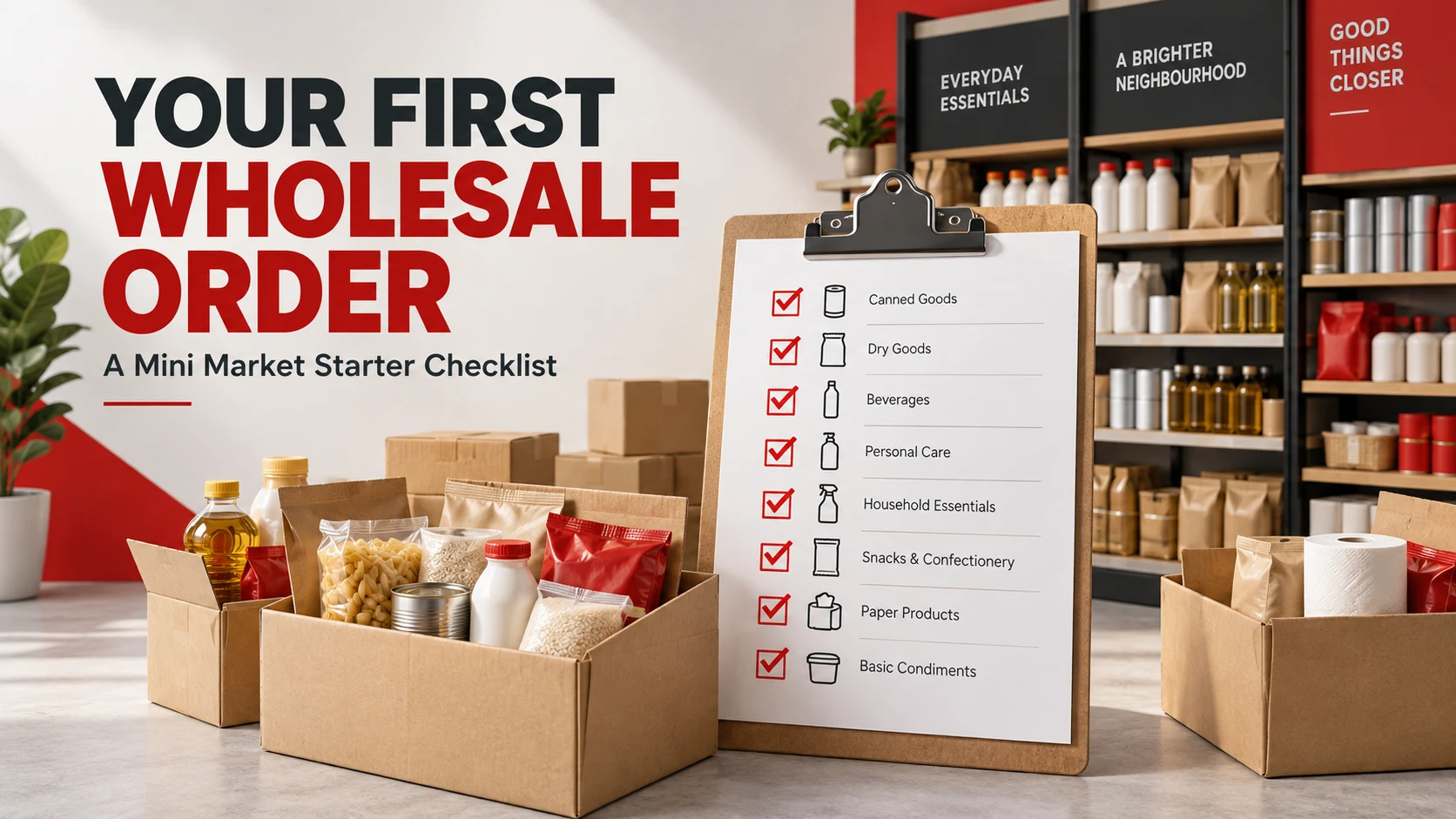
For your first wholesale FMCG order, prepare a clear product list, confirm the supplier’s order units and terms, and check that the quantities fit your opening budget, shelves and storage. Get the final order confirmed in writing, arrange someone to receive it, and compare the delivery against that confirmation before recording stock as available for sale.
A new mini market has limited sales history, so the opening order is a starting hypothesis, not a proven replenishment plan. The aim is to cover the shopping needs you intend to serve while leaving room to learn. This checklist takes Malaysian mini market and kedai runcit owners from a rough shopping list to a controlled first delivery.
1. Prepare a one-page purchasing brief
Before contacting suppliers, write down the store name, delivery address, purchasing contact, planned opening date and the date when the premises will be ready to receive goods. Include practical access details such as stairs, loading restrictions or a narrow entrance. Ask the supplier what information they require to open a customer account rather than assuming every business follows the same process.
Describe the customers and purchase occasions you plan to serve. A residential shop might prioritise household top-ups, while a shop near workplaces may see demand for individual drinks and snacks. These are possibilities to investigate locally, not guaranteed demand patterns. Record observations and customer enquiries separately from your own preferences.
Measure usable shelf and backroom space before choosing quantities. Include any suitable chilled capacity if relevant, and check the handling and storage requirements of the products you shortlist. Keep the first order within the facilities actually ready for use. A refrigerator that has been ordered but not installed is not available storage.
For the broader opening sequence, refer to the convenience-store startup guide. This article focuses on the purchase itself: what to specify, what to confirm and how to check the first goods received.
2. Organise a starter range around clear roles
Separate opening essentials from small trials
Build your shortlist by category, then give every product a reason to be there. You might identify a basic shopping need, a particular pack size requested locally, or a small trial intended to test demand. Avoid treating every flavour and size as essential simply because a supplier offers it.
Use three labels: opening priority, limited trial and later review. Opening priorities should have the strongest support from your store concept and local observations. Trials should have a defined quantity and review date. Items for later review can stay off the first purchase while you gather evidence.
This does not require a universal number of products or a fixed category percentage. The suitable range depends on your space, intended customers and supplier order increments. A smaller range with identifiable quantities is easier to check than a long list assembled from unrelated promotions.
Assign space before approving quantity
Give each selected line an intended shelf location and a backroom allowance. Check how many retail units fit without overcrowding displays or blocking access. Include the cartons waiting to be opened, not just the units visible to customers. Similar-looking packs may have different dimensions.
When a minimum order creates more stock than the location can reasonably hold, reconsider the quantity, pack format or product choice. Ask about alternatives rather than assuming cartons can be split. Supplier flexibility must be confirmed for the specific order.
3. Identify the exact product and order unit
A product name alone is rarely enough for an accurate first order. Record the brand, product or flavour, size, supplier code or SKU where available, and the number of units in the quoted pack. A photograph can help identify packaging, but it should support a written description rather than replace it.
Distinguish the supplier’s order unit from your retail selling unit. One quoted carton may contain individual units, multipacks or inner packs. Confirm the relationship explicitly. If you intend to sell individual items, check that the proposed format is suitable for that use and that the relevant labelling remains available.
A useful order line reads: “Exact product and size; supplier SKU; confirmed units per carton; number of cartons requested.” Avoid a line such as “two boxes of the usual biscuits” when there is no agreed product history. Spell out whether a quantity refers to cartons or pieces.
Record substitutions as a separate decision. A different flavour, bottle size or pack count changes your shelf plan and may change your unit cost. Ask the supplier to seek confirmation before replacing a selected line, and keep the accepted replacement in the final order record.
4. Set quantities using assumptions you can review
Without your own sales records, estimate cautiously and label the assumptions. For each line, write an expected daily unit demand, the period you are buying for and any separately justified buffer. Then subtract suitable stock already owned and confirmed incoming stock before rounding to the supplier’s order increment.
The planning period should reflect when you can review sales and obtain another delivery. Confirm delivery timing with the supplier; do not assume a particular lead time or delivery day. If timing remains uncertain, resolve it before using it in a calculation.
Illustrative opening-order calculation
Imagine a fictional snack line with an estimated demand of four retail packs per day over seven days. Expected sales are 28 packs. Adding a chosen buffer of eight packs gives a target of 36. If the confirmed fictional carton contains twelve packs and there is no existing stock, the proposed purchase is three cartons.
If another format contains 24 packs per carton, rounding the same target produces two cartons, or 48 packs. That extra quantity needs a deliberate space, cash and date check. A different carton format can change the purchase even when the demand assumption stays the same.
These figures are only a worked example. They are not sales forecasts, recommended quantities or actual Trader Max pack configurations. Replace them with the exact quoted format and your own assumptions, then compare the estimate with real sales after opening.
5. Keep the purchase within a defined stock budget
Separate the amount available for opening inventory from money committed to other store expenses. Within the inventory amount, distinguish the planned first purchase from the amount you want available for the next replenishment decision. The appropriate split is specific to your business; no single percentage fits every shop.
Calculate the total for each line from the confirmed quantity and quotation unit. Add applicable charges and clarify whether quoted amounts already include them. Check delivery charges, handling charges or any other stated costs before comparing suppliers. Do not assume a displayed catalogue amount is the final delivered total.
For a simple fictional example, six cartons quoted at RM40 each produce a goods subtotal of RM240. If a separately confirmed delivery charge were RM20, the total would be RM260 before any other applicable charges. Those invented amounts explain the arithmetic only; they are not company prices or delivery terms.
A discount should not automatically increase your quantity. Compare the saving with the additional cash committed and the time needed to sell the extra stock. If the larger purchase leaves no room to replenish a stronger line, a lower carton price may not suit your opening plan.
6. Ask suppliers questions that produce usable answers
The mini market supplier guide covers the broader supplier-selection discussion. For an actual first order, turn that discussion into specific questions whose answers can be recorded alongside the quotation.
- What exact products, sizes and pack configurations does this quotation cover?
- Which quantities are available for the requested order, and when will availability be confirmed?
- Is there a minimum per product, per carton or for the overall order?
- Can different products be combined, and are split cartons offered for these lines?
- What is the quotation validity period, and which charges are included?
- What payment arrangements apply to this first purchase?
- Can you deliver to the stated address, and what timing and access arrangements can you confirm?
- What date information can you provide, and how are shortages, damage or incorrect items reported?
Ask one follow-up whenever an answer is ambiguous. “Minimum ten” is incomplete unless both parties know whether it means pieces, cartons, a particular product or something else. Similarly, “delivery available” does not establish the date, charges or arrangements for your address.
Keep expectations separate from agreed terms. Credit, free delivery, returns of unsold goods and replacement timing should never be assumed. Request the applicable policy and record what has actually been accepted for your order.
7. Use one order worksheet and one final confirmation
Keep a single current worksheet rather than several competing message lists. Give it a date or version number, and mark earlier versions as superseded within your own records. When quantities change during a discussion, update the relevant line and ask the supplier to confirm the revised total.
Useful worksheet columns are: line number, exact product, supplier SKU, order unit, units per order unit, ordered quantity, quoted unit price, line total, storage location and unresolved question. Add a status such as proposed, confirmed or unavailable so a requested item is not mistaken for an accepted item.
Before approving, compare the final confirmation with your worksheet line by line. Check accepted substitutions, omitted products and quantity changes. Recalculate totals and ensure that the receiving address, contact and agreed timing refer to the correct store.
Record who approved the purchase and keep the quotation, confirmation and subsequent delivery documents together. If several people help open the shop, designate one person to communicate changes. This reduces the chance that two people independently order the same goods.
8. Prepare the shop for its first delivery
Clear a receiving area before goods arrive and identify where each category will go. Keep pathways usable and arrange appropriate handling for the actual cartons and route. Assign someone who can compare quantities and product descriptions with the confirmed order, rather than relying on memory.
Prepare a receiving copy of the worksheet with separate columns for ordered, received and discrepancy quantities. Keep a place to record product dates and visible packaging issues. If your stock system is ready, make sure the item names and units match the order worksheet before entering quantities.
Plan the order of work: identify and count, inspect condition, record exceptions, then move accepted goods to their storage locations. Follow relevant product storage instructions. Do not leave products needing particular storage conditions in an unsuitable area while dealing with paperwork.
9. Check the delivery and document differences
Compare each delivered line with the final confirmation. Check the exact variant and size, count cartons and any separately supplied pieces, and confirm that the packing matches the order unit. Where appropriate, verify inner counts rather than assuming every outer package represents the same quantity.
Look for visible damage, leaks, broken seals and readable date markings. Record differences clearly and keep questionable goods separate while contacting the supplier. Ask for the agreed next step; do not assume a replacement, refund or collection has been arranged merely because a message was sent.
For a more detailed checking sequence, use the mini market stock receiving checklist. Keep your first-order worksheet attached to the delivery record so the original quantity and the received quantity remain easy to compare.
Enter only the stock actually accepted and available into your usable inventory. Retain evidence of unresolved shortages or damage and track the resolution separately. Otherwise the system may show stock that staff cannot put on the shelf, causing the next purchase calculation to start from the wrong number.
10. Review the first order before repeating it
Choose an initial review date and record sales by exact item and retail unit. Separate sales from damaged stock, samples, internal use and other adjustments. Check the backroom as well as the shelf: an empty display may need a refill rather than another supplier order.
Compare actual movement with the opening assumptions. A slow start does not automatically mean the product is unsuitable; first check its shelf location, price label and whether customers could find it. A strong opening day also does not establish a permanent daily sales rate.
For each line, decide whether to retain, reduce, increase or pause the next quantity, and note the reason. Keep confirmed supplier timing and available order increments in the next calculation. The first order has done its job when it provides a reliable starting stock record and useful evidence for the second.
First wholesale order: final approval checklist
- Store details, receiving contact and access information are complete.
- Every selected product has an exact identity and confirmed order unit.
- Opening priorities and limited trials are clearly distinguished.
- Quantities fit the available shelves, storage and stock budget.
- Prices, charges, minimums, payment and delivery arrangements are confirmed.
- Substitutions and unresolved questions have been settled before approval.
- One final written order is available to both purchasing and receiving staff.
- A receiving worksheet and first sales-review date are ready.
Frequently asked questions
How much stock should a new mini market buy?
There is no universal opening quantity. Start with your intended range, local observations, available space and stock budget. Calculate each product separately using explicit assumptions, then check the supplier’s actual order increments and confirmed replenishment arrangements.
Should I buy every flavour in the first order?
Only include variants that have a clear role in your opening range or a deliberately limited trial. Similar products compete for the same shelf space and purchasing budget. Record what each trial is intended to test and when you will review it.
Can I assume wholesale suppliers accept unsold stock back?
No. Ask for the applicable policy before ordering. Unsold goods, damaged deliveries and incorrect products may be handled differently. Keep the agreed terms with your confirmation and avoid buying extra stock on the assumption that it can be returned.
Discuss your initial stock requirements
Prepare your product shortlist, proposed quantities and store details, then discuss your initial stock requirements with Trader Max’s. Ask the team to confirm current availability, packing, quotation details and delivery arrangements for your location before finalising your first wholesale FMCG order.
Featured cover: a newly designed AI-generated illustration of an order checklist and generic grocery cartons, not a photograph of Trader Max’s products or premises.



Leave A Comment