
Introduction: Why Your Supplier Determines Your Profit
In the mini market business, your profit is not decided at the cashier—it is decided at the point of purchase from your mini market supplier Malaysia.
Many store owners focus heavily on sales tactics, promotions, or store layout, but overlook the most critical factor behind sustainable profit: cost of goods and supply consistency.
The truth is simple—if your buying price is already too high, no amount of selling effort can fully recover your margins.
A strong supplier directly impacts how much you earn on every single item.
Even a small difference of RM1 per carton can scale into thousands of ringgit over time, especially for fast-moving products like beverages, snacks, and daily essentials.
This is why experienced operators treat supplier selection as a strategic decision, not just a purchasing task.
Beyond pricing, your supplier also determines your stock availability. Running out of key products like mineral water, soft drinks, or popular RTD beverages doesn’t just mean lost sales—it trains your customers to buy elsewhere.
In a competitive environment where chains like 99Speedmart thrive on consistency, independent mini markets must rely on reliable suppliers to stay competitive.
Speed is another critical factor. A supplier that can deliver within 1–3 days allows you to operate lean, reduce storage pressure, and react quickly to demand.
On the other hand, slow or inconsistent delivery forces you to overstock, tying up your cash flow and increasing risk.
Ultimately, the right mini market supplier Malaysia does more than supply products—they shape your pricing strategy, influence your product mix, and determine how efficiently your business runs.
Choosing the right partner is not just about buying stock—it is about building a foundation for long-term profitability and growth.
What is a Mini Market Supplier in Malaysia?
A mini market supplier Malaysia is a business that provides retail stores with the products they need to operate daily, typically in bulk quantities and at wholesale pricing.
These suppliers form the backbone of the FMCG (fast-moving consumer goods) ecosystem, ensuring that mini markets, kedai runcit, and convenience stores are consistently stocked with essential items that customers buy every day.
At its core, a mini market supplier acts as the bridge between manufacturers and retailers.
Instead of store owners dealing directly with multiple brands or factories, suppliers consolidate products from various sources and offer them through a single, streamlined channel.
This makes purchasing faster, more efficient, and easier to manage.
A typical mini market supplier Malaysia carries a wide range of product categories, including beverages like soft drinks, mineral water, and energy drinks, as well as snacks, instant food, dairy products, canned goods, and basic household items.
The goal is to provide a one-stop solution so retailers can source most, if not all, of their inventory from one place.
These suppliers usually serve a diverse group of customers such as mini markets, convenience stores, cafés, small restaurants, and even office pantries.
In high-density areas like Klang Valley, suppliers also play a crucial role in supporting rapid restocking cycles, helping businesses keep up with fast-moving demand.
Beyond just supplying products, a reliable mini market supplier Malaysia often provides additional value.
This can include advising on best-selling items, helping retailers optimise their product mix, offering flexible order quantities, and ensuring timely delivery.
Some suppliers also introduce new or trending products, allowing store owners to stay competitive and relevant in the market.
In today’s environment, the role of a mini market supplier has evolved from a simple wholesaler into a strategic partner.
The right supplier not only keeps your shelves filled but also helps you run your business more efficiently, reduce costs, and respond quickly to changing consumer demand.
Why Choosing the Right Supplier Matters
Choosing the right mini market supplier Malaysia is not just an operational decision—it is a direct driver of your business profitability, stability, and long-term growth.
Many mini market owners underestimate how much influence a supplier has on daily performance. In reality, your supplier affects everything from your cost structure to your customer retention.
A strong supplier relationship can quietly compound your profits, while a weak one can slowly drain your business without you realizing it.
The most immediate impact is on profit margins.
Every ringgit saved at the wholesale level translates directly into higher earnings.
For fast-moving items like soft drinks, mineral water, and snacks, even a small difference in cost per carton can significantly affect your monthly profit.
Over time, this becomes the difference between a store that merely survives and one that scales.
Beyond pricing, consistency of supply is critical. Running out of key products does not just mean losing a sale—it risks losing the customer permanently.
When shoppers cannot find what they need, they naturally turn to alternatives, including larger chains like 99Speedmart, which are known for consistent stock availability.
A reliable supplier ensures your shelves are always filled with the products your customers expect.
Another key factor is delivery speed and reliability.
A supplier that can deliver within a short timeframe allows you to operate with lean inventory, reduce storage costs, and respond quickly to demand spikes.
In contrast, slow or unpredictable delivery forces you to overstock, tying up cash flow and increasing the risk of unsold goods.
The right supplier also contributes to your product strategy.
Experienced suppliers understand market trends and can guide you toward fast-moving SKUs, helping you avoid dead stock.
This insight is especially valuable in a competitive environment where product selection can directly influence customer traffic.
Finally, a strong mini market supplier Malaysia acts as a long-term partner, not just a vendor.
They support your business growth by offering better pricing as your volume increases, providing flexible terms, and helping you scale efficiently.
In a competitive retail landscape, your supplier is not just part of your operations—they are a key part of your competitive advantage.
Types of Mini Market Suppliers in Malaysia
Understanding the different types of mini market supplier Malaysia is essential if you want to build a stable and profitable supply chain.
Not all suppliers operate the same way, and choosing the right combination can significantly impact your pricing, product range, and operational efficiency.
1. Direct Brand Distributors
Direct distributors are officially appointed by manufacturers to distribute specific brands or product lines.
These suppliers typically focus on categories like beverages, dairy, or snacks.
They offer strong advantages in terms of authenticity and pricing, as products come straight from the source.
For example, if you are stocking popular drinks or branded goods, working with a direct distributor ensures consistent supply and competitive rates.
However, the limitation is clear—they usually carry only a narrow range of products.
This means you may still need multiple suppliers to cover your full inventory, which increases complexity in ordering and logistics.
2. FMCG Wholesalers (One-Stop Suppliers)
FMCG wholesalers are the most practical and widely used type of mini market supplier Malaysia, especially for independent store owners.
These suppliers stock a wide variety of products across multiple brands and categories, including beverages, snacks, household goods, and daily essentials.
Instead of dealing with many different distributors, you can source most of your inventory from a single partner.
The biggest advantage is convenience and efficiency. Ordering becomes faster, delivery is more streamlined, and you reduce administrative workload.
For mini markets looking to scale, this type of supplier is often the backbone of operations.
3. Cash & Carry Wholesalers
Cash & carry suppliers operate through physical warehouses where retailers visit, purchase goods, and transport them independently.
This model offers immediate access to stock, which can be useful for urgent restocking needs.
There is also flexibility in purchasing smaller quantities without strict delivery schedules.
However, it comes with trade-offs. It is time-consuming, requires your own transportation, and may not be efficient for long-term scaling.
For busy operators, relying solely on cash & carry can limit growth.
4. Hybrid Suppliers (Distributor + Retail Model)
Some modern suppliers combine wholesale distribution with their own retail network.
This hybrid model allows them to understand real market demand while supplying other businesses.
These suppliers often provide better insights into fast-moving products, pricing strategies, and consumer behavior.
Because they operate both upstream and downstream, they can offer more practical recommendations compared to traditional wholesalers.
5. Specialized or Niche Suppliers
These suppliers focus on specific product categories such as frozen food, imported goods, or health products.
While they may not be suitable as your main supplier, they are valuable for differentiation.
Carrying unique or niche products can help your mini market stand out and attract specific customer segments.
Choosing the Right Mix
Most successful mini market owners in Malaysia do not rely on just one type of supplier. Instead, they build a balanced supplier network, typically combining:
- A main FMCG wholesaler for daily operations
- Selected direct distributors for key products
- Occasional cash & carry for urgent needs
This approach gives you the flexibility to control costs, maintain stock availability, and respond quickly to market demand.
In today’s competitive environment, understanding the different types of mini market supplier Malaysia is not just helpful—it is a strategic advantage.
The better you structure your supplier network, the stronger and more resilient your business becomes.
How to Choose the Best Mini Market Supplier Malaysia
Choosing the best mini market supplier Malaysia is not about finding the cheapest option—it is about finding the most reliable, scalable, and profitable partner for your business.
A good supplier helps you grow.
A bad one silently eats your margins, disrupts your operations, and limits your potential.
Here’s how to evaluate and choose the right one.
1. Look Beyond Price — Focus on Total Profit
Most store owners make the mistake of comparing suppliers based on price alone.
But the real question is: what is your total profit after everything?
A slightly higher-priced supplier that offers:
- consistent stock
- faster delivery
- better product mix
can actually generate more profit than a cheaper but unreliable one.
Think long-term, not per carton.
2. Evaluate Product Range (One-Stop vs Fragmented Supply)
A strong mini market supplier Malaysia should be able to cover most of your needs.
If you need:
- one supplier for drinks
- one for snacks
- one for household items
you are wasting time and increasing complexity.
The best suppliers offer a wide FMCG range, allowing you to:
- consolidate orders
- reduce admin work
- simplify logistics
This becomes critical when you scale.
3. Check Stock Consistency (Very Important)
Nothing kills a mini market faster than out-of-stock issues.
Your supplier must:
- maintain stable inventory
- restock fast-moving items quickly
- handle demand spikes
Customers expect consistency. If your shelves are empty, they will go elsewhere—often to competitors like 99Speedmart.
4. Delivery Speed & Reliability
Delivery is not just a service—it is your operational backbone.
Look for a supplier that can:
- deliver within 1–3 days
- cover your area reliably (Klang, Shah Alam, etc.)
- maintain consistent schedules
Fast delivery allows you to:
- reduce storage space
- free up cash flow
- react quickly to demand
Slow delivery forces you to overstock, which increases risk.
5. Flexible MOQ (Minimum Order Quantity)
Rigid MOQ can limit your flexibility, especially when you are testing new products.
A good mini market supplier Malaysia should offer:
- reasonable MOQ
- flexibility for mixed orders
- scalability as your business grows
This allows you to manage inventory smarter and avoid dead stock.
6. Payment Terms & Relationship Growth
In the early stage, most suppliers operate on COD.
But a strong supplier relationship can evolve into:
- credit terms
- better pricing tiers
- priority allocation during shortages
This is where long-term partnership matters.
7. Supplier Support & Market Insight
The best suppliers don’t just sell—they guide.
Look for suppliers who:
- recommend fast-moving products
- share market insights
- help you optimise your product mix
This is especially valuable if you are new or expanding.
8. Reliability & Reputation
Always check:
- consistency of service
- feedback from other retailers
- how they handle problems
A supplier that disappears, delays, or gives excuses will cost you more than you think.
Common Mistakes Mini Market Owners Make
Running a mini market may seem straightforward, but many operators unknowingly make decisions that slowly reduce profitability and limit growth.
Understanding these mistakes can help you build a stronger, more resilient business—especially when working with a mini market supplier Malaysia.
1. Choosing Based on Price Alone
The most common mistake is chasing the lowest price without considering reliability.
A cheaper supplier might:
- run out of stock frequently
- delay deliveries
- offer inconsistent product quality
In the short term, you save a few ringgit. In the long term, you lose customers and sales.
Smart operators understand that consistency and reliability often generate more profit than the lowest cost.
2. Relying on Only One Supplier
Putting all your trust in a single mini market supplier Malaysia is risky.
If that supplier:
- runs out of stock
- increases prices suddenly
- faces delivery issues
your entire business is affected.
Experienced store owners always maintain:
- a primary supplier
- one or two backup suppliers
This ensures continuity and gives you negotiation power.
3. Poor Product Selection
Not all products sell equally.
Many mini market owners:
- overstock slow-moving items
- follow personal preference instead of market demand
- ignore local buying patterns
The result is dead stock—products that sit on shelves and tie up your cash.
A better approach is to focus on:
- fast-moving beverages
- high-demand daily essentials
- proven best-sellers
Your supplier should help guide this.
4. Overbuying and Cash Flow Mismanagement
Buying in bulk may seem like a way to save money, but overbuying can hurt your cash flow.
Problems include:
- money locked in inventory
- increased risk of expiry
- limited flexibility to restock trending items
Without proper planning, you end up with full shelves but no liquidity to grow.
5. Ignoring Stock Availability Patterns
Some products sell faster at specific times—weekends, festive seasons, or hot weather periods.
Many store owners fail to:
- anticipate demand spikes
- adjust inventory accordingly
This leads to missed opportunities, especially when competitors like 99Speedmart are always well-stocked.
6. Not Tracking Margins Properly
Some operators know their selling price but don’t track their actual margin per item.
Without this, you cannot:
- identify high-profit products
- optimise pricing
- eliminate underperforming SKUs
A successful mini market is built on data-driven decisions, not guesswork.
7. Lack of Supplier Relationship Building
Treating your supplier as just a vendor is a missed opportunity.
Strong relationships can lead to:
- better pricing
- priority stock allocation
- flexible payment terms
A good mini market supplier Malaysia is more than a seller—they can be a growth partner.
8. No Clear Inventory Strategy
Many mini markets operate reactively—buying only when stock runs low.
This leads to:
- inconsistent availability
- emergency purchases at higher prices
- operational stress
A proper inventory strategy ensures:
- steady stock levels
- smoother operations
- better financial control
How to Increase Profit with the Right Supplier
Increasing profit in a mini market is not just about selling more—it is about buying smarter, managing inventory efficiently, and working closely with the right mini market supplier Malaysia.
The supplier you choose directly influences your margins, cash flow, and ability to scale, often more than any marketing or promotional effort.
The first way a strong supplier increases your profit is through better purchasing efficiency.
When you work with a supplier that offers competitive and stable pricing, you gain more control over your cost structure.
Even a small difference in cost per carton can significantly impact your overall profit when multiplied across high-volume items.
Over time, these incremental gains compound into substantial financial improvement, especially for fast-moving products like beverages and daily essentials.
Another key factor is stock consistency. A reliable supplier ensures that your best-selling items are always available, which directly translates into uninterrupted sales.
In retail, availability is everything.
If a customer walks in and cannot find what they need, the sale is lost immediately, and worse, the customer may not return.
By maintaining a steady supply of high-demand products, you maximise every opportunity to generate revenue without increasing effort.
Working with the right supplier also allows you to optimise your product mix.
Experienced suppliers understand market demand and can guide you toward products that sell quickly while avoiding slow-moving items.
This reduces the risk of dead stock, which ties up capital and occupies valuable shelf space.
A well-curated product selection leads to faster inventory turnover, which is one of the most important drivers of profitability in a mini market.
Cash flow management is another area where the right supplier makes a difference. Faster delivery cycles mean you do not need to hold excessive inventory, allowing you to operate with leaner stock levels.
This frees up cash that can be reinvested into expanding your product range, improving your store, or increasing order frequency.
Over time, better cash flow creates more flexibility and resilience in your business.
In addition, a strong supplier relationship often leads to long-term benefits such as better pricing tiers, priority access to stock during shortages, and more flexible payment terms.
These advantages may not be visible immediately, but they play a critical role in helping your business grow sustainably.
Ultimately, increasing profit is not just about selling at a higher price—it is about building a system where your costs are controlled, your shelves are always stocked, and your inventory moves efficiently.
The right mini market supplier Malaysia enables all of this, turning your supply chain into a powerful engine for growth rather than a daily challenge to manage.
Why Klang Valley is a Competitive Advantage
Operating in Klang Valley gives mini market owners a structural advantage that goes far beyond just location—it directly impacts cost efficiency, supply speed, and overall business scalability.
For anyone working with a mini market supplier Malaysia, this region offers one of the most favourable environments to build and grow a retail operation.
One of the biggest advantages is supplier density.
Klang Valley is the core hub for FMCG distribution in Malaysia, where many wholesalers, distributors, and logistics players are concentrated.
This creates a highly competitive supply ecosystem, which naturally drives better pricing, wider product availability, and improved service levels.
As a result, mini market owners in this region often enjoy more favourable wholesale rates compared to those in less central locations.
Another key factor is logistics efficiency.
With well-developed infrastructure, shorter travel distances, and higher delivery frequency, suppliers in Klang Valley can operate faster and more reliably.
This allows retailers to receive stock within a short timeframe, often within one to three days.
Faster replenishment cycles mean you can run leaner inventory, reduce storage costs, and respond quickly to changes in demand without overcommitting your cash flow.
The region also benefits from high product circulation and demand visibility. Because of the dense population and high consumption rate, trends emerge and spread faster in Klang Valley.
This gives mini market owners early exposure to fast-moving products and shifting consumer preferences.
When paired with a responsive mini market supplier Malaysia, you can quickly adjust your product mix to capture demand while it is still rising, rather than reacting too late.
In addition, competition from major retail chains like 99Speedmart forces suppliers to continuously improve their operations.
This indirectly benefits independent mini markets, as suppliers must maintain strong service standards, reliable stock levels, and competitive pricing to stay relevant in such an aggressive market.
Klang Valley also offers better access to diverse product categories, including imported goods, niche items, and new product launches.
This allows mini markets to differentiate themselves by offering a more curated and relevant selection, rather than competing purely on price.
Ultimately, being in Klang Valley means you are operating at the center of Malaysia’s FMCG ecosystem.
With the right mini market supplier Malaysia, you gain faster access to products, better pricing power, and greater flexibility—all of which translate into stronger margins and faster business growth.
The Future of Mini Market Suppliers in Malaysia
The landscape of the mini market supplier Malaysia industry is evolving rapidly, driven by technology, changing consumer behavior, and increasing competition within the FMCG ecosystem.
What used to be a straightforward wholesale business is now transforming into a more sophisticated, data-driven, and service-oriented model.
One of the most significant shifts is the move toward digitalisation.
Suppliers are no longer relying solely on manual orders through WhatsApp or phone calls.
Many are developing ordering platforms, mobile apps, and integrated systems that allow retailers to browse products, check real-time stock availability, and place orders instantly.
This not only improves efficiency but also reduces errors and speeds up the entire supply process. For mini market owners, this means better control, faster decision-making, and a more seamless purchasing experience.
Another major trend is the rise of faster and more flexible logistics.
Delivery expectations are increasing, especially in high-density areas like Klang Valley.
What used to be a standard two to three-day delivery window is gradually shifting toward next-day or even same-day fulfilment. This allows retailers to operate with lower inventory levels, minimise storage costs, and respond quickly to demand fluctuations without overstocking.
The future will also see suppliers becoming more data-driven partners rather than just product providers.
By analysing sales patterns, seasonal trends, and product performance, suppliers can guide mini market owners on what to stock, when to restock, and how to optimise their product mix.
This level of insight helps retailers reduce dead stock and maximise turnover, which is critical in a business built on fast-moving goods.
At the same time, there is a growing trend toward supply chain consolidation.
Instead of working with multiple fragmented suppliers, mini market owners increasingly prefer fewer partners who can offer a broader range of products.
This simplifies operations, reduces coordination effort, and improves purchasing efficiency.
As a result, full-range FMCG wholesalers are becoming more valuable in the market.
Competition is also intensifying, particularly with large retail chains like 99Speedmart continuing to expand aggressively.
To stay competitive, suppliers must offer not just good pricing, but also reliability, speed, and value-added services.
This pressure is pushing the entire industry to raise its standards, which ultimately benefits independent retailers.
Looking ahead, the role of a mini market supplier Malaysia will continue to shift toward being a strategic growth partner.
Suppliers that can combine competitive pricing, fast logistics, digital convenience, and actionable insights will define the next phase of the industry.
For mini market owners, aligning with such forward-thinking suppliers will be key to staying competitive, profitable, and ready for future growth.
How Trader Max’s Fits Into This Ecosystem
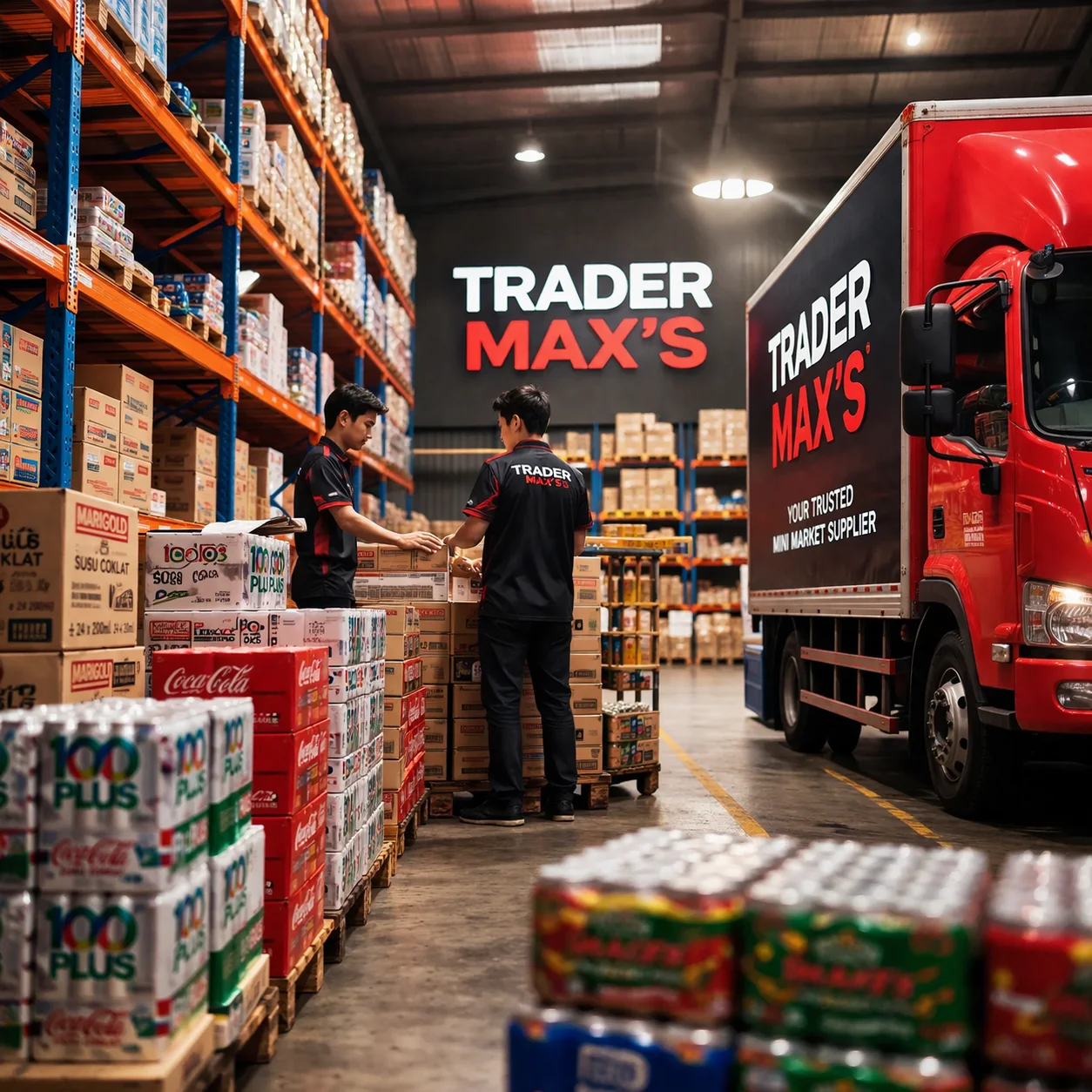
In an evolving FMCG landscape where speed, pricing, and reliability define success, Trader Max’s is positioned to operate not just as a traditional wholesaler, but as a modern mini market supplier Malaysia built for today’s retail realities.
Unlike fragmented suppliers that focus on limited categories, Trader Max’s is structured to deliver a one-stop FMCG solution tailored for mini markets, kedai runcit, cafés, and small businesses.
By consolidating a wide range of fast-moving products—especially high-demand beverage SKUs—into a single supply channel, it simplifies purchasing and reduces the operational burden on retailers.
This allows business owners to spend less time coordinating multiple suppliers and more time focusing on sales and growth.
One of the key strengths of Trader Max’s lies in its pricing philosophy.
With a strong emphasis on wholesale-level pricing and a “Trader’s Price” positioning, the goal is clear: help customers maximise margins without compromising on product availability.
In a competitive market where every ringgit matters, this approach directly supports profitability at the store level.
Trader Max’s also aligns with the industry’s shift toward speed and efficiency.
With dedicated logistics capabilities and a focus on fast delivery within Klang Valley, it enables retailers to operate with leaner inventory and faster restocking cycles.
This is critical in a market where demand can change quickly and shelf availability directly impacts sales performance.
Beyond supply, Trader Max’s reflects the growing role of suppliers as business partners rather than just vendors.
By understanding the real challenges faced by mini market operators—such as product selection, cash flow management, and fast-moving inventory—the company is positioned to provide more practical, ground-level support.
This includes offering the right product mix, maintaining consistent stock for key items, and ensuring a smoother ordering experience.
In an environment where large players like 99Speedmart dominate through scale and system efficiency, Trader Max’s differentiates itself through flexibility, accessibility, and customer-centric execution.
It bridges the gap between large-scale distribution and independent retail needs, giving smaller operators access to competitive pricing and reliable supply without the complexity of dealing with multiple channels.
As the industry continues to evolve toward digitalisation, faster logistics, and consolidated supply chains, Trader Max’s is well-positioned to grow alongside its customers.
Its role in the ecosystem is clear: to become a trusted, efficient, and profit-driven mini market supplier Malaysia that empowers retailers to compete, scale, and succeed in a demanding market.
Final Thoughts: Your Supplier is Your Growth Engine
At the end of the day, your success depends heavily on your supplier.
The right mini market supplier Malaysia helps you:
- Lower costs
- Increase margins
- Improve product availability
- Scale your business faster
Don’t treat your supplier as just a vendor.
Treat them as a strategic partner.




Leave A Comment