
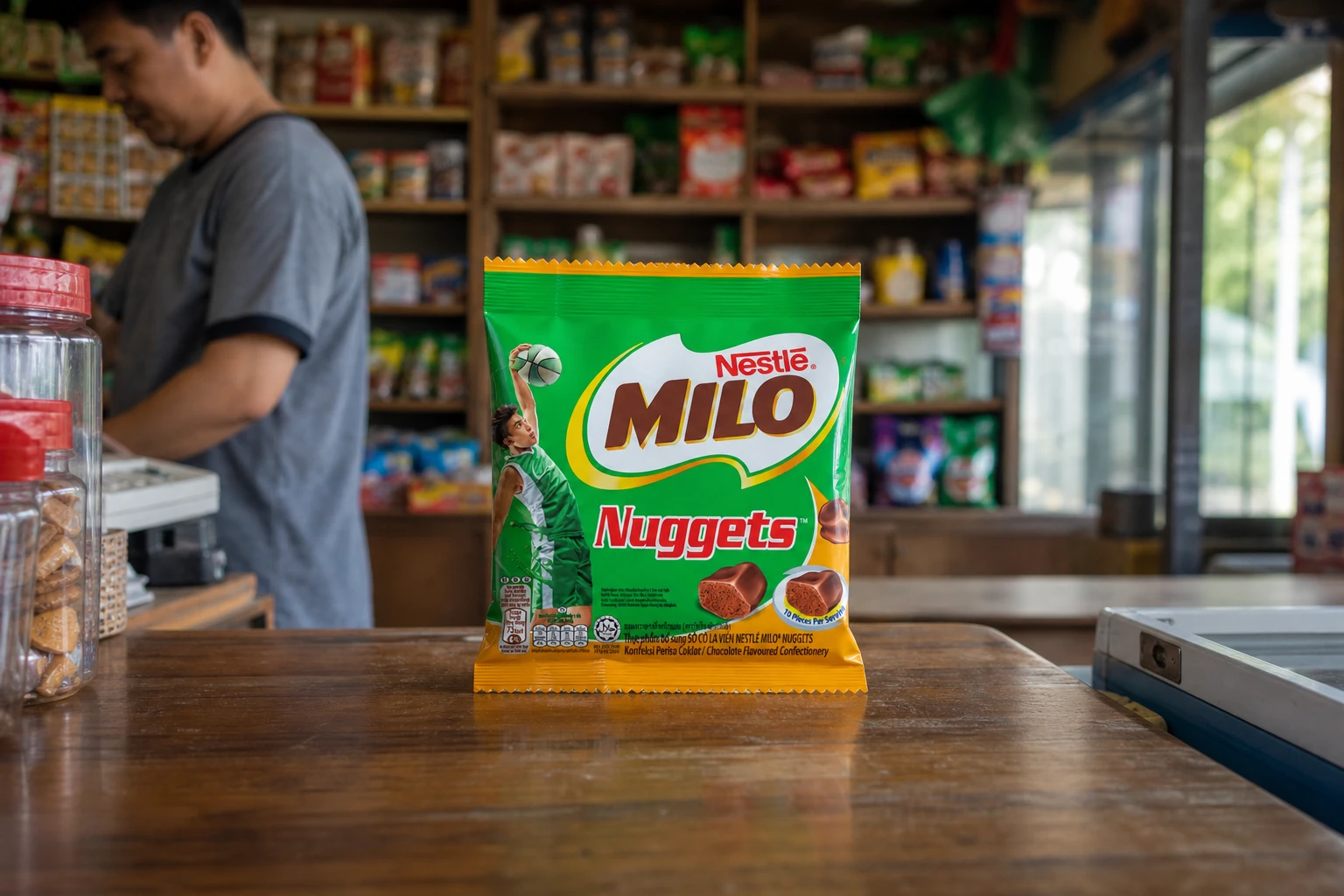
The milo origin country is Australia: Milo was created there in 1934 by Nestlé Australia scientist Thomas Mayne, who developed the powdered chocolate malt drink that would later become a household name across Asia, including Malaysia (according to the official Milo brand history page, milo.com.my/the-milo-story). What this means for wholesale buyers is more nuanced than a single country name, however. A product’s brand heritage does not tell you where any specific carton on a shelf was actually manufactured or packed, since Nestlé operates Milo production across multiple markets to serve regional demand. Buyers sourcing for Malaysian retail, food service, or export must verify manufacturing origin at the pack level, not at the brand level, and this article explains exactly how to do that.
Milo’s Origin Story: From Australia to Regional Manufacturing
Milo’s invention in Australia in 1934 is well documented on Nestlé’s own Milo brand site, which positions Thomas Mayne as the product’s original developer (milo.com.my/the-milo-story). This origin story is useful background for understanding the brand’s history, but it is a separate fact from where any individual pack sold in Malaysia today was produced. Large global brands typically localise manufacturing to serve nearby markets efficiently, and confirming the actual production site for a given batch requires checking the pack itself rather than relying on brand history. For procurement purposes, treat the Australian origin as a historical and branding fact, and treat country-of-manufacture as a separate, pack-specific question that only the printed label on the carton in front of you can answer.
Why Country of Origin Matters for Business Buyers
For Malaysian retailers, mini-marts, cafés, and institutional buyers, country of origin can affect several practical business decisions beyond simple curiosity. Some buyers need to confirm manufacturing origin for import documentation, shelf labelling compliance, or customer queries about where a product comes from. Others are simply verifying that the stock they receive matches what was quoted or advertised. Whatever the reason, the approach is the same: read the actual product packaging rather than assuming brand origin equals manufacturing origin, and keep a record of what the label states at the time of purchase.
Matching Product to Intended Outlet Use
Before sourcing Milo in bulk, clarify how the product will be used in your outlet, since this shapes which format and pack type you should be asking suppliers about. Nestlé’s official Malaysian product page confirms that the Milo range sold in Malaysia includes powder in tins, Original stick packs, and MILO CAN ready-to-drink beverages (milo.com.my/products). Each format suits a different kind of business:
- Powder tins suit retail shelf resale, café beverage stations, or canteens that prepare drinks on demand.
- Stick packs suit convenience retail, vending-style sales, or office pantry supply where single-serve convenience matters.
- MILO CAN ready-to-drink suits cold beverage fridges in convenience stores, petrol kiosks, or food service outlets needing grab-and-go stock.
Matching the format to your actual point of sale avoids ordering stock that doesn’t fit your operation, and it also narrows down which label details you need to check first.
Product Identification: What to Check on the Pack
Once you know which format you need, the next step is confirming product identity against what a supplier offers. Because no single Trader Max SKU, carton configuration, or batch-level manufacturing origin has been independently verified for this article, buyers should treat every quotation as a starting point for verification rather than a confirmed spec sheet. When you receive a sample, quotation, or product photo from a supplier, check the following directly against the physical pack or its photographed label:
- The printed country of manufacture or country of origin statement on the pack, usually near the barcode or ingredient panel.
- The product name and format exactly as described (for example, confirming whether a listing is powder, stick packs, or MILO CAN, since these are distinct formats per the official product page).
- Net weight or volume printed on the pack, which determines unit economics regardless of brand.
- Batch code or production date, useful for your own stock rotation and for raising questions with a supplier if something looks inconsistent.
- Language and market markings on the label, which can hint at which market a pack was originally produced for, though this should be confirmed with the supplier rather than assumed.
If a supplier cannot show you a clear label photo or sample before you commit to a bulk order, ask for one. This is a reasonable and standard request, not an unusual one, for any wholesale buyer confirming product identity before purchase.
Label Information Every Bulk Buyer Should Record
Keeping a simple internal record of label details at the point of receiving stock protects your business in two ways: it gives you a reference if a customer asks about origin, and it gives you a paper trail if a future batch arrives looking different from what you ordered previously. For each incoming shipment or carton batch, consider logging:
- Date received and supplier name.
- Format purchased (powder tin, stick pack, or MILO CAN, per the official product range).
- Country of manufacture as printed on the label at time of receipt.
- Pack size and quantity received.
- Any discrepancy noticed between what was quoted and what was delivered.
This kind of record does not require special software or compliance expertise. A simple spreadsheet row per batch is sufficient for most small and mid-sized retail or food service operations, and it becomes invaluable if you ever need to answer a customer or auditor’s question about where your stock came from.
Decision Checklist Before You Commit to a Bulk Order
Before finalising any bulk Milo purchase, work through this checklist to confirm you are ordering the right product for your outlet and that you have enough information to verify it on arrival:
- Confirm the format. Decide whether you need powder tins, stick packs, or MILO CAN ready-to-drink based on how your outlet sells or serves the product.
- Request a label photo or physical sample. Ask the supplier to confirm the printed country of manufacture before you place a large order, rather than relying on brand reputation alone.
- Clarify pack size and carton configuration. Ask the supplier directly how many units are in a carton and what the net weight or volume per unit is, since this has not been independently verified here and varies by format and market.
- Ask about minimum order quantities. Confirm with the supplier what MOQ applies to the format you want, since this differs between retail and wholesale channels.
- Check documentation needs. If your business requires certificates, invoices with origin statements, or other paperwork for internal compliance, ask the supplier whether these can be supplied alongside the order.
- Verify before, not after, committing to volume. Request samples or clear photos for a small trial quantity before scaling up to a full carton or pallet order.
- Record what you receive. Log the label details from the actual delivered stock, not just the quotation, so your internal records match reality.
Working through this checklist does not guarantee a specific outcome, but it ensures you are asking the right questions at the right stage of the buying process, and that your internal records can answer a country-of-origin question accurately if one ever comes up from a customer, auditor, or business partner.
Comparing Milo Formats for Bulk Purchase
Since no specific carton size, unit count, or wholesale pricing has been independently verified for this article, this section compares the three manufacturer-confirmed formats — powder tins, Original stick packs, and MILO CAN ready-to-drink (per milo.com.my/products) — on operational tradeoffs rather than invented specifications. The goal is to help you decide which format fits your outlet before you request a formal quotation from any supplier.
Operational Tradeoffs by Format
Powder tins generally suit businesses that prepare beverages on-site, such as cafés, canteens, or hotel pantries. The tradeoff is that powder requires preparation equipment, clean water, and staff time at point of service, but a single tin typically serves many cups, which can suit high-volume beverage counters. Storage also matters: powder is sensitive to moisture, so your storage area needs to be dry, and any specific storage instructions printed on the pack should always take precedence over general assumptions.
Stick packs suit outlets that want single-serve convenience without preparation equipment beyond hot water, such as convenience stores, office pantries, or vending-adjacent retail. The tradeoff is that stick packs usually cost more per gram of product than bulk tins (a common pattern across single-serve sachet formats generally, not a confirmed Milo-specific figure), but they reduce waste, simplify portion control, and appeal to customers who want a quick self-serve drink.
MILO CAN ready-to-drink suits outlets with cold beverage fridges and customers seeking an immediate, no-preparation purchase, such as petrol kiosks, convenience stores, or quick-service food counters. The tradeoff here is cold chain and fridge space: ready-to-drink cans require refrigerated display to sell well, which is a different operational commitment compared to shelf-stable powder or stick packs. If your outlet lacks reliable fridge space or consistent footfall for cold beverages, this format may carry more holding risk than the other two.
A Simple Quotation Comparison Worksheet
When you request quotations from more than one supplier, comparing them fairly requires more than looking at a single headline price. Use a worksheet with these columns for each quotation you receive:
- Supplier name and date of quotation
- Format quoted (powder tin, stick pack, or MILO CAN)
- Printed country of manufacture (to be confirmed from label or sample, not assumed)
- Minimum order quantity stated by the supplier
- Unit size or net weight/volume as confirmed by the supplier
- Total quoted price for the stated quantity
- Price per unit (total price divided by number of units) for an apples-to-apples comparison
- Any additional terms mentioned, such as delivery arrangements or documentation offered
Calculating price per unit is the single most useful step in this worksheet, because suppliers may quote different carton sizes or minimum order quantities, making headline totals misleading on their own. Always ask the supplier to confirm the exact unit count in their quoted carton before you calculate this, since carton configurations have not been verified here and can vary.
Hypothetical Purchasing Scenarios
The following scenarios are illustrative examples only, using invented numbers to demonstrate how a comparison worksheet works in practice. Every figure below is explicitly labelled hypothetical. None of the figures, pack sizes, or supplier names are real verified prices or specifications — they exist solely to show the calculation method a buyer would use with real supplier quotations.
Hypothetical Scenario One: Mini-Mart Comparing Two Quotations
| Item | Supplier A (hypothetical) | Supplier B (hypothetical) |
|---|---|---|
| Quoted total price | RM 240 (hypothetical figure) | RM 300 (hypothetical figure) |
| Stated units per carton | 60 units (hypothetical figure) | 80 units (hypothetical figure) |
| Calculated price per unit | RM 240 ÷ 60 = RM 4.00 (hypothetical calculated result) | RM 300 ÷ 80 = RM 3.75 (hypothetical calculated result) |
On a per-unit basis, Supplier B’s hypothetical quotation works out cheaper, even though its hypothetical total price is higher. This illustrates why comparing only headline totals can be misleading, and why confirming exact unit counts with each real supplier before calculating is essential.
Hypothetical Scenario Two: Café Deciding Between Powder Tins and MILO CAN
Imagine a café currently serves hot Milo prepared from powder tins but is considering adding MILO CAN to its cold beverage fridge. The owner requests a quotation for a hypothetical order of 24 cans (hypothetical figure) at a hypothetical total of RM 96 (hypothetical figure), giving a calculated per-unit cost of RM 96 ÷ 24 = RM 4.00 per can (hypothetical calculated result). Before committing, the owner should weigh this hypothetical per-unit figure against the fridge space it will occupy, how quickly cold beverages turn over in that location, and whether the convenience justifies testing a small trial order first rather than committing to a large one immediately.
Hypothetical Scenario Three: Office Pantry Supplier Choosing Between Formats
Imagine a facilities manager stocking office pantries across several floors is deciding between powder tins (requiring a kettle and cups already available in the pantry) and stick packs (requiring no measuring). If a hypothetical powder tin quotation works out to a hypothetical RM 2.50 per serving (hypothetical calculated result) based on standard preparation measurements, while a hypothetical stick pack quotation works out to a hypothetical RM 3.20 per serving (hypothetical calculated result), the manager must weigh the stick pack’s added convenience and reduced staff time against its higher per-serving cost. This is a tradeoff between operational simplicity and unit economics, not a fixed rule, and the right choice depends on how much pantry staff time is worth to that business.
In all three scenarios, the method matters more than the specific numbers: request itemised quotations, confirm unit counts and formats directly with the supplier, calculate price per unit consistently, and request label verification before committing to volume. These steps apply regardless of which format or supplier you are evaluating, and they protect you from comparing quotations that look similar on the surface but differ meaningfully once unit counts and formats are accounted for.
Running a Stock Trial Before Committing to Volume
Before placing a full carton or pallet order, it is worth running a small stock trial to measure how the product actually performs in your outlet rather than relying on assumptions. A stock trial simply means ordering a small, manageable quantity first, selling or using it under normal conditions, and tracking a few basic figures before deciding whether to scale up.
For retail outlets, this means tracking how many units sell over a fixed period, such as two or four weeks, and comparing that against your shelf space and holding cost. For cafés or food service outlets, it means tracking how many servings a tin or carton actually produces under your own preparation habits, since actual yield can vary with serving size and staff technique. For cold beverage formats like MILO CAN, it means tracking fridge turnover rate against the fridge space the product occupies, so you can judge whether it earns its place compared to other cold items already stocked.
Whatever the format, write down your trial figures rather than estimating from memory. A simple note of units received, units sold or used, and days elapsed is enough to calculate a rough turnover rate, which then informs how much to reorder and how often.
Receiving Records: What to Check on Arrival
Earlier sections covered what to log when stock arrives, including format, label-stated country of manufacture, and pack size. At the actual point of receiving a delivery, there are a few additional practical checks worth doing before signing off on a shipment or filing the delivery note away.
- Count the cartons or units received against the delivery note or invoice, and note any shortfall or overage immediately rather than assuming it will be corrected later.
- Check for visible damage to outer cartons, since crushed or torn packaging can affect saleability even if the product inside is intact.
- Spot-check a sample of individual units within a carton to confirm the label matches what was quoted, rather than checking only the outer carton labelling.
- File the delivery note, invoice, and any label photos together, ideally referenced by date and supplier name, so they can be retrieved quickly if a question arises later.
These checks take only a few minutes per delivery but create a reliable paper trail that protects your business if a customer, auditor, or business partner later asks about a specific batch.
Storage Questions Governed by Pack Instructions
Storage requirements for any Milo format should be governed by the instructions printed on the actual pack, not by general assumptions carried over from other products. Different formats and even different batches can carry different storage guidance, so the printed instructions on the specific carton or unit you receive should always take precedence over general practice. That said, there are useful questions to ask your supplier or to check against the pack before committing to a storage plan:
- Does the pack specify a temperature range or a requirement to keep the product away from direct sunlight or moisture?
- Does the format require refrigeration at any point, as may apply to ready-to-drink formats such as MILO CAN, versus shelf-stable storage for powder or stick packs?
- Is there a stated shelf life or best-before period printed on the batch you received, and does your storage and rotation plan allow you to sell through stock comfortably within that window?
- Does your storage area match what the pack instructions require, particularly for powder formats where moisture exposure can affect product quality?
Rather than assuming a storage protocol based on general beverage category habits, treat the pack instructions on each batch as the authoritative source, and adjust your storage area or rotation schedule accordingly.
Reordering and Staff Handover
Once your stock trial and receiving records give you a reasonable picture of turnover, set a simple reorder trigger based on your own sales data rather than guessing. For example, you might decide to reorder once stock falls to a certain number of units or cartons, based on how long your trial period showed stock lasting. This figure will be specific to your outlet’s footfall and should be revisited periodically rather than fixed permanently.
Staff handover is equally important, particularly in outlets where more than one person manages stock or placing orders. A short handover note covering current stock level, last reorder date, last supplier used, and any label or batch discrepancies noticed should be kept somewhere accessible to whoever manages purchasing next. This avoids repeat questions to suppliers and ensures continuity if the person who placed the original order is unavailable when a reorder decision needs to be made.
Scope Note
This guide provides general purchasing and record-keeping guidance based on verified brand history and confirmed product formats. No specific Trader Max SKU, carton configuration, minimum order quantity, current price, stock availability, or delivery arrangement has been independently verified for this article, so these details should always be confirmed directly with a supplier before committing to an order.
FAQ
What country is Milo from?
Milo originated in Australia, where it was developed in 1934 by Nestlé Australia scientist Thomas Mayne (milo.com.my/the-milo-story).
Is Milo made in Malaysia?
Brand origin and the manufacturing country of a specific carton are two different questions. To find out where a particular pack was made, check the printed country-of-manufacture statement on that pack’s label rather than relying on the brand’s Australian origin.
What Milo formats are available in Malaysia?
According to the official Malaysian product page, the range includes powder (in tins), Original stick packs, and MILO CAN ready-to-drink products (milo.com.my/products).
How do I confirm carton size and MOQ for bulk orders?
These details vary by supplier and have not been independently verified here, so confirm them directly with your supplier before placing an order, and request this in writing alongside your quotation.
Get in Touch
If you are sourcing Milo in bulk for a retail, café, or food service outlet, browse the product enquiry catalogue at tradermaxs.com.my/shop or reach out directly through the contact page at tradermaxs.com.my/were-here to confirm current formats, pack details, and minimum order quantities for your business.

Leave A Comment