
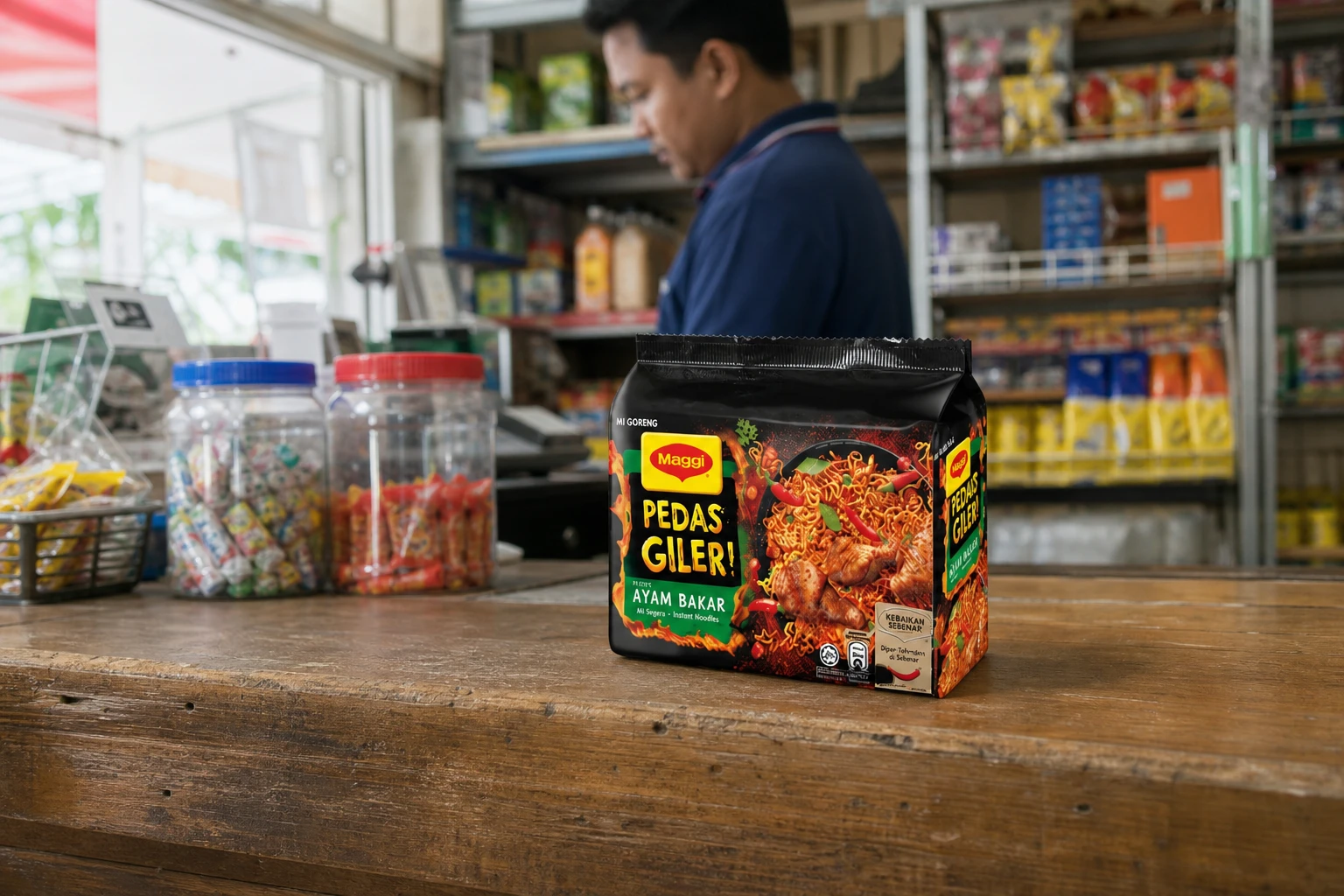
Buyers asking about maggi pedas giler ayam bakar in bulk carton quantities should know upfront that specific carton counts, per-unit pricing and current stock levels are not published facts here and need to be confirmed directly with the supplier before any purchase order is raised. This guide does not state a price or a delivery promise. What it offers instead is a structured way to evaluate the product, identify the correct SKU, and ask the right questions so that a retailer, sundry shop or canteen operator can make a sound bulk-buying decision once a supplier confirms the commercial details.
What This Guide Covers and Why It Matters for Bulk Buyers
Instant noodles sold in flavour variants are a common fast-moving category for Malaysian retail and food-service outlets. Buyers purchasing for resale or for canteen use typically need more than a flavour name — they need to confirm the exact product listing, the carton configuration, and how that carton fits into their existing shelf space or meal-prep routine. This article focuses specifically on the operational and purchasing questions relevant to sourcing this flavour in bulk, rather than repeating general advice on Maggi or snack wholesaling that may already be covered elsewhere.
Because no topic-specific pricing, stock or certification facts have been independently verified for this product, numbers are not quoted as fact anywhere in this article. Where example figures appear later, they are clearly labelled as hypothetical and used only to illustrate how a comparison or calculation should be structured once a buyer has real supplier quotes in hand.
Why This Flavour Tends to Move Quickly on Shelves
Spicy grilled-chicken style instant noodle flavours are a familiar category on Malaysian sundry shop shelves and in canteen menu rotations, where shoppers and students alike often look for a quick, flavour-forward option. Without citing specific sales figures, it is fair to say that flavour variety is one reason retailers keep more than one instant noodle SKU in stock rather than relying on a single plain variant — different customers have different preferences, and carrying a popular flavour alongside standard options is a common shelf strategy. This general pattern is useful context for why a buyer might consider adding this flavour to a product mix, but it should not replace checking actual movement at your own outlet through the trial process described later in this guide.
Identifying the Correct Product Before You Order
The first practical step for any business buyer is confirming that the product referenced in a quotation or catalogue listing is the exact flavour and format intended for purchase. Flavour names in the instant noodle category can be similar across a brand’s range, and a canteen operator or shop owner ordering at carton volume should not rely on a flavour name alone.
Points to Confirm on the Packaging or Listing
Before placing an order, request or check the following details directly from the product listing or packaging photo supplied by the seller:
- The full product name as printed on the pack, matched against what is listed in the enquiry catalogue.
- The net weight per individual packet, since this affects per-serving cost calculations once pricing is confirmed.
- The number of individual packets per carton, which determines how the bulk unit breaks down for shelf stocking or canteen portioning.
- Any batch or production date markings visible on the carton, useful later for your own receiving records.
- The ingredient panel and any printed label details, which buyers should read directly from the pack rather than relying on third-party summaries.
Buyers can raise these identification questions through the product enquiry catalogue at https://www.tradermaxs.com.my/shop/, which serves as the reference point for confirming exact listings before a formal quotation is requested.
Understanding Carton Packing for Instant Noodle SKUs
Carton packing conventions vary across suppliers and sometimes across formats of the same flavour, which is why this section focuses on how to read and question a carton specification rather than asserting any fixed structure for this product. A typical instant noodle carton holds a fixed number of individual packets, but the exact count, whether packets are grouped into inner bundles, and whether the carton is a sealed case or an open display box are all details a buyer should confirm rather than assume.
Questions That Apply to Any Carton Format
- Is the carton a single inner layer, or does it contain inner trays that bundle packets into smaller groups?
- Does the carton ship as a sealed case, or is it an open display box intended for immediate shelf use?
- Are there different net weights offered under the same flavour name, which would change per-serving cost even if the packet count per carton is identical?
- Is the carton itself sturdy enough for repeated partial removal of stock, relevant for shops that will not empty a carton in one go?
These questions should be put to the supplier directly rather than assumed, since this guide has no verified answer for any of them specific to this product. Because no manufacturer-confirmed format variations have been verified for this flavour, this guide cannot state whether more than one carton format exists for maggi pedas giler ayam bakar — that is a question to raise at enquiry stage.
Matching the Product to Your Outlet Type
Bulk carton purchasing decisions differ depending on where the product will be used. A sundry shop, a mini-mart and a canteen each have different handling needs, and understanding this before ordering helps avoid over-buying or mismatched carton sizes.
Sundry Shops and Mini-Marts
Retail outlets reselling individual packets need to think about shelf turnover and display format. A carton intended for resale should be easy to break down into individual units or smaller multiples for shelf stocking, and the outer carton packaging should hold up to repeated opening and partial removal of stock without damaging remaining packets. Retailers should ask the supplier whether the carton is designed for easy resealing or whether it is intended to be opened once and emptied in full.
Canteens and Food-Service Counters
Canteen operators typically use instant noodles as a quick-prep menu item rather than a resale product, which changes the purchasing priority. Instead of shelf appearance, the relevant questions are about consistent carton weight and packet count, since this affects portion planning and ingredient costing per serving. A canteen buyer should also confirm whether the carton size matches realistic weekly usage, since instant noodle stock that sits too long before use raises questions about storage conditions that are better addressed by checking the manufacturer’s printed storage instructions on the pack itself.
Reading the Label Before You Commit to a Bulk Order
Regardless of outlet type, every bulk buyer should physically inspect at least one sample pack — either from a sample unit or from carton photos provided by the seller — before committing to a full carton order. The printed label is the only verified source of product-specific information such as net weight, ingredient listing, and storage guidance, and none of this should be assumed from the product name alone.
Specifically, check that the label:
- States a clear net weight per packet, which should be consistent across all packets in the carton.
- Lists a manufacturing or best-before date in a legible format, which your receiving team can log against delivery date.
- Includes storage instructions printed by the manufacturer, which should guide how your outlet stores the carton rather than general assumptions about instant noodle shelf life.
- Shows the manufacturer or distributor name and the country of manufacture clearly, which may differ from the brand’s country of origin — a pack manufactured under licence in one country can carry a brand that originated elsewhere, so this line on the label should be read as a statement about that specific carton, not about the brand generally.
This article does not assert any specific certification or label claim for this product, since no such facts have been independently verified for this listing. Buyers requiring confirmation of any label detail should request a clear photograph of the current pack’s label directly through the supplier’s enquiry channel before finalising a bulk order.
Comparing Wholesale Quotes for Instant Noodles
Once a supplier provides a quotation, the comparison should never be based on total carton price alone. The only meaningful comparison is price per individual packet, calculated after confirming the exact packet count per carton for each option. A carton with fewer packets at a lower total price is not automatically the better deal, and a buyer who skips this step risks misjudging true unit cost.
A Quotation Comparison Worksheet
When a buyer receives quotations from more than one supplier, or multiple format options from the same supplier, a simple worksheet helps keep the comparison objective. The following structure is a suggested format only, not a pricing table with real figures:
- Supplier name and date of quotation. Record who issued the quote and when, since prices can change between enquiries.
- SKU and flavour confirmed. Note the exact product name as written on the quotation, matched against the catalogue listing.
- Packets per carton. Record the confirmed figure rather than an assumed round number.
- Total carton price quoted. Record exactly as stated by the supplier, including currency and whether it is inclusive of any tax.
- Calculated price per packet. Divide the total carton price by the confirmed packet count.
- Minimum order quantity. Record the number of cartons the supplier requires per order.
- Delivery terms stated. Note whether delivery is offered, to which locations, and any lead time mentioned — without assuming any promise not explicitly stated.
- Validity period of the quote. Many quotations are only valid for a limited number of days; record this to avoid planning around an expired price.
This worksheet structure allows a buyer to lay two or more real quotations side by side once they are received, rather than comparing headline carton prices that may represent different packet counts or formats.
Hypothetical Purchasing Scenarios (Illustrative Only, Not Real Figures)
The following scenarios use invented numbers purely to demonstrate how the worksheet above should be applied. Every figure below is explicitly hypothetical and does not represent actual prices, stock levels or carton specifications for maggi pedas giler ayam bakar, and none of it should be used for real purchasing decisions.
| Scenario | Hypothetical inputs | Hypothetical calculated result |
|---|---|---|
| Sundry shop trial order | Carton price RM48 (hypothetical), 40 packets (hypothetical) | RM48 ÷ 40 = RM1.20 hypothetical per-packet cost |
| Sundry shop minimum order | Minimum order quantity of 3 cartons (hypothetical) at RM48 each (hypothetical) | 3 × RM48 = RM144 hypothetical total before delivery |
| Canteen weekly planning | Target 100 packets/week (hypothetical), 24 packets per carton (hypothetical) | 100 ÷ 24 ≈ 4.2, rounded up to 5 cartons (hypothetical) to avoid running short |
| Supplier A vs Supplier B | Supplier A: RM50 for 36 packets (hypothetical). Supplier B: RM45 for 30 packets (hypothetical) | A ≈ RM1.39/packet; B = RM1.50/packet (both hypothetical) — A is cheaper per packet despite a higher total carton price |
Buyers should rebuild this worksheet with real quotations obtained through the enquiry catalogue at https://www.tradermaxs.com.my/shop/, since every figure in the table above is invented solely to illustrate the calculation method.
Operational Tradeoffs Between Carton Sizes
Once a supplier confirms real carton specifications, buyers still need to weigh operational tradeoffs that have nothing to do with price. A larger carton generally means a lower delivery frequency and less administrative work per unit of stock, but it also ties up more storage space and more working capital in a single purchase. A smaller carton or split-case order may cost more per unit in some wholesale pricing structures, but it reduces the risk of overstocking a flavour that does not move as quickly as expected in a specific outlet.
For a canteen with a small kitchen storage area, a bulkier carton that cannot be stacked safely may create a workplace hazard or force stock into an unsuitable storage spot, which is a question better resolved against the manufacturer’s printed storage instructions and your own site’s shelving before ordering. For a mini-mart with steady walk-in traffic, a larger carton may be justified if shelf space and sales velocity support it, but this should be judged against the outlet’s own sales history for similar instant noodle flavours rather than assumed from the flavour’s general popularity.
Minimum Order Quantities and Working Capital
Some suppliers set a minimum order quantity in terms of number of cartons rather than individual packets. A buyer who has not confirmed this figure in advance may find that a single-carton trial order is not possible, and that the minimum commitment is several cartons at once. This has direct working capital implications for a small sundry shop, which should weigh the minimum order size against its typical weekly instant noodle turnover before committing.
Stocking Tips for Canteens, Sundry Shops and Mini-Marts
Running a Stock Trial Before Committing to Full Carton Volumes
Before locking in a recurring order pattern, most retailers and canteen operators benefit from a short stock trial using a single carton or the smallest quantity a supplier will release. The purpose of a trial is to measure actual movement against assumptions, rather than relying on how popular the flavour seems in general conversation or how well similar flavours have sold in the past.
A simple way to measure this is to record the date the trial carton is opened, count the packets at the start, and check remaining stock at fixed intervals — for example, every three or seven days depending on your outlet’s rhythm. For a sundry shop, this means noting how many packets sold off the shelf in that window. For a canteen, it means tracking how many packets were used in meal preparation against how many were planned for. This single measurement, repeated over two or three trial cartons, gives a far more reliable reorder baseline than a one-off guess.
What to Record During a Trial
- Opening date and packet count at the start of the trial.
- Packet count remaining at each check-in point.
- Any packets removed for reasons other than sale or service, such as damaged packaging found during handling.
- Staff observations on customer or kitchen demand, noted briefly rather than relied on from memory later.
These records do not need to be complex. A simple notebook or shared spreadsheet entry per carton is enough to build a pattern over two or three reorder cycles, which is far more useful for planning than a single impression of fast or slow movement.
Keeping Receiving Records for Every Carton Delivery
Once a bulk order is confirmed and delivered, a short receiving check protects both the buyer and the ongoing supplier relationship. This matters more for repeat bulk orders than for a single trial, since discrepancies are easier to resolve quickly than weeks later. On delivery, check and record the carton count received against the quantity stated on the delivery note, any visible damage to the outer carton (photographed before opening if present), the batch or production date logged against the delivery date, and the condition of the carton seal on arrival. Keeping this log consistently, even in a simple format, makes it straightforward to raise a query with the supplier if a discrepancy is found, and it builds a useful internal history of delivery consistency over several orders.
Storage and Shelf Rotation
Storage guidance for this product should come directly from the manufacturer’s printed instructions on the pack, not from general assumptions about instant noodles as a category. Before storing a new carton, check the label for any stated storage condition and compare it against where the carton will actually sit in your outlet. Practical questions worth resolving include whether the storage area is dry and free from direct sunlight, whether cartons are stacked in a way consistent with the packaging’s printed handling guidance, and whether older stock is positioned for use before newer stock — a straightforward first-in-first-out rotation that reduces the risk of any carton sitting unused past a reasonable period.
Sundry shops and mini-marts restocking shelves from a bulk carton should apply the same first-in-first-out principle to individual packets as they would to the carton itself. When a new carton arrives, move any remaining packets from the previous carton to the front of the shelf display rather than placing new stock in front of older stock.
Reordering: Turning Trial Data Into a Routine
Once a buyer has two or three cycles of trial data and receiving records, reordering becomes a matter of pattern rather than guesswork. Compare packet movement across the trial period to decide whether the next order should match the previous carton count, increase to meet higher-than-expected demand, or reduce if movement was slower than anticipated. It is worth revisiting the minimum order quantity question at this stage too, since a supplier’s minimum may not align neatly with your measured weekly or monthly usage. If usage sits below the minimum order threshold, it may be more practical to order less frequently in larger batches, provided storage conditions allow it, rather than forcing a reorder cycle that does not match actual consumption.
Staff Handover: Keeping Stock Knowledge Consistent
In outlets with shift-based staffing, such as canteens or mini-marts with multiple staff members handling stock, a short handover note prevents knowledge about this product from being lost between shifts. A simple handover record might note current carton stock on hand, the date of the last delivery, any damaged packets identified and set aside, and the expected date of the next reorder. This is particularly useful when the person placing supplier orders is not the same person receiving deliveries or managing shelf stock day to day. Without a shared record, reorder timing can drift, leading either to shelves running empty or to excess stock building up without anyone noticing until a routine stock check.
How to Request Current Availability from Trader Max’s
Before submitting a purchase enquiry, Malaysian business buyers should work through a short internal checklist to ensure the order matches both operational needs and record-keeping requirements:
- Confirm the exact SKU. Match the product name and pack image against the listing in the enquiry catalogue before requesting a quote.
- Clarify carton composition. Ask the supplier directly how many individual packets are included per carton, since this has not been independently verified here and varies by listing.
- Request current availability. Stock levels change, and this guide does not state any current stock position — confirm directly with the supplier before planning around a specific quantity.
- Ask about minimum order quantity. Many wholesale suppliers set a minimum carton count per order; confirm this figure rather than assuming a round number.
- Check delivery logistics. Ask whether delivery is available to your outlet’s location and what lead time applies, since no delivery promise is made in this guide.
- Verify pricing in writing. Request a written quotation referencing the specific SKU and carton count discussed, rather than relying on a verbal estimate.
- Record the enquiry date and contact person. Keep an internal note of who you spoke with and when, useful for following up or resolving discrepancies later.
Buyers can begin this process by browsing the enquiry catalogue at https://www.tradermaxs.com.my/shop/ and following up directly through the contact page at https://www.tradermaxs.com.my/were-here/ to request current details specific to this flavour and carton format. Readers looking for wider sourcing context across instant noodles and snacks as a category, rather than this single flavour, may also find the existing Pembekal Jajan & Maggi Borong article a useful companion reference.
Scope Note
This guide does not state or imply any current price, stock level, delivery timeframe, certification or specific carton specification for maggi pedas giler ayam bakar, as none of these details have been independently verified at the time of writing. Packet count per carton, minimum order quantity, delivery terms and current pricing should all be confirmed directly with the supplier before placing an order.
Frequently Asked Questions
Can I order a single carton to trial this flavour before committing to a larger quantity?
This depends on the supplier’s minimum order quantity, which has not been independently verified here. Ask directly through the enquiry catalogue whether a single-carton order is possible before planning a trial.
How do I know how many packets are in a carton?
Packet count per carton should be confirmed directly with the supplier or checked against the printed carton label, since this figure has not been verified independently in this guide.
Is the country of manufacture the same as the brand’s origin?
Not necessarily — check the printed label on the specific carton you receive for the manufacturer or distributor name and country of manufacture, rather than assuming this from the brand name alone.
What should I do if a carton arrives with damaged packaging?
Photograph the damage before opening the carton further, log it against the delivery date, and raise the issue directly with the supplier referencing your receiving record.
How do I decide on reorder timing?
Use trial and receiving records covering at least two or three order cycles to establish actual packet movement, then set reorder timing based on that pattern rather than a one-off estimate.
Request Current Availability Directly
To confirm current carton details, packet counts and ordering terms for maggi pedas giler ayam bakar, browse the product enquiry catalogue at https://www.tradermaxs.com.my/shop/ and reach out directly through the contact page at https://www.tradermaxs.com.my/were-here/ to request a written quotation suited to your outlet’s needs.


Leave A Comment