
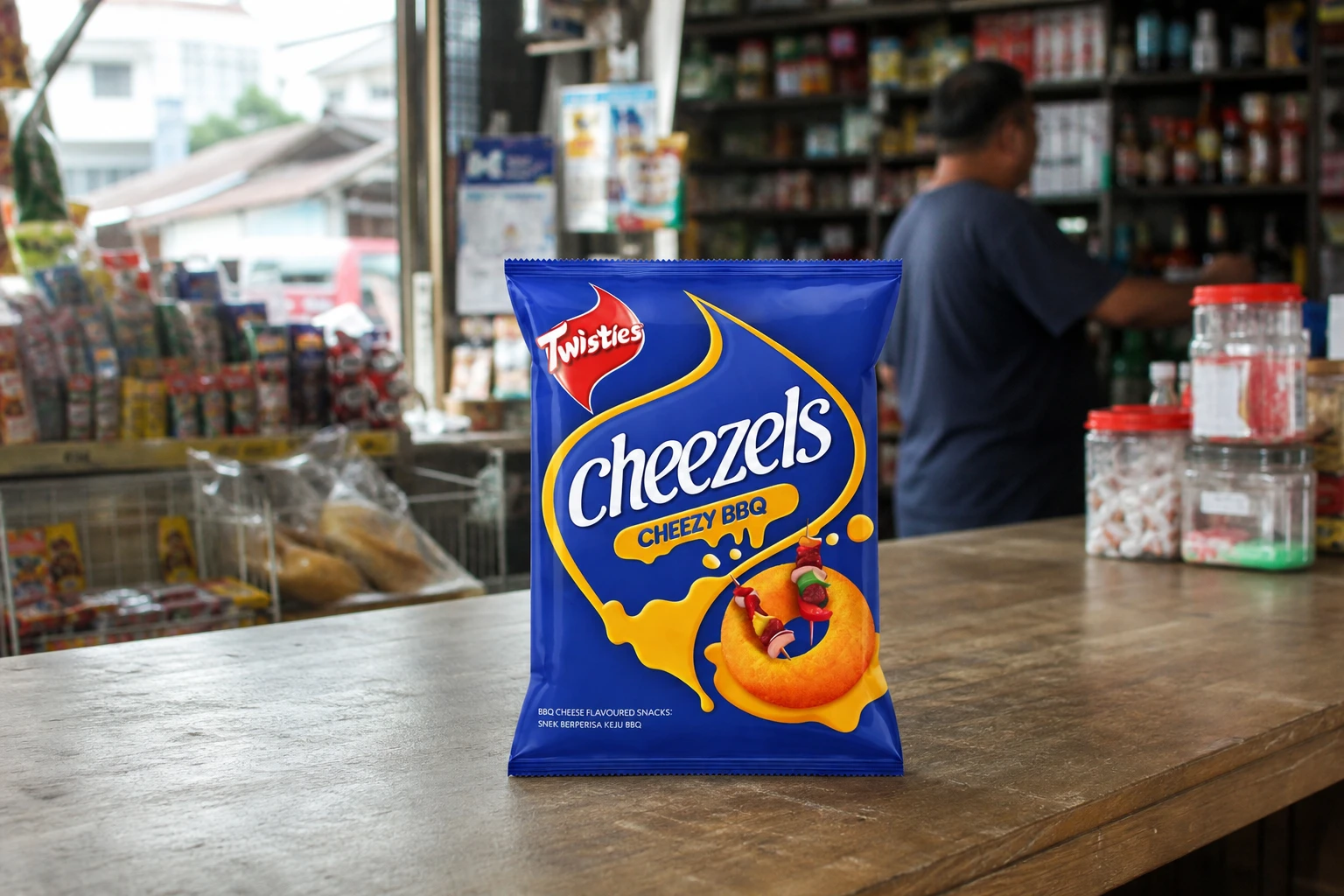
There is no published carton price for Cheezels BBQ that can be confirmed at this time. Retailers and cafes interested in stocking this snack should treat any carton price they see elsewhere as provisional until it is checked directly against a current supplier listing, such as the product enquiry catalogue at Trader Max’s shop page. This guide focuses on what you can verify yourself, and how to evaluate a wholesale offer once you have the actual figures in hand.
Cheezels BBQ: A Popular Snack for Malaysian Retail Shelves
Cheezels BBQ is a familiar name on snack shelves across Malaysia, and search interest around the term reflects that familiarity. But search traffic is mixed. Some people typing “Cheezels BBQ” into a search engine are shoppers looking for a single pack at a nearby store, while others are retail buyers, cafe operators or pasar malam traders trying to source cartons for resale. Because both groups use similar search terms, a product page or article discussing “Cheezels BBQ” may attract clicks from people who have no intention of placing a bulk order.
If you run a shop, mini-mart, canteen or snack stall and are specifically looking for carton quantities, it helps to be clear about that intent when you contact a supplier. Stating upfront that you want wholesale or carton pricing — rather than a single retail pack — will usually get you a faster, more relevant response than a general inquiry. If you are evaluating whether this product fits your assortment at all, it may also help to browse a broader snack wholesale resource first; Trader Max’s existing guide on sourcing snacks wholesale in Malaysia covers general supplier-vetting steps that apply just as well here.
It is also worth tracking, on your own end, whether enquiries generated from a “Cheezels BBQ” search actually convert into carton-sized orders or mostly result in single-pack questions. If you manage a product page or run paid traffic toward this term, a short review of enquiry volume against actual wholesale conversions can tell you whether further investment in this specific keyword is justified, rather than assuming commercial intent from search volume alone.
Understanding Carton Sizes and Packing for Cheezels BBQ
Snack brands frequently sell multiple variants under one family name — different flavours, pack sizes, or limited editions can all share a similar label design. Before requesting a quote or placing an order, confirm you are looking at the correct item by checking:
- The exact flavour name printed on the pack (BBQ versus other flavour variants in the same range)
- The net weight per individual pack, as stated on the product label
- Whether the listing refers to a single pack, a multi-pack sleeve, or a full carton
- Any batch code or product code shown on the supplier’s listing, which can help you cross-check against what arrives
Carton configurations can vary between products even within the same snack brand, so the only reliable way to confirm pack size and carton count is to check the live listing on the Trader Max’s shop page or ask directly through their contact channel. Treat any carton count mentioned elsewhere, including on forums or older listings, as a starting point for your own check rather than a confirmed figure.
Reading the Label Before You Buy in Bulk
When you are buying for resale rather than personal consumption, the product label carries more weight than it would for a single household purchase. A few label details are worth reviewing carefully before you commit to a carton order:
Net weight and pack count. Confirm whether the price you are quoted is per single pack, per inner box, or per full carton. Wholesale conversations sometimes use these terms loosely, so ask the supplier to spell out exactly what unit their quoted price covers.
Manufacturing and expiry dates. For any snack product bought in carton quantities, check the production date and expiry date printed on the packaging when the goods arrive. This is especially relevant if you are placing a larger order that will sit on shelves for some weeks before it all sells through.
Labeling requirements. If you plan to retail the product in Malaysia, check that the labeling on the cartons you receive matches what is required for retail sale in your market, including any local labeling conventions your business is expected to follow. This is a compliance question for your own business, not something this guide can confirm on the supplier’s behalf.
Storage instructions. Snack cartons typically carry storage guidance such as being kept away from direct sunlight or moisture. Note what is printed on the pack so you can plan shelf placement and back-of-store storage accordingly.
Matching the Product to Your Outlet Type
Before requesting a quote, it is worth thinking through how Cheezels BBQ would actually move through your specific outlet, since this affects how much you should order and how urgently you need to confirm supply.
A convenience store or mini-mart with steady walk-in traffic may be able to absorb a full carton within a predictable window, making it easier to justify a bulk order once pricing is confirmed. A cafe or canteen that sells snacks as a secondary item, rather than a core offering, may be better served by starting with a smaller trial quantity before committing to repeat cartons. A pasar malam or event-based trader has different turnover patterns again, often needing stock concentrated around specific dates rather than spread evenly across weeks.
None of these scenarios changes the product itself, but they do change what counts as a sensible order size for your business. A carton quantity that makes sense for a busy mini-mart could sit unsold for months in a low-traffic cafe, tying up capital and shelf space unnecessarily.
How to Compare and Request a Wholesale Quote for Cheezels BBQ
Use the following checklist to prepare before you contact a supplier about Cheezels BBQ carton pricing. Having these answers ready will make your enquiry faster to process and easier to compare against other snack lines you may already stock.
- Confirm the exact product variant. Note the flavour name and any pack size shown on the listing or packaging you are referencing.
- Clarify the unit of sale. Ask whether quoted pricing is per pack, per box, or per carton, and how many packs make up each unit.
- Check current availability. Ask the supplier directly whether the product is currently in stock before planning shelf space around it.
- Ask about minimum order quantities. Some suppliers set a minimum carton count or minimum order value for wholesale pricing to apply; confirm this before assuming a single carton qualifies.
- Request the expiry window on current stock. For snack products, knowing how much shelf life remains on the batch you would receive helps you plan sell-through realistically.
- Clarify delivery versus self-collection. Ask how the order would reach your outlet and what lead time to expect, rather than assuming standard delivery terms.
- Get the quote in writing. A written quote, even a simple email or message confirming unit price and carton count, gives you a record to check against the invoice when goods arrive.
Working through this checklist before you reach out means your conversation with a supplier can focus on confirming numbers rather than clarifying basic product details. It also gives you a documented reference point if anything about the order — quantity, pricing, or condition of goods — needs to be queried after delivery.
For buyers who want to see what is currently listed, the Trader Max’s product enquiry catalogue is the starting point to check against, with direct queries handled through their contact page.
Comparing Pack Formats: What Can and Cannot Be Assumed
Snack brands sold through wholesale channels are sometimes offered in more than one format — for example, a standard single pack, a multi-pack sleeve, or a full case carton. Some brands also run limited promotional formats alongside their standard line. This section explains how to compare formats in general terms, since specific formats for Cheezels BBQ should be confirmed with the supplier rather than assumed from this guide.
When a supplier does present more than one format option, the comparison usually comes down to three operational factors: unit cost per pack, storage footprint, and how quickly each format will sell through at your specific outlet. A larger carton format may lower the cost per individual pack, but it also means more capital tied up in a single order and more shelf or storage space committed to one product line. A smaller multi-pack format may cost more per individual unit but reduces the risk of slow-moving stock sitting in a back room.
Neither format is inherently better. The right choice depends on your outlet’s foot traffic, how many snack lines you already carry, and how much storage space you can realistically dedicate to one product while it sells through.
Operational Tradeoffs Beyond Unit Price
Buyers new to wholesale snack purchasing sometimes focus on per-unit price alone and overlook other costs that affect the real value of an order. A few tradeoffs worth considering before you compare quotes:
Cash flow versus unit savings. A larger carton order may bring down the cost per pack, but it also means more money committed upfront and held in inventory until it sells. For a smaller outlet, a slightly higher per-unit cost on a smaller order can sometimes be the more sensible cash flow decision, even if it looks less efficient on paper.
Storage conditions versus order size. If your storage space is limited or not climate-controlled to the standard suggested on the product packaging, ordering a large carton quantity increases the risk of stock sitting in suboptimal conditions for longer. Check what the pack instructions say about storage before deciding how much to order at once.
Shelf life versus turnover speed. A product with a shorter remaining shelf life at the time of delivery needs to move faster through your outlet. If you are not confident in your turnover rate, it may be worth requesting a smaller trial order first rather than committing to a full carton based on price alone.
Single supplier versus multiple quotes. Sticking with one familiar supplier can simplify ordering and invoicing, but comparing at least one alternative quote — where practical — helps you confirm whether the pricing and terms you are offered are reasonable for the quantity you need.
A Quotation Comparison Worksheet
When you receive a wholesale quote for Cheezels BBQ, or any comparable snack line, it helps to record the same details each time so you can compare offers consistently. Consider setting up a simple worksheet with these columns:
- Supplier name and date of quote
- Exact product variant and pack size quoted
- Unit of sale (per pack, per box, per carton) and how many packs per unit
- Quoted price per unit
- Minimum order quantity, if stated
- Delivery or self-collection terms, if stated
- Expiry window on the batch being offered, if disclosed
- Any other conditions mentioned (payment terms, return policy, etc.)
Filling in this worksheet for each quote you receive — rather than relying on memory or a verbal estimate — makes it far easier to compare two or more offers side by side, and gives you a record to refer back to if the goods that arrive do not match what was discussed.
Worked Example With Hypothetical Numbers
The following example uses entirely invented numbers to illustrate how a comparison worksheet functions. These figures are not real prices, pack sizes or supplier terms for Cheezels BBQ, and should not be treated as a reference point for actual purchasing decisions.
Hypothetical scenario: Suppose Supplier A quotes RM48 per carton of 24 packs, while Supplier B quotes RM90 for two cartons of 24 packs each (48 packs total). Dividing each quote by its total pack count gives a cost per pack: RM48 ÷ 24 = RM2.00 per pack from Supplier A, and RM90 ÷ 48 = RM1.875 per pack from Supplier B. On a pure per-pack basis, Supplier B’s quote works out slightly cheaper, but Supplier B’s order also requires committing to double the total quantity upfront. Whether that tradeoff makes sense depends on how confident you are that 48 packs will sell through before any relevant expiry date, not just on which number is lower.
This worked example is illustrative only. Real quotes should always be checked directly against current supplier figures before any order is placed.
Pairing Cheezels BBQ with Other Snacks for a Balanced Retail Assortment
Beyond sourcing the product itself, many retailers ask how a snack like Cheezels BBQ fits alongside what is already on their shelves. This is a general merchandising consideration rather than a confirmed bundle or supplier recommendation, but it is a useful planning exercise regardless of which specific snacks you stock.
A savoury, cheese-style snack such as this typically sits in the same shelf section as other corn- or wheat-based crisps and curls. When planning an assortment, retailers often think in terms of flavour variety (savoury versus spicy versus sweet options side by side), price-point variety (an entry-level option next to a mid-range or premium one), and format variety (small grab-and-go packs next to larger sharing-size packs, where both exist). Grouping products this way can help shoppers find what they want quickly and can encourage a slightly larger basket if complementary items are placed near each other.
If you already stock a range of savoury snacks, consider whether Cheezels BBQ would occupy a genuinely different spot in your lineup or whether it would largely compete with an item you already sell well. Adding a near-duplicate of an existing bestseller rarely grows total snack sales; it more often splits the same demand across two SKUs. A genuinely complementary addition — a different flavour profile, a different pack size, or a different price point — is more likely to expand your overall snack category sales rather than cannibalise them.
For retailers building out a wider snack section from scratch, it may help to review Trader Max’s general snack wholesale sourcing guide for Malaysian retailers, which covers broader supplier-vetting and assortment-planning steps beyond this single product.
Three Hypothetical Purchasing Scenarios
The following scenarios are illustrative examples only, built to show how the same checklist and worksheet might be applied differently depending on outlet type. They do not reflect actual orders, confirmed pricing or real supplier terms.
Scenario 1: The neighbourhood mini-mart. A mini-mart owner with consistent daily footfall is considering adding Cheezels BBQ alongside existing snack lines. Because the store already has steady snack turnover, the owner requests a full carton quote and compares it against the worksheet columns above, paying particular attention to the expiry window and minimum order quantity before committing.
Scenario 2: The campus cafe testing a new line. A cafe operator near a college campus wants to try Cheezels BBQ as a new snack option but is unsure how it will sell compared to items already on the counter. Rather than ordering a full carton upfront, the operator asks the supplier whether a smaller trial quantity is possible, and plans to request a larger order only after observing a few weeks of actual sales.
Scenario 3: The pasar malam trader stocking for an event. A night market trader planning for a weekend event wants enough stock to cover expected footfall over two or three days, rather than ongoing weekly turnover. This trader prioritises confirming delivery or collection timing against the event date over negotiating the lowest possible per-unit price, since running out of stock mid-event carries its own cost.
In each case, the checklist from the earlier section and the worksheet above remain the same tools — only the quantities, urgency and risk tolerance differ based on how the outlet actually sells snack products.
Questions to Ask Before Placing a Bulk Order
Running a Stock Trial Before You Commit to Full Cartons
If you decide to start with a smaller trial quantity rather than a full carton, measure the trial properly rather than relying on a general impression of how it sold. Record the date you put the product on the shelf, the quantity you started with, and the date you sold out or decided to reorder. This gives you an actual sell-through rate you can compare against other snack lines you already stock, rather than a guess.
It also helps to note where in the store the product was placed during the trial. A snack positioned near the counter or checkout will usually perform differently from the same snack placed on a lower shelf further from foot traffic. If a trial order moves slowly, consider whether placement affected the result before concluding that the product itself is a poor fit for your outlet.
A short trial period is only useful if you track it consistently. Even a simple notebook entry or spreadsheet row — date stocked, quantity, date reordered or date remaining stock was marked down — is enough to make a second ordering decision based on evidence rather than impression.
Keeping Receiving Records When Stock Arrives
Whether you order a trial quantity or a full carton, check the delivery against your quote at the point of receiving, not later. Confirm the quantity received matches what was invoiced, and check the production and expiry dates printed on the cartons against what was discussed when you placed the order, if that information was provided.
Keeping a simple receiving record protects you if a discrepancy comes up later. Note the delivery date, the quantity received, the batch or production code if visible, and any visible condition issues such as damaged outer cartons. This record is separate from your quotation worksheet, but the two should be kept together so you have a full paper trail from quote to delivery for each order.
If you operate more than one outlet or have more than one staff member handling deliveries, a consistent receiving record format matters more, not less. Relying on memory or verbal confirmation between staff increases the chance that a discrepancy goes unnoticed until stock is already on the shelf.
Storage Questions Governed by the Pack Itself
Storage guidance for any snack carton should come from what is printed on the packaging rather than general assumptions about how snack products are usually stored. Before you commit shelf or back-of-store space to a new carton order, check the pack for any instructions on temperature, humidity or light exposure, and compare this against the storage space you actually have available.
If your storage area is shared with other products, or subject to temperature fluctuation such as proximity to a doorway or direct sunlight through a window, factor this into how much stock you order at once. A smaller, more frequent reorder pattern may suit a storage-constrained outlet better than a single large carton sitting in suboptimal conditions for an extended period.
Reordering and Staff Handover
Once you have a sell-through pattern established, reordering becomes a matter of comparing your current stock level against your average turnover rate, rather than restarting the full decision checklist each time. Keep your original quotation worksheet and receiving records on file so that any staff member placing a reorder has the same reference points you used initially — exact product variant, unit of sale, prior pricing, and supplier contact details.
If stock ordering is handled by more than one person, or if responsibility changes over time, a short handover note prevents repeated basic questions to the supplier. This note should cover the confirmed product variant, the usual order quantity, the supplier contact used previously, and where the receiving records are kept. This is a matter of your own internal record-keeping and does not depend on any supplier-confirmed information.
Scope Note
This guide does not state carton pricing, pack counts, current stock availability, minimum order quantities or delivery timelines as fact, since these details vary by listing and over time. Every figure used in the worked example and the three scenarios above is explicitly hypothetical and included only to illustrate how to compare quotes. Confirm the current product listing, pricing and terms directly with the supplier before placing any order.
Frequently Asked Questions
Is Cheezels BBQ sold only by the carton, or can I order smaller quantities?
Ask the supplier directly whether single packs, smaller multi-packs or trial quantities are available alongside full carton orders, as this depends on the current listing.
How do I know if a quoted price is per pack or per carton?
Ask the supplier to confirm the unit of sale explicitly, and record it on your quotation worksheet so there is no ambiguity when the invoice arrives.
What should I check first when stock is delivered?
Count the quantity received against the invoice, and check the production and expiry dates on the cartons against anything discussed at the time of quoting. Log this in a receiving record before the stock goes onto the shelf.
Can I assume Cheezels BBQ has the same carton size as other Cheezels flavours?
Not necessarily. Carton configurations can differ between variants within the same snack range. Confirm the specific pack size and carton count for the BBQ flavour directly rather than assuming consistency across the line.
Should I order a full carton on my first purchase?
Not necessarily. If you are unsure how the product will perform at your outlet, a smaller trial quantity, where available, lets you measure actual sell-through before committing capital and shelf space to a full carton.
To check current listings or request a wholesale quote for Cheezels BBQ, start with the Trader Max’s product enquiry catalogue and direct any specific questions through their contact page. Confirming product variant, carton size, pricing and availability directly with them before ordering will give you the accurate figures this guide cannot provide.

Leave A Comment