
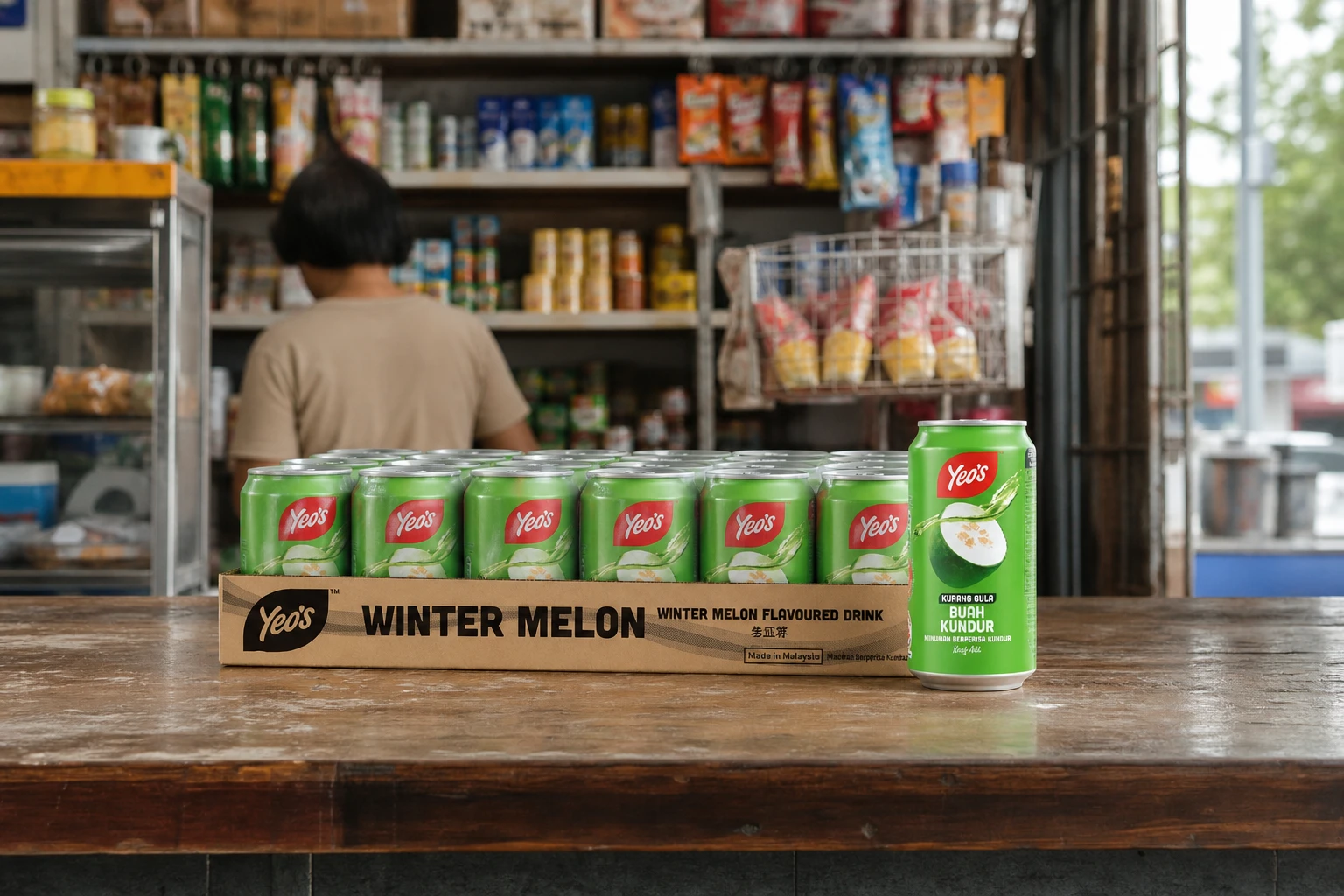
Yeo’s wholesale Malaysia sourcing works best through a direct enquiry process rather than a published price list: specific pack sizes, carton quantities, and current stock availability are not published facts, so retailers, canteens and caterers in Klang Valley who want Yeo’s canned drinks in bulk need to submit a product enquiry and get confirmation in writing before planning purchase volumes. This guide explains how to prepare that enquiry properly, what information to check on any product you are offered, and how to build a decision checklist so your buying team is not relying on assumptions.
What We Can Confirm About Sourcing Yeo’s in Bulk
At present, there is no independently verified pricing, carton specification, or stock-availability data for Yeo’s canned drinks that can be stated as fact in this guide. What is confirmed is the sourcing channel: Trader Max’s operates a product enquiry catalogue at tradermaxs.com.my/shop/, where buyers can look up listed items and submit enquiries, and a separate contact page at tradermaxs.com.my/were-here/ for direct communication with the supplier team. Any claim about specific SKUs, case counts, unit pricing, promotional discounts, or delivery timelines for Yeo’s products should be treated as unverified until a buyer receives it directly from the supplier in response to a formal enquiry.
This distinction matters for B2B purchasing because wholesale decisions are usually made against a quotation or supplier confirmation, not against marketing copy. Before you commit shelf space, storage capacity, or a purchase order to Yeo’s canned drinks, your first actionable step is to raise a product enquiry through the catalogue page and follow up through the contact page if the listing does not give you enough detail to compare offers.
Yeo’s Product Range: What to Ask About
This guide does not list specific Yeo’s variants, flavours, or pack configurations as confirmed facts, since none have been independently verified for publication here. Rather than guessing which products a buyer might find in the catalogue, treat your first enquiry as a discovery step: ask the supplier what is currently listed under the Yeo’s range, and request written confirmation of the variant names, pack formats, and any minimum order quantities attached to each.
One point worth clarifying early, because it often causes confusion in FMCG sourcing generally: the brand’s origin is separate from where a specific carton was packed or filled. A brand can be long-established in one country while a particular batch or carton you receive is manufactured or packed at a different facility, possibly in another country, depending on the supplier’s sourcing arrangement at the time. This is not a claim about Yeo’s specifically — it is a general principle of packaged goods distribution. The only way to know the manufacturing origin of the exact carton you are buying is to check the country-of-origin text printed on the can or carton itself, and to ask your supplier to confirm this in writing if it matters to your business, for example if a downstream customer asks you about it.
Matching Yeo’s Canned Drinks to Your Outlet Type
Different buyers have different reasons for stocking Yeo’s in bulk, and the intended use of the product should shape how you structure your enquiry.
Retail Outlets (Convenience Stores, Mini-Markets, Grocery Shops)
If you are restocking shelf-ready inventory, you will likely want to know how products are packed for retail display — for example, whether cartons are designed for direct shelf placement or require repacking into smaller units. Since no specific carton configuration has been verified here, ask the supplier directly whether the pack format suits your shelving and point-of-sale setup before placing an order.
Canteens and Institutional Caterers
Canteens and school or factory caterers typically buy for high-volume, repeat consumption rather than retail display, so the buying priority shifts toward consistent reorder quantities and predictable receiving schedules rather than shelf presentation. If this describes your outlet, your enquiry should focus on whether the supplier can support a recurring order pattern, and what information they can confirm about minimum order quantities for that pattern.
Event Caterers and Function Suppliers
Caterers buying for events or functions often need a single bulk delivery rather than a recurring supply arrangement. For this use case, confirm turnaround time for a one-off enquiry response and whether the supplier can accommodate a single large order, since no delivery promises are published and this needs to be clarified case by case.
Product Identification Before You Order
Because specific Yeo’s SKUs are not listed as verified facts in this guide, buyers must rely on direct product identification steps when an offer or quotation is received, rather than assuming consistency across different enquiries or suppliers. Treat the following as a basic identification routine:
- Confirm the exact product name and variant as written on the supplier’s quotation or catalogue listing, and match it against the physical label when goods are received.
- Record the pack format described in the quotation — for example, how many units are said to be in a carton — and verify this matches what is delivered, since this detail has not been independently confirmed here and should not be assumed from past experience with other brands.
- Check the printed label details against what the supplier stated in writing so any discrepancy is identified at the point of receiving rather than after stock has been shelved or served.
- Keep a copy of the product listing or enquiry response you received from the catalogue or contact page, so you have a reference point if the delivered product differs from what was described.
Reading the Label Correctly
Every can or carton of Yeo’s product will carry its own manufacturer label, and this label — not marketing material, not a prior order, and not this guide — is the only reliable source for product-specific details at the point of receiving. Buyers should treat label-reading as a standard receiving step rather than an optional check:
- Note the product name and variant exactly as printed, and compare it to what was ordered.
- Note any date markings printed on the can or carton, and record them in your own receiving log so you can track stock rotation internally.
- Note the net content or volume printed per unit, and cross-check this against the unit count and total volume stated in your purchase order or quotation.
- Photograph the label and carton markings at the point of receiving if you plan to raise any query with the supplier later — this creates a record independent of memory or assumption.
Only the information printed on the product label and confirmed in writing by the supplier should be treated as accurate for your own stock records.
Decision Checklist for Bulk Buyers
Before submitting a purchase order for Yeo’s canned drinks in bulk, work through the following checklist. This is designed to help you avoid committing budget or storage space based on assumptions rather than confirmed information.
- Have you identified your outlet’s actual consumption pattern? Retail resale, canteen service, and one-off event catering each call for different order sizes and reorder frequency. Define this before requesting a quotation so the supplier can respond with relevant options.
- Have you submitted a specific enquiry through the catalogue page? General browsing will not give you pricing or stock confirmation — a direct enquiry through tradermaxs.com.my/shop/ is the step that produces an actual quotation.
- Have you followed up through the contact page if the listing was unclear? Use tradermaxs.com.my/were-here/ when you need carton specifications, minimum order quantities, or delivery timing clarified in writing.
- Have you recorded what the supplier confirmed, in writing, for comparison later? Keep the quotation or email response so you can check it against what is actually delivered.
- Have you planned a label check at receiving? Decide in advance who on your team is responsible for checking product name, pack count, and date markings against the order when stock arrives.
- Have you avoided assuming price or stock availability from past orders or other brands? Each enquiry should be treated as a fresh request, since no current pricing or stock information is published for Yeo’s canned drinks.
Working through this checklist before contacting the supplier will make your enquiry more precise, and it will make any quotation you receive easier to evaluate against your actual outlet needs rather than against general assumptions about canned drink wholesale in Malaysia.
Comparing Pack Formats: What You Can and Cannot Assume
Canned drinks in Malaysia are commonly sold through a few generic wholesale formats — single cans, shrink-wrapped multi-can bundles, and full cartons — but none of these formats has been confirmed as the actual packaging Trader Max’s offers for Yeo’s canned drinks. Rather than guessing which format applies, treat pack format as a question to put to the supplier directly, and use the generic categories below only as a framework for asking better questions, not as a statement of what is available.
Single Cans or Loose Units
Some retail buyers prefer to receive loose cans for flexible shelf restocking, particularly where shelf space is limited or turnover is slow for a given variant. The operational tradeoff is that loose units usually cost more per can than carton purchases, and handling loose stock takes more staff time at receiving and shelving. If your outlet has low daily turnover of canned drinks, ask the supplier whether loose-unit ordering is even offered, since bulk suppliers often structure pricing around carton quantities rather than single cans.
Shrink-Wrapped Multi-Can Bundles
A multi-can bundle — for example, six or twelve cans wrapped together — is a common generic retail format across many beverage brands, but whether Yeo’s canned drinks are supplied this way by Trader Max’s has not been confirmed. This format can suit mini-markets that want faster shelf restocking than single cans but do not have storage space for full cartons. The tradeoff is that bundle pricing, where it exists, is still carton-derived, so buyers should ask whether a bundle price is simply a fraction of the carton price or whether it carries a separate margin.
Full Cartons
Full cartons are the typical unit for wholesale beverage purchasing industry-wide, and they generally offer the lowest per-unit cost in exchange for higher upfront spend and more storage space required. For canteens and caterers with consistent, high-volume consumption, full cartons are usually the more practical format because they reduce handling frequency and are easier to track in a receiving log. However, since no specific carton size has been verified for Yeo’s canned drinks in this guide, do not plan storage racking or shelf-life rotation around an assumed carton count — confirm it in writing first.
Operational Tradeoffs to Weigh Before You Order
Choosing a pack format is not just about unit cost. Consider these operational factors alongside any quotation you receive:
- Storage space versus order frequency. Larger cartons reduce how often you need to reorder, but they require more immediate storage capacity. If your stockroom is small, a smaller, more frequent order may suit you better even if the per-unit price is slightly higher.
- Staff handling time. Loose cans and multi-can bundles take longer to count, shelve, and reconcile against a delivery note than full cartons. Factor this labour cost into your comparison, even though it will not appear on a supplier’s quotation.
- Capital tied up in stock. A larger bulk order reduces reorder frequency but ties up more cash in inventory sitting on your shelves or in your storeroom. Weigh this against your outlet’s actual sales velocity for canned drinks rather than ordering the largest format simply because it looks cost-efficient on paper.
- Risk of mismatched expectations. Ordering a format you have not confirmed in writing increases the risk of a delivery that does not match your shelving plan or storage layout. This is avoidable simply by confirming pack format before the order is placed, not after.
Building a Quotation Comparison Worksheet
When you approach Trader Max’s or any other supplier for Yeo’s canned drinks, it helps to compare quotations side by side using a simple worksheet rather than relying on memory or informal notes. Structure your worksheet with these columns:
- Product name and variant exactly as quoted
- Pack format offered (loose can, bundle, or carton, as confirmed by the supplier)
- Unit count per pack format, as confirmed by the supplier
- Quoted price per pack format, as confirmed by the supplier
- Minimum order quantity, if any, as confirmed by the supplier
- Any delivery or collection terms, as confirmed by the supplier
- Date the quotation was received, and from which channel (shop enquiry or contact page)
This worksheet format lets you compare multiple quotations fairly, and it also gives you a paper trail if a delivered order does not match what was quoted. Because no pricing has been verified in this guide, every cell in this worksheet should be filled in only after you receive an actual response from the supplier — do not pre-fill assumed figures.
Hypothetical Purchasing Scenarios (Illustrative Only)
The following scenarios are entirely hypothetical and are included only to illustrate how a buyer might use the worksheet above. Every amount and calculated figure below is explicitly labelled hypothetical — none of the quantities, prices, or carton sizes are real, verified, or confirmed by Trader Max’s or any supplier. They exist solely to demonstrate the comparison process and the arithmetic a buyer might run.
Hypothetical Scenario 1: Mini-Market Restocking
| Item | Hypothetical value |
|---|---|
| Quotation A — cans per carton (hypothetical) | 24 cans |
| Quotation A — price per carton (hypothetical) | RM 28.00 (hypothetical) |
| Quotation A — price per can (hypothetical, calculated) | RM 28.00 ÷ 24 = RM 1.17 (hypothetical) |
| Quotation B — cans per bundle (hypothetical) | 12 cans |
| Quotation B — price per bundle (hypothetical) | RM 15.00 (hypothetical) |
| Quotation B — price per can (hypothetical, calculated) | RM 15.00 ÷ 12 = RM 1.25 (hypothetical) |
In this invented example, the carton format is nominally cheaper per unit, but the bundle format needs less storage space and may suit a small shop better. This is a reasoning example only — actual figures must come from a real quotation.
Hypothetical Scenario 2: Canteen Recurring Order
| Item | Hypothetical value |
|---|---|
| Standard price per carton (hypothetical) | RM 30.00 (hypothetical) |
| Cartons needed per month (hypothetical) | 20 cartons |
| Monthly spend at standard price (hypothetical, calculated) | 20 × RM 30.00 = RM 600.00 (hypothetical) |
| Discounted price per carton at 20-carton minimum (hypothetical) | RM 27.00 (hypothetical) |
| Monthly spend at discounted price (hypothetical, calculated) | 20 × RM 27.00 = RM 540.00 (hypothetical) |
| Hypothetical monthly saving (calculated) | RM 600.00 − RM 540.00 = RM 60.00 (hypothetical) |
These numbers are fabricated purely to show how a canteen buyer might calculate monthly cost — they are not real Trader Max’s figures.
Hypothetical Scenario 3: One-Off Event Catering Order
| Item | Hypothetical value |
|---|---|
| Expected guests (hypothetical) | 300 guests |
| Assumed consumption rate (hypothetical) | 1.5 cans per guest |
| Total cans needed (hypothetical, calculated) | 300 × 1.5 = 450 cans (hypothetical) |
| Cans per carton (hypothetical) | 24 cans |
| Cartons needed, rounded up (hypothetical, calculated) | 450 ÷ 24 = 18.75, rounded up to 19 cartons (hypothetical) |
| Total cans covered by 19 cartons (hypothetical, calculated) | 19 × 24 = 456 cans (hypothetical) |
Ordering 18 cartons (432 cans, hypothetical) would fall short of the illustrative 450-can requirement, so rounding up to 19 cartons is shown here only to illustrate how a caterer might size a one-off order. Actual carton counts and availability must be confirmed with the supplier before ordering.
In all three scenarios, the actionable step is the same: use the worksheet to record what a real quotation states, and only commit a purchase order once pack format, unit count, and price have been confirmed in writing by the supplier through the catalogue or contact page.
Running a Small Stock Trial Before Committing to Volume
Before placing a full bulk order of Yeo’s canned drinks, many buyers find it practical to run a small trial order first, particularly if this is a new product line for your outlet. A trial order lets you measure actual sell-through or consumption rate against your estimated demand, rather than ordering a large volume based on assumptions about how fast the stock will move.
To measure a trial properly, record the date stock was received, the quantity received, and then track how much is sold or used each week. For a retail outlet, this means checking shelf stock against your point-of-sale records. For a canteen or caterer, this means checking how much was served or used against how much was drawn from the storeroom. This record gives you a factual basis for your next order size, rather than a guess carried over from a different brand or product category.
A trial period also gives you a chance to test the supplier relationship itself — how clearly they respond to your enquiry, how accurately the delivered stock matches the quotation, and how they handle any discrepancy you raise. These observations are more useful for planning a recurring order than a general assumption about supplier reliability, since they come from your own direct experience rather than secondhand impressions.
Keeping a Receiving Record
A simple receiving record protects your outlet from disputes and helps with internal stock planning, regardless of how large or small your Yeo’s order is. At minimum, your receiving record should capture:
- The date and time stock was received
- The quantity received, counted against the delivery note or invoice
- The product name and variant, matched against the label on the can or carton
- Any date markings printed on the packaging, noted at receiving so you can plan stock rotation
- The name of the staff member who checked and signed off the delivery
- Any discrepancy between what was ordered and what was delivered, noted immediately rather than after stock has been shelved
This record does not need to be complicated — a simple logbook or spreadsheet is sufficient for most small and mid-sized outlets. What matters is consistency: every delivery should be checked and logged the same way, so that if a query ever needs to be raised with the supplier, you have a clear, dated record to refer back to rather than relying on memory.
Storage and Reordering Practice
Storage conditions for any canned beverage should follow the instructions printed on the can or carton itself, since this is the only reliable source of storage guidance for a specific product. When stock arrives, check the carton and can for any printed storage instructions and follow them exactly, and build your storeroom layout around that instruction rather than general assumptions carried over from other beverage brands. If no storage instruction is printed or legible, raise this directly with the supplier through the contact page so you receive written guidance rather than relying on guesswork. It also helps to agree internally that older date-marked stock is moved to the front of the storeroom or chiller, with newer stock placed behind it — a basic first-in-first-out habit that applies across most packaged beverages.
Once your trial period and first few receiving cycles are complete, you should have enough of your own data to set a sensible reorder point — the stock level at which you place your next order, based on actual consumption rather than estimation. Review this reorder point periodically, particularly if your outlet’s sales pattern shifts seasonally or due to local demand changes. Staff handover matters here too: when responsibility for ordering or receiving Yeo’s canned drinks changes hands, make sure the incoming staff member has access to the most recent supplier quotation on file, the receiving record log with any past discrepancies noted, the agreed reorder point and typical order quantity, and the contact details used for prior enquiries. A short handover checklist like this reduces the risk of reordering from an outdated quotation or missing a storage instruction a previous staff member had already clarified with the supplier.
Scope Note
This guide does not state or confirm specific Yeo’s product prices, carton sizes, stock availability, delivery timelines, or certifications, because none of these details have been independently verified. All figures and formats discussed in earlier sections for comparison purposes were clearly labelled as hypothetical. Buyers should treat every commercial detail — pricing, pack format, minimum order quantity, and delivery terms — as unconfirmed until received in writing from the supplier.
Frequently Asked Questions
Where do I start a Yeo’s wholesale enquiry in Malaysia?
Begin at the product enquiry catalogue at tradermaxs.com.my/shop/, where you can look up listed items and submit a request for a quotation.
What if the catalogue listing does not give enough detail?
Use the contact page at tradermaxs.com.my/were-here/ to ask directly for pack format, minimum order quantity, or delivery terms in writing.
Can I assume Yeo’s pricing is similar to other canned drink brands?
No. Pricing has not been verified for this guide, and should not be assumed from other brands or past orders. Always confirm current pricing directly with the supplier.
Is the carton I receive necessarily made in the same place the brand originates from?
Not necessarily — check the country-of-origin text printed on the actual can or carton you receive, and ask the supplier to confirm it in writing if this matters for your business.
How do I know if a delivered carton matches what I ordered?
Check the product name, variant, and unit count printed on the carton and can against your quotation and purchase order, and log this at the point of receiving.
Should I order a trial quantity first?
A small trial order is a practical way to measure actual demand before committing to a larger recurring order, particularly for a new product line.
Next Step
If you are ready to request a quotation for Yeo’s canned drinks in bulk, visit the product enquiry catalogue at tradermaxs.com.my/shop/ or reach the supplier team directly through tradermaxs.com.my/were-here/ to confirm pack format, pricing, and order terms in writing before you plan your purchase.

Leave A Comment