
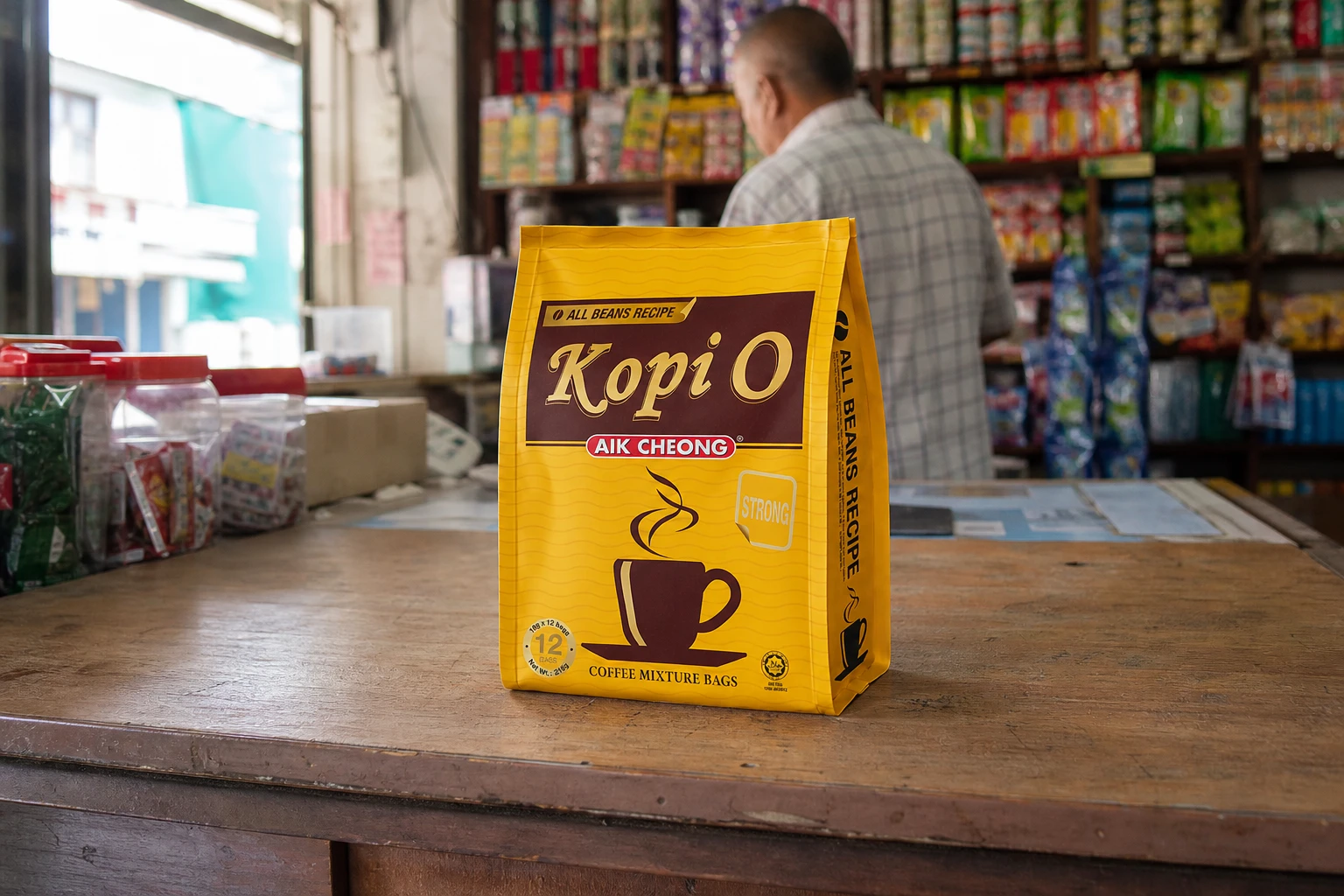
Aik Cheong kopi o is a packaged coffee product that cafes and canteens in Malaysia typically source through wholesale enquiry rather than retail purchase. To answer the question buyers usually ask first: no current pricing, carton size, minimum order quantity or stock availability is confirmed in this article, because these details are not independently verified here and must be confirmed directly with the supplier before you place an order. What this guide does provide is a practical checklist for identifying the correct product, reading the label accurately, comparing quotations once you receive them, and running a short trial before committing to a standing order — so that your enquiry is precise and leads to a useful, comparable quotation.
Why Product Identification Matters Before You Enquire
Coffee mix products sold under a single brand name often come in multiple formats aimed at different outlet types. A brand may offer a stronger or more concentrated version alongside a standard version, and these can be packed differently — for example, individually wrapped sachets versus a bagged loose mix. Without confirming the exact product name, pack format and unit count, a cafe or canteen buyer risks requesting a quotation for the wrong item, which wastes time for both the buyer and the supplier.
Before contacting a supplier, write down the full product name as it appears on the supplier’s catalogue page, rather than relying on a shortened or generic name used in conversation. If you found the product through a catalogue listing, note the exact title, any format descriptor (such as “strong” or “bag”), and the listed pack configuration shown on that page. This becomes your reference point when you request a formal quotation, and it reduces the chance of a mismatched order arriving at your outlet.
Matching the Product to Your Outlet Type
Cafes and canteens do not always have the same operational needs, even when both are buying the same general category of product. A canteen serving high volumes over a lunch period may prioritise a format that is quick to prepare in bulk, while a cafe focused on individual servings may prefer a format that allows consistent single-cup preparation with less staff handling per cup. Before you approach a supplier, it is worth clarifying internally:
- How many servings per day or per peak period does your outlet typically need to prepare?
- Does your preparation workflow rely on pre-portioned sachets, or can staff measure from a bulk bag?
- How much storage space is available for cartons at your outlet, and how often can you realistically reorder?
- Who on your team is responsible for preparation, and do they need a format that reduces measuring steps?
These questions do not require supplier input to answer — they are internal planning questions. Once answered, they help you describe your outlet’s needs clearly when you do reach out for a quotation, which in turn helps the supplier recommend or confirm a suitable pack format from what they currently carry.
Reading the Product Label and Catalogue Listing
When you locate a product listing, such as through a supplier’s catalogue page, the listing title itself often carries useful structural information: a format descriptor, a carton or pack count, and a per-unit weight. Buyers should treat this listed information as a starting point for verification rather than a final confirmation, since catalogue listings can change and should be checked again close to the time of your actual enquiry. Specifically, when reviewing a catalogue listing, check for:
- Exact product name — does it match the name you intend to order, including any format descriptor?
- Pack structure — how many units are described per carton, and what is the stated weight or count per individual unit, as shown on the listing?
- Listing freshness — when was the catalogue page last checked or updated, and is it reasonable to assume the listed structure is still current?
- Absence of claims — note what is not stated on the listing, such as pricing, stock availability, certification or delivery terms, so you know what you still need to ask the supplier directly.
Because pricing, current stock levels, discounts, delivery timelines and certifications are not published or verified in general catalogue browsing, these items should always be confirmed by direct enquiry rather than assumed from a listing title or past order.
Building a Decision Checklist for Your Enquiry
A structured checklist helps your purchasing team move from “browsing a catalogue” to “requesting a specific, comparable quotation.” Before you contact a supplier, prepare answers to the following:
- Exact product and format name — write the full name as listed, including any format descriptor, so there is no ambiguity in your enquiry message.
- Intended use case — note whether the product will be prepared for individual table service, self-service stations, or bulk canteen service, since this affects which format may suit your workflow.
- Estimated order volume — even a rough estimate of cartons per month helps the supplier respond with a relevant quotation structure.
- Delivery and storage constraints — note your outlet’s receiving hours, storage space and whether you need staged deliveries, so you can ask the supplier whether these are accommodated.
- Confirmation items to request — current price per carton, current stock availability, minimum order quantity if any, and any documentation you require for your own records.
This checklist does not replace direct communication with the supplier — it exists to make that communication efficient. A buyer who arrives at an enquiry with the exact product name, a clear use case and a volume estimate is more likely to receive a fast, accurate quotation than one who asks a general question about “coffee mix” without specifics.
Comparing Formats: What Can and Cannot Be Assumed
Buyers researching Aik Cheong kopi o will often come across more than one catalogue listing under the same brand, distinguished by a format descriptor such as “strong” or by a packaging style such as “bag” versus individually wrapped sachets. These naming differences are worth taking seriously, because they usually signal a genuine difference in how the product is portioned or prepared, not just a marketing variation. However, beyond the name itself, this guide does not independently verify strength, ingredient composition or any other product property — those details belong on the supplier’s label or product documentation, and should be read there directly rather than inferred from a listing title.
One distinction worth being precise about is brand origin versus carton manufacturing origin. The brand name on a pack reflects where that brand originates and is marketed, which is not necessarily the same as the country where a specific carton was manufactured or packed. If this detail matters for your procurement records, check the printed label on the actual carton you receive rather than assuming it from the brand name alone.
What can be reasonably compared at the planning stage is format structure: whether a listing describes individually counted units within a carton, or a bagged format intended for scoop-based preparation. This distinction matters operationally even before price enters the conversation, because it affects staff workflow, preparation time per serving, and how you track consumption against stock on hand.
Sachet-Style Formats
A sachet-style or individually packed format typically suits outlets where consistency per cup matters and where staff turnover or training time is limited, since each unit is pre-measured and reduces room for preparation error. This can be useful for a canteen with multiple part-time staff rotating through a beverage counter, or a cafe that wants every cup to follow the same preparation steps regardless of who is on shift.
Bagged or Bulk-Style Formats
A bagged format, where staff measure servings from a larger quantity, can offer more flexibility in portion size and may suit an outlet that wants to adjust strength or volume per cup based on customer preference or cup size. The tradeoff is that it typically requires a consistent measuring tool and a trained process to avoid variation between servings, which matters more in a canteen serving large numbers of customers quickly.
Neither format is inherently better — the right choice depends on your outlet’s staffing, training capacity and the degree of consistency you need per serving. This is a judgment call for your own operation, not a claim about the product’s quality or suitability.
A Quotation Comparison Worksheet
Once you have identified the exact product names and formats you intend to enquire about, the next step is comparing supplier responses on a like-for-like basis. A simple worksheet, prepared before you contact the supplier, helps avoid comparing numbers that are not actually equivalent. Useful columns to prepare include:
- Exact product name and format, as confirmed by the supplier in their reply
- Carton structure confirmed by the supplier (units per carton, and weight or count per unit)
- Quoted price per carton, as stated in the supplier’s quotation
- Calculated price per individual unit or per serving, derived from the above
- Minimum order quantity, if the supplier states one
- Any delivery or collection terms the supplier confirms in writing
- Date the quotation was given, since prices and availability can change
Calculating a price-per-serving figure is particularly useful when comparing two different formats, since a carton of sachets and a carton of bagged mix may not contain directly comparable serving counts. Only once you have confirmed unit counts from the supplier should you attempt this calculation — do not estimate serving counts from assumption.
Hypothetical Worked Example (Illustrative Only — Not Real Figures)
To illustrate how a comparison worksheet functions, consider a fully hypothetical scenario with invented numbers used only to demonstrate the calculation method. These figures are not real prices, pack sizes or supplier terms, and must not be treated as representative of Aik Cheong kopi o or any actual product.
| Item | Hypothetical Scenario A | Hypothetical Scenario B |
|---|---|---|
| Hypothetical quoted carton price | Hypothetical RM120.00 | Hypothetical RM100.00 |
| Hypothetical units per carton (as stated by supplier) | Hypothetical 288 units | Hypothetical 480 servings |
| Hypothetical calculated price per unit | Hypothetical RM120.00 ÷ 288 = RM0.4167 (≈42 sen) | Hypothetical RM100.00 ÷ 480 = RM0.2083 (≈21 sen) |
In this invented example, Hypothetical Scenario B shows a lower calculated price per serving, but a buyer would still need to weigh that against preparation time, consistency per cup, and whichever format better matches their outlet’s staffing — the lower per-serving figure does not automatically make it the better operational choice. This worked example exists only to demonstrate how to structure a comparison once real quotations are in hand. Your actual worksheet should be built entirely from numbers the supplier confirms in writing, not from estimates or examples like the one above.
Distinct Purchasing Scenarios for Planning Purposes
Different outlet types will reasonably approach their enquiry differently, even before any real quotation is received. The following hypothetical scenarios are provided to help you think through your own situation — they are illustrative only and do not reflect confirmed supplier terms, pricing or stock.
Hypothetical Scenario 1 — Small Cafe Trial Order: A small cafe owner unsure of customer demand might request a quotation for a single carton of each format under consideration, intending to run a short trial before committing to a larger standing order. Their enquiry would specify the exact product name, a small estimated volume, and a question about whether a trial-sized order is possible at all, since this guide does not assume any minimum order policy.
Hypothetical Scenario 2 — Canteen Standing Order: A canteen operator serving a predictable daily volume might instead ask about a recurring monthly order, requesting the supplier confirm whether pricing or terms differ for a standing arrangement compared to a one-off purchase. This buyer would want to know delivery scheduling options and whether carton quantities can be adjusted month to month based on actual consumption.
Hypothetical Scenario 3 — Multi-Outlet Operator: A business running several cafe or canteen locations might request a consolidated quotation covering multiple delivery points, asking the supplier to confirm whether order volume across locations affects pricing, and whether invoicing can be consolidated or must be handled per outlet.
In each scenario, the common thread is that the buyer approaches the supplier with a specific product name, a realistic volume estimate, and direct questions rather than assumptions. None of these scenarios should be read as describing actual supplier policy — they are structured examples meant to help you prepare your own enquiry clearly, regardless of your outlet’s size or order pattern.
Running a Short Stock Trial Before a Standing Order
Before committing to a recurring monthly order, it is worth running a short, measured trial with whatever quantity your supplier is willing to supply for this purpose. The goal of a trial is not to judge taste or customer reaction in vague terms, but to produce numbers your purchasing team can actually use: how many servings were prepared per carton, how long that quantity lasted at your actual service volume, and how much, if any, product was wasted through spillage, over-measuring or spoilage during storage.
To make a trial useful, record the carton or pack opening date, the date it was fully used up, and a daily or shift-based count of servings prepared. If your outlet uses a bagged format requiring staff to measure servings, also note whether measuring was consistent across shifts, or whether some staff used more or less per cup than others. This tells you whether your actual serving count per carton is likely to match what a supplier’s listed unit count suggests, or whether your own preparation process is introducing variance that affects how far a carton really goes.
A trial period of two to four weeks is generally long enough to capture a representative pattern for most cafes and canteens, since it covers variation across different days of the week and different staff shifts. Shorter trials may not reveal inconsistencies that only appear during a busy period or when a particular staff member is on duty.
Receiving Records for Every Delivery
Once you move from a trial to a standing order, a simple receiving record protects both your stock planning and your ability to query any discrepancy with the supplier. At minimum, each delivery should be checked against the supplier’s delivery document or invoice for the following:
- Exact product name and format matching what was ordered
- Number of cartons received, counted physically against the delivery note
- Condition of packaging on arrival, noting any damage, crushing or signs of moisture
- Date of receipt, recorded against the date stated on the delivery document
- Any discrepancy between what was ordered and what was delivered, noted immediately rather than after the cartons are moved into storage
Keeping this record consistently, even in a simple logbook or spreadsheet, means that if a future delivery arrives short or with the wrong format, you have a clear history to reference when raising the issue with your supplier contact.
Storage Questions to Settle Against the Pack Label
Storage instructions for any packaged coffee product should come from the label or pack instructions printed by the manufacturer, not from general assumption. Rather than guessing at shelf life or storage conditions, treat the label as the authoritative source and use it to answer practical questions before stock is placed into your storage area:
- Does the label specify a particular storage condition, such as keeping cartons away from direct heat or moisture?
- Is there a best-before or expiry date printed on the carton or individual units, and has this been checked against your expected usage rate from the trial period?
- Does the label give guidance on how long an opened bag or carton remains suitable for use once opened, particularly for bagged formats where the full carton is not used in one sitting?
- Are there any handling instructions printed on the pack regarding stacking, carton orientation, or exposure to sunlight during storage?
Your storage area should be arranged so that staff can easily read these instructions on the outer carton without needing to open it, and older stock should be positioned for use before newer stock, based on the dates printed on each delivery.
Reordering Based on Trial Data, Not Estimates
Once your trial period and initial receiving records give you a realistic picture of how many servings a carton yields under your actual working conditions, use that figure to set a reorder point rather than relying on the supplier’s listed unit count alone. If your trial showed that a carton lasted, for example, ten operating days at your outlet’s actual pace, you can use that figure to decide when to place your next order so that stock does not run out between deliveries.
Build in a small buffer above your measured usage rate to account for busier periods, since a single trial window may not capture every seasonal or event-driven spike in demand. Revisit this buffer periodically, especially after any change in your outlet’s operating hours, menu, or staffing, since any of these can shift actual consumption away from your original trial figures.
Staff Handover and Ongoing Consistency
Coffee preparation is often handled by rotating staff, particularly in canteens with shift-based scheduling. To keep serving consistency stable over time, prepare a short handover note or checklist covering the exact product name in use, the measuring method for that format, and any storage or rotation instructions relevant to day-to-day handling. This is particularly useful when training new staff or when a regular staff member is absent, since it reduces the chance of inconsistent preparation affecting your per-carton usage figures going forward.
Scope note: This guide does not confirm current pricing, stock availability, minimum order quantities, delivery terms or certifications for Aik Cheong kopi o, as these details were not independently verified at the time of writing and may change. Confirm all such details directly with the supplier before placing an order.
Frequently Asked Questions
How do I confirm the exact product name before enquiring?
Check the supplier’s catalogue listing directly and note the full title, including any format descriptor, rather than relying on a shortened name from memory or conversation.
Can I request a small trial quantity before a full order?
This depends entirely on what the supplier is able to offer, and should be asked directly as part of your enquiry rather than assumed.
Where do I find storage, shelf-life or country-of-manufacture details?
Check the printed label on the actual carton you receive. This guide does not state shelf life, storage conditions or manufacturing origin, as none of these are independently verified here.
What should I do if a delivery doesn’t match my order?
Record the discrepancy against your receiving log immediately and raise it with your supplier contact, referencing the delivery date and document number.
To begin your enquiry, review current listings on the product catalogue, then reach out through the contact page with your exact product name, estimated volume and outlet requirements to request a formal quotation.

Leave A Comment