
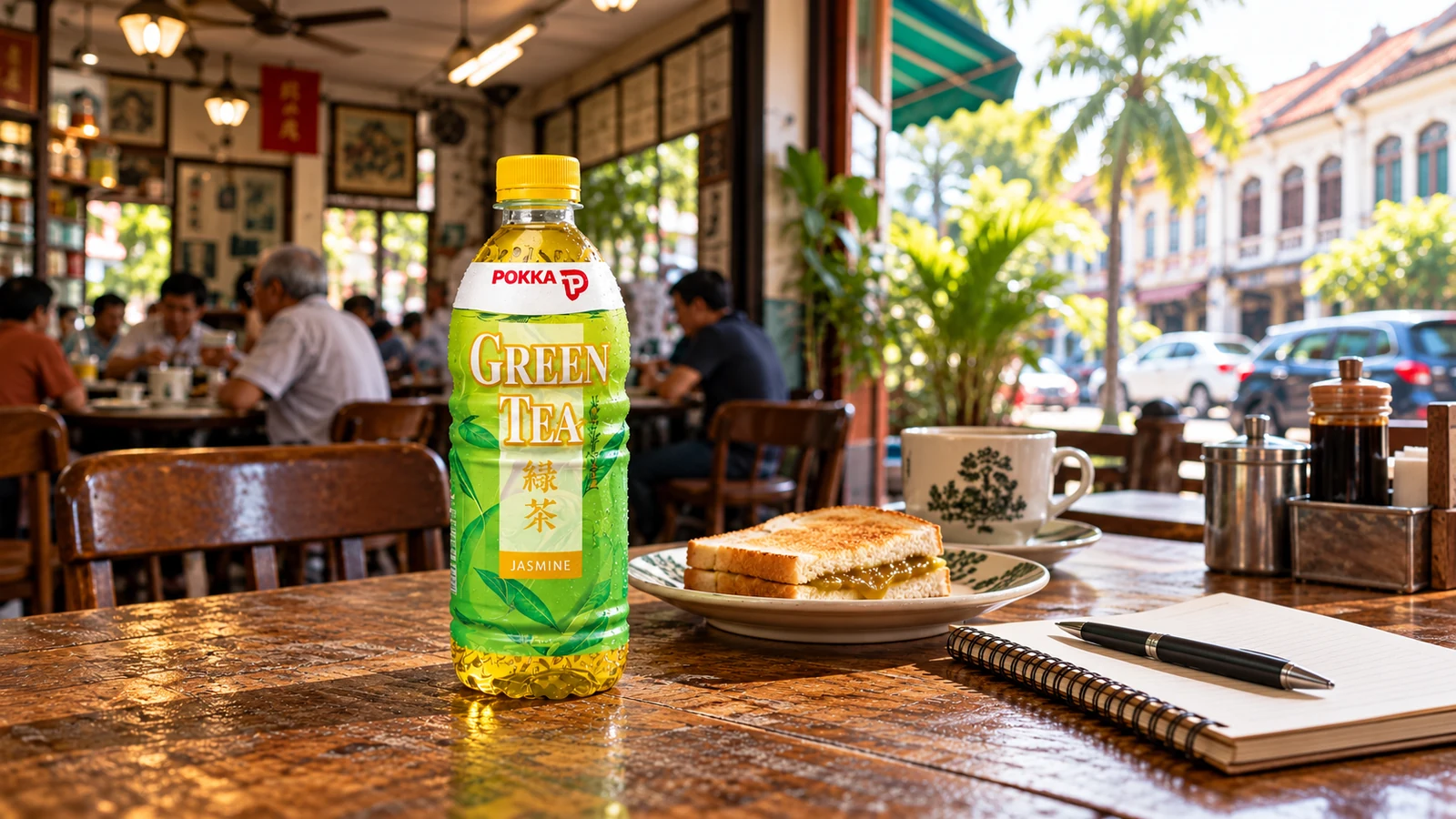
POKKA Jasmine Green Tea in Malaysia has a story that stretches beyond the familiar green label and yellow bottle cap. It connects a Japanese beverage business, decades of development in Singapore, and a manufacturing and commercial presence in Malaysia. For a shopper, the appeal may simply be a convenient tea drink. For a Malaysian retailer, understanding the product also means distinguishing its heritage, pack formats and current business context.
This spotlight looks at the regular Jasmine Green Tea listed in Trader Max’s catalogue, with the 500ml bottle as the featured product. It explains what the manufacturer documents, what recent corporate reporting says about Malaysia, and how those facts can inform a sensible buying decision. Research was checked on 21 October 2026; business announcements below retain their original dates.
What is POKKA Jasmine Green Tea?
POKKA describes its Jasmine Green Tea as brewed from selected tea leaves rather than tea extract, with jasmine flowers providing its floral character. Its product page also states that it contains no added preservatives or colouring. These are manufacturer descriptions of the drink, rather than independent taste-test findings. See the official Jasmine Green Tea product information.
The useful distinction for a customer is between a ready-to-drink beverage and tea prepared at home. A packaged drink offers a defined serving format and an ingredient declaration that can be checked before purchase. Someone choosing it for lunch, a journey or an office break can compare the actual label with alternatives instead of relying on the colour of the packaging.
Green tea branding should never be treated as shorthand for sugar-free. POKKA separately lists Jasmine Green Tea (No Sugar). That separate variant should not be confused with the regular product featured here. Retail shelf labels, quotations and online descriptions should identify the exact variant so that a customer receives the drink they intended to buy.
From Japanese origins to a regional tea brand
According to POKKA’s official history, the business began in Japan in 1957 as NIKKA LEMON and adopted the POKKA LEMON name in 1966. Its Singapore company was established in 1977, initially producing canned coffee. The timeline records the POKKA ACE Malaysian joint venture in September 1993.
The same history dates Jasmine Green Tea in cans to April 1998 and the bottled version to February 2000. These are product milestones in the company’s timeline; they do not establish the exact first Malaysian retail launch date. POKKA’s history also records its incorporation into the Sapporo group in 2011 and the establishment of POKKA Malaysia in 2013.
Those distinctions matter when telling the story on a Malaysian retail website. A brand’s founding year is not the age of every product it sells. Equally, the arrival of a corporate entity does not automatically tell us when a particular bottle first appeared in a local shop. Keeping the dates separate produces a more useful account than assigning one broad anniversary to everything bearing the logo.
The transition between cans and bottles also offers a way to think about packaging. Different containers can serve different occasions, even when the flavour name remains familiar. A retailer can therefore evaluate the format customers actually request without assuming that the longest-established pack must be the best choice for every outlet.
Malaysia’s role includes manufacturing
Malaysia is more than a destination for the brand’s sales. In an announcement dated 1 October 2014, Pokka Sapporo reported that its new Malaysian factory had been completed and had started operating. The facility was located in the Senai airport logistics area in Johor. The company described an aseptic filling line capable of handling 500ml and 1.5-litre PET bottles across several beverage categories, including tea. This was an operational milestone, not merely a proposed project. See the manufacturer’s Malaysian factory announcement in Japanese.
That historical investment helps explain Malaysia’s place in the regional business. However, a factory’s existence does not establish the manufacturing origin of every pack currently on sale. Buyers who need country-of-origin information should read the supplied pack and obtain the relevant product documentation. The same discipline applies when checking a particular batch, pack revision or certification.
For retailers, the practical value of knowing this background is better communication. Customers sometimes ask whether a Japanese-origin brand means the drink was imported from Japan. Brand heritage and manufacturing origin answer different questions. Staff can explain the brand’s origins while checking the actual bottle for the information that applies to the item in their hands.
Recent developments: what the reporting actually says
Sapporo’s business report for the year ended 31 December 2025 discussed packaging problems at the Malaysian factory that had begun in early March 2025. It stated that the situation had subsequently normalised. The report also described efforts to increase Malaysian sales through a new distributor’s network, while noting that manufacturing conditions had affected the business during that year. These are broader overseas-beverage disclosures, not a published sales report for Jasmine Green Tea alone. See the 2025 shareholder business report, under the overseas-beverages discussion.
For a shop owner, the important lesson is to separate historical corporate reporting from a present purchase order. A report that describes normalised production is not a promise that a particular wholesaler has a particular pack available today. Conversely, an earlier manufacturing issue should not be represented as an ongoing shortage without current evidence. Stock enquiries need a date, an exact product and a confirmed quantity.
It is also unhelpful to turn a company-wide sales movement into a claim about customer demand for one flavour. Manufacturing, distribution and the mix of products sold can all affect reported business results. Without product-level figures, this article cannot say that Malaysian sales of Jasmine Green Tea rose or fell by a particular percentage.
A retailer’s own sales records answer a different, more local question: how quickly does this pack move in this outlet? Recording units sold, days out of stock and replenishment dates makes that evidence more useful. A week with an empty shelf should not be interpreted in the same way as a week when customers had the opportunity to buy but chose something else.
What has been announced for Malaysia’s future?
Sapporo’s Integrated Report 2025 identified stronger marketing and a strengthened sales network as the approach to building POKKA brand awareness and pursuing growth in Malaysia. This is a stated business strategy. It does not specify a new Malaysian Jasmine Green Tea flavour, a replacement bottle design or a launch date for this exact product.
In the manufacturer and corporate sources reviewed for this article, we did not find a dated, Malaysia-specific future launch plan for the regular Jasmine Green Tea SKU. The supported outlook is therefore about broader brand visibility and distribution. A new product, promotion or factory expansion should only be described as confirmed when an announcement identifies what is planned, where it applies and when it is expected.
Our interpretation for retailers is straightforward: stronger distribution could create more opportunities to evaluate the range, but an announced strategy is not guaranteed demand at an individual store. The sensible response is to monitor actual availability and customer requests. A small outlet gains little from treating a corporate growth ambition as a reason to order beyond its own selling capacity.
Future announcements are most useful when they answer practical questions. Does the initiative cover Malaysia? Does it include this variant and pack size? Is it already operating or still planned? Is there a published date? Asking these questions keeps a buying decision tied to evidence and avoids mistaking a neighbouring market’s campaign for a local offer.
500ml bottles and 250ml packs in Trader Max’s catalogue
Trader Max lists POKKA Jasmine Green Tea 500ml × 24 and POKKA Jasmine Green Tea 250ml × 24. These links establish the catalogue formats checked for this spotlight. A listing is a starting point for an enquiry; current availability and commercial terms should be confirmed when ordering.
Both listings contain 24 units, but they represent different quantities of drink. Twenty-four 500ml bottles total 12 litres, while twenty-four 250ml units total 6 litres. That simple calculation helps avoid comparing carton prices as though the cartons contained equivalent volumes. It does not establish which pack offers the better margin, because current costs and achievable selling prices are separate inputs.
The 500ml bottle may suit customers who prefer a larger individual drink, while a smaller pack may suit an occasion where a smaller portion is wanted. These are possible uses, not measured demand claims. An office pantry, neighbourhood shop and food outlet may each receive different requests. Observing those requests is more reliable than assigning one format to every type of customer.
Retailers comparing the wider range can use the Trader Max POKKA catalogue. Keep a separate line for each flavour, volume and variant in the stock record. Similar-looking packaging is not a reason to combine different items into a single count, particularly when customers distinguish regular and no-sugar drinks.
A practical approach to stocking the product
Start with the exact purchase description. Write the brand, flavour, variant, unit volume and units per carton on the order. Match those details against the quotation and delivery. This small habit prevents a common type of purchasing mistake: agreeing on a familiar product name while overlooking the size or number of units supplied.
Next, assess space and turnover together. A display decision is not only about how many cartons fit in the storeroom. It is also about how many saleable units the outlet can present clearly and replenish efficiently. Compare sales over a representative period, and note any unusual event that might have temporarily increased or reduced demand.
When a delivery arrives, check the received quantity, packaging condition and date markings. Follow the product’s printed storage instructions and organise stock so that earlier-expiring units are used or sold first. Avoid hiding older stock behind a new delivery. If a pack is damaged or a label is unclear, resolve it with the supplier before placing that item on sale.
For shelf communication, keep the description factual: the exact product name, size and current selling price. Avoid adding unsupported claims about weight loss, disease prevention or other health outcomes. A straightforward label helps customers compare drinks and reduces the risk that staff repeat an attractive but unverified claim.
Finally, review the result after a defined selling period. Compare units sold with the quantity received, account for any remaining stock, and decide whether the next order should stay the same or change. The purpose is not to produce a complicated forecast. It is to give the next buying decision a clear basis in what happened at the outlet.
Frequently asked questions
Is regular POKKA Jasmine Green Tea the same as the no-sugar version?
No. The manufacturer presents them as separate products. Check the complete variant name and the current pack’s ingredient and nutrition information rather than assuming that all green-labelled tea drinks have the same formulation. Specify the required version when making a wholesale enquiry.
When did POKKA Jasmine Green Tea first appear?
The official company timeline records cans in April 1998 and bottles in February 2000. Those dates describe the product’s documented history. They should not be presented as a verified first-sale date in Malaysia, which the sources reviewed did not establish.
Does Japanese brand heritage mean every bottle is made in Japan?
No. Brand origins and the manufacturing origin of an individual pack are different matters. POKKA has documented manufacturing operations in Malaysia, but buyers should use the actual product label and supplier documentation to establish the origin of the stock being purchased.
How should a retailer compare the two listed carton sizes?
Check both the number of units and the volume per unit. The listed 500ml and 250ml formats each contain 24 units, so the larger format contains twice the total beverage volume. Then consider the outlet’s customer preferences, current quotation, shelf space and expected turnover.
Has a new Malaysian Jasmine Green Tea launch been announced?
No dated future launch for this exact regular product was found in the sources reviewed. The documented Malaysian outlook concerns wider POKKA marketing and distribution. It should not be converted into a promise of a new flavour, package or local promotional offer.
Make the next enquiry specific
POKKA Jasmine Green Tea combines an established product history with a regional business that includes Malaysia. That background makes an interesting story, but a good retail order still depends on the exact format, present terms and the needs of the outlet. History explains how the product developed; current stock information determines what can be supplied.
To discuss the listed packs, contact Trader Max with the required size, carton quantity and delivery location. A precise enquiry makes it easier to confirm the relevant product and available arrangements before an order is placed.


Leave A Comment