

There is no single published Coca-Cola wholesale price Malaysia figure that applies across all retailers, because carton pricing depends on pack format, order volume, and the specific supplier quotation a buyer requests. Instead of quoting a number that cannot be verified here, the practical approach for a retailer or F&B operator is to request a current, itemised quotation directly from a supplier for the exact pack size and quantity you intend to stock, and to compare that quotation against a clear set of product-identification and decision criteria. This guide, filed under Beverages, sets out what those criteria should be, and walks through how to structure a comparison once quotations are in hand.
Coca-Cola’s Position in the Malaysian Soft Drink Market
Coca-Cola is widely recognised across Malaysian retail, from sundry shops to restaurants to event caterers, which is exactly why it appears so often in bulk wholesale enquiries. Because the brand is familiar to nearly every type of outlet, buyers sometimes assume pricing is similarly standardised — a flat, known figure that applies regardless of who is asking or how much they are ordering. In practice, wholesale carton pricing for any branded beverage is shaped by variables that differ from one purchase to the next: the pack configuration being ordered, the order quantity, whether the buyer is a first-time or repeat account, and the terms a particular supplier is offering at the time of enquiry. None of these are fixed or published figures, so a retailer cannot responsibly rely on a generic number seen online or quoted by word of mouth. The only reliable way to know what a carton will cost for your business is to request a written quotation for your specific order.
This also explains why a buying guide cannot responsibly state current prices, stock levels, or delivery timelines as fact. Those details change and must be confirmed directly with a supplier before an order is placed. What a guide can do is help you ask sharper questions and read product information correctly, so that the quotations you receive are easy to compare on a like-for-like basis, regardless of which supplier you approach.
Common Pack Formats Retailers Stock
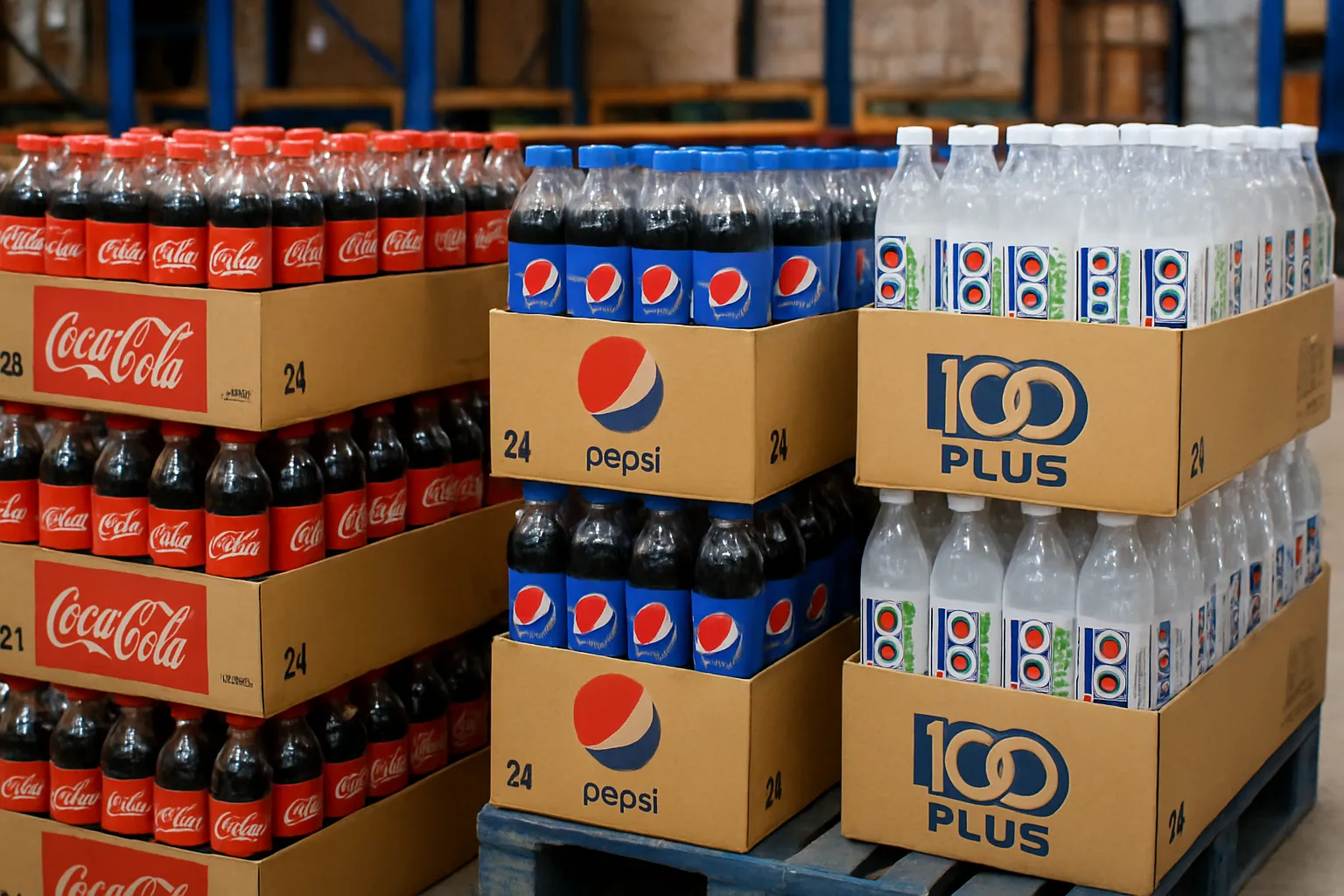
Coca-Cola is understood to be available in more than one pack format in the Malaysian market — commonly referenced as cans, glass or PET bottles, and multipack cartons — but exact sizes, unit counts, and which variants are currently offered should always be confirmed on the live product listing rather than assumed from general market familiarity. What a retailer can reasonably plan for in advance is the operational tradeoff between formats, since these tradeoffs hold regardless of the exact specification confirmed at enquiry stage.
Cans are generally easier to chill quickly and display in small-format refrigerators, which suits outlets with limited cold storage space or high single-unit turnover, such as a small sundry shop or a food stall. Bottles, depending on size, may suit table service in restaurants or cafes where a customer consumes the drink on-site over a longer period. Multipack cartons intended for resale as a bundle may suit convenience retailers who want to move volume without breaking down packaging, but this depends entirely on whether the carton is designed for shelf-ready resale or for back-of-house bulk storage only — a distinction that should be confirmed with the supplier rather than guessed from the outside of the box.
The tradeoff is rarely about price alone. A format that looks cheaper per carton may cost more in practice if it requires packaging you then have to break down, repack, or store in a way that ties up chiller space your outlet cannot spare. Before comparing quotations, it is worth asking yourself which format reduces your own handling and storage workload, not just which has the lowest headline number.
Before comparing any quotation, retailers should also be clear on how the stock will actually be used in their outlet. A sundry shop selling single cold cans to walk-in customers has different carton-handling and turnover needs than a restaurant serving bottled Coca-Cola with meals, or a canteen operator buying multipacks for resale in smaller units. Consider these use-case questions before contacting a supplier:
- Will the stock be sold as single chilled units, or resold in its original multipack packaging?
- Does your outlet have refrigerated display space, or will cartons be stored ambient until use?
- Is this a one-off event order or a recurring stock line for regular resale?
- Do you need a mix of formats (for example, both can and bottle variants) in the same order, or a single uniform pack type?
Answering these questions internally first means that when you do reach out to a supplier — for instance through the product enquiry catalogue at https://www.tradermaxs.com.my/shop/ — your enquiry can specify exactly what you need, which tends to produce a more directly comparable quotation. Retailers comparing Coca-Cola alongside other soft drink lines may also find it useful to review a broader multi-brand sourcing comparison, such as the existing guide on bulk soft drinks supply in Selangor, before narrowing down to a single-brand order.
How to Compare Coca-Cola Wholesale Price Quotations
Any carton of Coca-Cola you receive or are quoted for should be identifiable against clear label information. Since this guide cannot assert specific pack sizes, certifications, or current product variants as verified facts, treat the following as a checklist of what to personally verify on the actual product listing or physical pack before committing to an order, rather than assumptions to carry forward:
- Pack format and unit count — confirm whether the carton contains cans or bottles, and how many units per carton, directly from the supplier’s product listing or packaging.
- Unit volume — check the stated volume per can or bottle on the label itself, as formats can differ even within the same brand range.
- Product variant — verify whether the listing refers to the standard formulation or another variant in the range, since names and packaging can look similar at a glance.
- Manufacturing and expiry dating — locate the batch code and expiry or best-before date printed on the pack, and record this at the point of enquiry or receiving.
- Brand origin versus carton manufacturing location — Coca-Cola as a brand is international, but the specific carton in front of you may be bottled at a particular facility or country, and this is not the same thing as the brand’s origin. The printed pack label tells you where that specific batch was bottled; check that line rather than assuming it from the brand name.
- Language and labelling compliance — note what label information is printed in Bahasa Malaysia and English, as this is relevant for retail display and customer-facing sale in Malaysia.
None of these details should be assumed from memory or from a previous order. Pack configurations and labelling can be updated by the manufacturer, so each new purchase cycle is an opportunity to re-confirm rather than repeat old assumptions.
Building a decision checklist before you enquire
A structured checklist helps retailers avoid comparing quotations on price alone, which is often misleading when pack formats or terms differ between suppliers. Before sending an enquiry, work through the following steps.
Define the exact order specification. Write down the pack format, unit volume, and carton quantity you want quoted. A vague enquiry such as “Coca-Cola cartons” invites a vague or mismatched quotation. A specific enquiry — naming the pack type and quantity — allows a supplier to respond with an accurate, comparable figure.
Decide your order frequency pattern. Clarify internally whether this is a trial order, a one-off bulk purchase, or the start of a recurring supply arrangement. This affects what questions you should be asking a supplier about future reordering, and it affects how you interpret any quotation you receive, since first-order and repeat-order terms are not guaranteed to be identical.
Confirm what the quotation includes. A carton price quotation can mean different things depending on the supplier — some figures may be per-carton while others could be structured differently. Always ask the supplier directly to state the unit of quotation clearly in writing, rather than assuming based on how competitors present pricing.
Check documentation and contact channels. Before placing any order, confirm how the supplier handles enquiries, order confirmation, and after-sales contact. For example, TraderMaxs lists a contact page at https://www.tradermaxs.com.my/were-here/ for buyers who want to reach the business directly; checking that a supplier has a clear, reachable contact channel is a reasonable baseline step regardless of which supplier you are evaluating.
Record what you are told, not what you assume. Whatever a supplier confirms by phone, email, or in writing — regarding pack size, quantity, or any other order detail — should be noted and kept on file. This record becomes your reference point if there is any discrepancy between what was quoted and what is delivered.
Building a quotation comparison worksheet
Once you have received quotations from one or more suppliers, the most reliable way to compare them is to lay out the same fields side by side for each offer, rather than comparing headline prices in isolation. A simple worksheet should capture, for every quotation received:
- Exact pack format and unit volume as confirmed by the supplier
- Number of units per carton, as stated in writing
- Price quoted and the unit it applies to (per carton, per case, or otherwise — confirmed directly, not assumed)
- Minimum order quantity, if any is mentioned
- Any conditions attached to the quotation, such as whether it is valid for a single order or ongoing supply
- Date the quotation was given, since prices are not fixed over time
- Contact person and channel through which the quotation was obtained
Filling in this worksheet for every supplier you approach turns a scattered set of phone calls and messages into a structured comparison. It also creates a paper trail that is useful later if a delivered order does not match what was discussed — a basic but often overlooked safeguard for bulk buyers.
Cost-Per-Unit vs Markup: A Worked Hypothetical Example
The figures below are entirely invented for illustration only. They are not real Coca-Cola prices, pack specifications, or supplier terms, and should not be used as a reference point when requesting an actual quotation. They exist solely to demonstrate the arithmetic of comparing cost-per-unit across differently sized hypothetical cartons. All amounts and results in this section, including table cells, are hypothetical and rounded to the nearest cent for realistic currency presentation.
| Item | Hypothetical Scenario A | Hypothetical Scenario B |
|---|---|---|
| Quoted carton price (hypothetical) | RM 48.00 | RM 90.00 |
| Units per carton (hypothetical) | 24 | 48 |
| Cost per unit (hypothetical, rounded) | RM 48.00 ÷ 24 = RM 2.00 | RM 90.00 ÷ 48 = RM 1.88 (unrounded RM 1.875) |
| Assumed resale price per unit (hypothetical) | RM 3.50 | RM 3.50 |
| Gross margin per unit (hypothetical, rounded) | RM 3.50 − RM 2.00 = RM 1.50 | RM 3.50 − RM 1.88 = RM 1.62 (unrounded RM 1.625) |
On a simple per-unit basis, hypothetical Scenario B appears cheaper by roughly a hypothetical RM 0.12 per unit. But this comparison only holds if the two cartons genuinely contain the same pack format and unit volume. If Scenario A’s carton holds larger bottles and Scenario B’s carton holds smaller cans, the per-unit figures are not comparable at all, and the retailer would be comparing two different products rather than two prices for the same item. This is exactly why confirming exact unit volume and format before comparing numbers matters more than the arithmetic itself.
A further hypothetical: if Scenario A requires a minimum order of 10 cartons and Scenario B requires a minimum order of 50 cartons, a retailer with limited storage or slower turnover may find Scenario A more workable even if its hypothetical per-unit cost is higher, because it avoids tying up capital and shelf space in stock that moves slowly.
Markup thinking follows the same logic as shown in the table above: cost-per-unit is subtracted from an assumed resale price to arrive at a gross margin per unit. These figures ignore handling costs, spoilage, chiller electricity, and staff time, all of which reduce actual margin in a real outlet — they are shown only to illustrate how cost-per-unit feeds into a markup calculation, not as a benchmark for real pricing decisions.
Three hypothetical purchasing scenarios
To make the decision process concrete, consider three distinct hypothetical buyer situations below. These are illustrative only and do not describe any real transaction, supplier, or confirmed stock position.
Scenario 1: The trial-order convenience store. A small convenience store owner in a residential area wants to test demand before committing to a large order. The priority here is a low minimum order quantity and a format that fits an existing small chiller, even if the hypothetical per-unit cost works out higher than a bulk quotation. The owner would ask the supplier specifically about smaller-quantity options and request written confirmation of the minimum order before proceeding.
Scenario 2: The recurring restaurant order. A restaurant that serves Coca-Cola as a standard beverage option with meals is thinking about a recurring monthly order rather than a one-off purchase. Here, the priority shifts toward confirming whether the supplier offers consistent terms across repeat orders, and whether the quoted price at first order is likely to be renegotiated for subsequent orders — a question that should be asked directly rather than assumed from the first quotation.
Scenario 3: The event caterer with a single bulk order. A caterer handling a one-time large event needs a single bulk delivery and has no ongoing storage requirement. In this scenario, the per-unit cost and total order value matter more than long-term supplier relationship terms, and the caterer would focus questions on confirming total quantity available for a single order date rather than on recurring account terms.
Each of these three hypothetical buyers would reasonably prioritise different fields on the comparison worksheet, which is why no single “best” quotation exists independent of how the stock will actually be used. Matching the comparison criteria to your own outlet’s pattern of use, rather than copying another retailer’s priorities, is the practical takeaway for structuring your own enquiry.
Questions to Ask Before Placing a Bulk Coca-Cola Order
Once a quotation has been accepted, the next practical step for most retailers is a stock trial rather than an immediate large commitment. A trial order lets you measure actual sell-through against your assumptions, which matters because a carton that looks attractively priced on paper is only a good purchase if it moves at a rate your outlet can sustain. Before placing a trial order, decide how you will measure it: track units sold per day against units received, note any spoilage or damage, and record how quickly chiller or shelf space turns over. These measurements are yours to define — there is no universal benchmark figure to apply here, since turnover depends entirely on your outlet type, footfall, and customer base.
A simple way to structure this is to treat the trial carton as a small experiment with a fixed observation period, for example two or four weeks, and compare actual sales against what you projected when requesting the quotation. If sell-through is slower than expected, this is useful information before you commit to a larger recurring order, not a sign that the product or supplier was wrong — it may simply mean your initial order size needs adjusting.
Keeping receiving records at delivery
Whatever quotation and format you have agreed with a supplier, the point of delivery is where your paper trail becomes most important. At receiving, check the delivered cartons against what was confirmed in writing: pack format, unit count per carton, and total carton quantity. Note the batch code and expiry or best-before date printed on the packs, and record these alongside the delivery date.
Keeping this record matters for two reasons. First, it gives you a reference point if a discrepancy arises later — for instance, if a delivered carton’s unit count does not match what was quoted. Second, it supports your own internal stock rotation, since knowing the expiry window on each batch helps front-line staff decide which stock to sell first. A simple receiving log, even a basic spreadsheet with date, supplier, pack format, quantity, and batch code, is sufficient for most small and mid-sized retail operations and does not need specialised software.
Storage questions governed by pack instructions
Storage requirements for any delivered carton should be read directly from the manufacturer’s instructions printed on the pack itself, rather than assumed from habit or from how a previous batch was stored. Printed pack instructions typically indicate matters such as whether ambient or chilled storage is expected before sale, and retailers should treat these instructions as the governing reference rather than general practice. Practical questions worth asking at the storage stage include:
- Does the pack instruction specify a storage condition before the product is sold, and does your current storage area meet it?
- Is there a stated handling instruction for stacking or carton orientation that affects how you can stack stock in a back room?
- Does the batch code or expiry marking remain legible after any repacking or display handling your outlet does?
- If your outlet moves stock between ambient storage and a chiller, have you confirmed this is consistent with the pack’s printed guidance?
Where pack instructions are unclear or not visible on a listing, this is a reasonable question to put to the supplier directly at enquiry stage, rather than guessing based on similar products you have stocked before.
Reordering and staff handover
Once a trial has run its course and you decide to reorder, the records built during the trial and receiving stages become the basis for a smoother repeat purchase. Reordering is also the point where staff handover becomes relevant: if the person who placed the original order is not the one managing day-to-day stock, the quotation worksheet, receiving log, and any supplier correspondence should be handed over clearly, not left as informal knowledge held by one staff member.
A simple handover should include the original quotation terms, the supplier’s contact details, the agreed unit of quotation (per carton or otherwise), and any notes on minimum order quantities or lead time that were discussed. This reduces the risk of a reorder being placed on outdated assumptions, particularly if some time has passed since the original enquiry and prices or terms may have changed.
Scope note: This guide does not state current Coca-Cola prices, stock availability, delivery timelines, or certifications, as none of these were independently verified at the time of writing. All figures presented as examples in this guide are clearly labelled hypothetical illustrations only, rounded to realistic currency precision. Retailers should treat every pricing, stock, and delivery detail as subject to direct confirmation with a supplier before placing an order.
Frequently Asked Questions
Is there a fixed Coca-Cola wholesale price Malaysia retailers can expect?
No single fixed figure applies across all retailers. Carton pricing depends on pack format, order quantity, and the specific quotation a supplier provides, so each buyer should request a current, written quotation for their exact order specification.
How often should I re-confirm pricing with a supplier?
Since prices are not published as standing figures, it is reasonable to re-confirm pricing at each reorder rather than assuming a previous quotation still applies, particularly if time has passed since the last order.
What should I do if a delivered carton does not match the quotation?
Refer to your receiving record, which should note the pack format, unit count, and batch details agreed at order time, and raise the discrepancy with the supplier directly using that written record as reference.
Where can I check where a specific carton was manufactured or bottled?
Check the printed label on the pack itself, alongside the batch code, at receiving. That line tells you where the specific carton was bottled, independent of the brand’s general origin.
Do storage conditions differ between pack formats?
Storage guidance should be read from the instructions printed on the pack itself rather than assumed, since this is the governing reference for any specific product you receive.
To request a current quotation for your intended pack format and order quantity, visit the product enquiry catalogue at https://www.tradermaxs.com.my/shop/, or reach the team directly through the contact page at https://www.tradermaxs.com.my/were-here/ to discuss your specific order requirements.


Leave A Comment