

Comparing wholesale prices in Malaysia is easier when every quotation is reduced to the same sellable unit. A cheaper carton is not automatically a cheaper purchase: pack quantities, delivery charges and order conditions can change the result.
For a mini market or kedai runcit, the useful question is: how much will each bottle, can, packet or retail box cost once this order reaches the shop? This guide shows how to compare quotes, check pack sizes and decide whether a bulk offer suits your business.
All prices, selling prices, charges and supplier comparisons below are illustrative. They are calculation examples, not Trader Max’s quotations, promotions or published terms.
1. Match the exact product before comparing wholesale prices
Start with a like-for-like comparison. Write down the brand, product name, flavour, net content, packaging format and barcode where available. Two listings with similar names can refer to different products. A 250ml can and a 300ml can are different retail offers, even if both arrive in cartons of 24.
Also check whether a quoted product is sold individually or as a retail multipack. A box of sachets may be your sellable unit if customers buy the sealed box. Dividing its cost by individual sachets answers a different question. Only use a single sachet as the retail unit when the packaging, labelling and your selling arrangement support that format.
If you accept a substitute, compare it separately. Do not silently replace a familiar product with another size because its carton price looks attractive. Customers may recognise the usual pack, and shelf labels or checkout records may need changing.
2. Confirm what CTN, OUT and PCS mean on that quote
CTN commonly means carton, OUT commonly means outer, and PCS means pieces. These abbreviations identify levels of packaging; they do not tell you a universal quantity. An outer can contain several retail packs, while a carton can contain several outers. Ask for the actual packing structure in writing.
The live Trader Max’s catalogue, for example, lists A1 5 Minutes Instant Flour Vermicelli 36g x 12 as an outer containing twelve 36g packs. That describes this specific listing. It does not mean every outer of noodles or snacks contains twelve pieces.
Illustrative conversion: if one carton contains six outers and each outer contains ten individually sellable packets, one carton contains 60 packets. An order for three cartons contains 180 packets. Confirm both multiplication steps before calculating a packet cost.
A practical quote line should therefore say more than “5 CTN”. Record the full product, carton structure and total retail units. This also gives receiving staff a clear quantity to check later.
3. Calculate purchase cost per sellable unit
Use this starting formula:
Purchase cost per unit = goods cost after confirmed discounts ÷ number of sellable units.
For example, an illustrative carton containing 24 cans at RM48 has a purchase cost of RM2 per can. A carton containing 20 cans at RM42 costs RM2.10 per can. The second carton has a lower total price but a higher unit cost.
Keep the units visible in your worksheet. “RM48 ÷ 24 cans” is clearer than “48 ÷ 24”. It helps a colleague spot when one quote uses cartons and another uses outers. Keep several decimal places during the calculation, then round the displayed result consistently.
For different bottle sizes, cost per litre can provide a secondary comparison. However, your main retail calculation should still use the actual bottle sold. A larger bottle may have a lower cost per litre yet require a higher shelf price and more display space.
4. Compare the cost of getting the order into your shop
The goods price is only one part of a buying decision. For your comparison worksheet, add confirmed charges that belong to that order, such as delivery or handling, and subtract confirmed discounts or credits that actually apply. Ask whether the quoted total includes all applicable charges.
Order cost per unit = (net goods cost + confirmed order charges) ÷ total sellable units.
For a mixed order, choose a consistent way to allocate shared delivery charges. Equal allocation per carton can suit similar cartons; weight, space or value may be more useful when products differ considerably. State your method so later comparisons use the same basis.
A cash-and-carry purchase also uses resources. Consider the fuel, trip time and loading work involved when deciding between collection and delivery. Keep estimated internal collection costs separate from the supplier’s invoice, so you can distinguish an actual charge from your planning assumption.
5. Worked example: the lower carton price costs more
Illustrative example only: a retailer compares two hypothetical quotes for ten identical cartons, each containing 24 cans. Both quotes cover the same variant, pack size and product condition.
| Comparison | Quote A | Quote B |
|---|---|---|
| Price per carton | RM48.00 | RM46.80 |
| Cartons ordered | 10 | 10 |
| Goods total | RM480.00 | RM468.00 |
| Delivery charge for this order | RM0.00 | RM18.00 |
| Total order cost | RM480.00 | RM486.00 |
| Sellable cans | 240 | 240 |
| Cost per can | RM2.000 | RM2.025 |
Quote B saves RM12 on goods but adds RM18 in delivery, leaving the order RM6 more expensive. At this quantity, Quote A has the lower cost per can. The result could change for another order size or a mixed order sharing the same delivery charge.
This comparison assumes all 240 cans are usable for sale and there are no other charges or discounts. Confirm those assumptions before accepting either quote. A price comparison becomes less useful when one quotation leaves key conditions unresolved.
6. Check discounts, free goods and quotation conditions
Ask how a discount is earned. It may depend on quantity, a particular product mix or an agreed payment arrangement. Compare the amount you will actually pay for the order you intend to place, rather than the lowest advertised figure for a different order.
Free goods need the same care. Illustrative example: if ten cartons cost RM480 and one additional identical 24-can carton is confirmed free, the order contains 264 cans. With no extra charges, RM480 divided by 264 gives approximately RM1.818 per can. The calculation only applies if the additional carton is genuinely included and sellable.
If a promotion supplies a different flavour or slow-moving item, keep that product on a separate line. Do not value every free item at its possible shelf price and call that amount an immediate saving. You still need customers willing to buy it.
Record quote validity, payment terms, minimum order requirements and any substitution arrangements. A short written confirmation prevents your purchase decision from relying on a promotion that has ended or a condition that your order does not meet.
7. Connect unit cost to gross profit
Once you know the unit cost, compare it with a realistic selling price for your shop. Use consistent cost and revenue figures, and include known order charges in the cost basis you are assessing.
Illustrative example: a product with a RM2 cost sells for RM2.50. Gross profit is RM0.50 per unit. Gross margin is RM0.50 divided by RM2.50, or 20%. Markup is RM0.50 divided by RM2, or 25%. Margin and markup use different denominators.
This gross profit is before shop expenses such as rent, wages and electricity. It is also before any losses or markdowns not already included in your cost calculation. A positive gross margin does not by itself prove the shop will make a net profit.
Use an achievable selling price. If customers usually pay less than your proposed shelf price, a spreadsheet built around that higher price can overstate the opportunity. Check your own sales records and comparable local packs before committing to a large purchase.
8. Test whether the bulk quantity fits your sales
A lower unit price can still create a poor order when the quantity is too large. Estimate how many days of stock the purchase adds, using recent sales for that exact product. Account for stock already on hand and other confirmed incoming orders.
Illustrative example: ten cartons of 24 units add 240 units. At twelve units sold per day, that is 20 days of additional stock. Thirty cartons add 720 units, equivalent to 60 days at the same sales rate. These are planning estimates, not demand forecasts.
Check available storage, date markings and the time you expect to need to sell the goods. Follow product storage instructions and avoid treating an uncertain future promotion as guaranteed demand. A familiar fast seller may justify a different quantity from a new flavour.
For deciding when stock needs replenishing, use our separate mini market reorder point guide. Here, the aim is to compare the economics of the quoted order without letting a bulk discount decide the quantity for you.
9. Build one reusable quotation comparison sheet
Use one row per exact product and one column group per supplier. A paper sheet or spreadsheet works if the fields are consistent. Include:
- Product name, variant, size and barcode or SKU.
- Quotation date and validity.
- Units per outer and outers per carton, where relevant.
- Quantity ordered and total sellable units.
- Goods price, confirmed discount and net goods total.
- Delivery or handling charges and the allocation method.
- Final order cost and cost per sellable unit.
- Payment arrangements and unresolved conditions.
Mark unknown fields as “to confirm” instead of entering zero. Zero delivery cost is a confirmed fact; an unanswered delivery question is missing information. Keeping them distinct stops incomplete quotes from appearing artificially cheaper.
Save the accepted quote with the purchase order. When the delivery arrives, compare the invoice and goods with that agreement. Our stock receiving checklist explains that next step.
10. Send a quote request that avoids missing details
A precise request helps suppliers quote the same basket of goods. Include your shop location, preferred purchase method and exact quantities. Ask them to separate unavailable items and proposed substitutes rather than folding replacements into the original product lines.
Illustrative enquiry: “Please quote ten cartons of the specified 300ml canned drink, with 24 cans per carton, for our shop in Klang. Confirm the exact variant, packing quantity, goods total, delivery charge, payment terms and quotation validity. Please list any alternative pack separately.”
For a mixed order, add each product on its own line and request a combined order total. Then ask whether the quoted delivery charge applies to that full basket. This prevents you from adding several standalone delivery charges to an order that has one shared charge, or assuming a shared charge when separate deliveries are needed.
Keep the reply alongside your worksheet. If a supplier later changes a quantity, charge or product, update the calculation before accepting the revised order.
FAQ: comparing wholesale prices in Malaysia
Is the cheapest carton always the best wholesale deal?
No. First compare identical products and actual units per carton. Then include confirmed charges, discounts and order conditions. Finally, check whether the quantity suits your sales and storage capacity.
Should I compare beverage prices per bottle or per litre?
Use cost per bottle or can for the retail item you sell. Cost per litre helps compare different sizes, but it does not replace checking the shelf price, customer preference and space required by each pack.
How should I treat an OUT price compared with a CTN price?
Ask how many retail units each contains. Convert both quotes to the same sellable unit before comparing. Never assume a fixed number of outers per carton across different products.
Can I assume payment terms or delivery charges from an earlier order?
Confirm them for the current quote, especially when the order size, delivery location or promotion changes. Your comparison should reflect the arrangement being offered for this purchase.
Request a quote with the details needed to compare it
Trader Max’s wholesale business serves retailers including mini markets and kedai runcit. To discuss an order, send the team your product list, exact pack sizes, quantities and shop location through the contact options on the website.
Ask for current pricing, availability, packing quantities and the applicable order and delivery terms. A clear request makes it easier to compare the quote with your buying worksheet and choose a quantity that fits your shop.
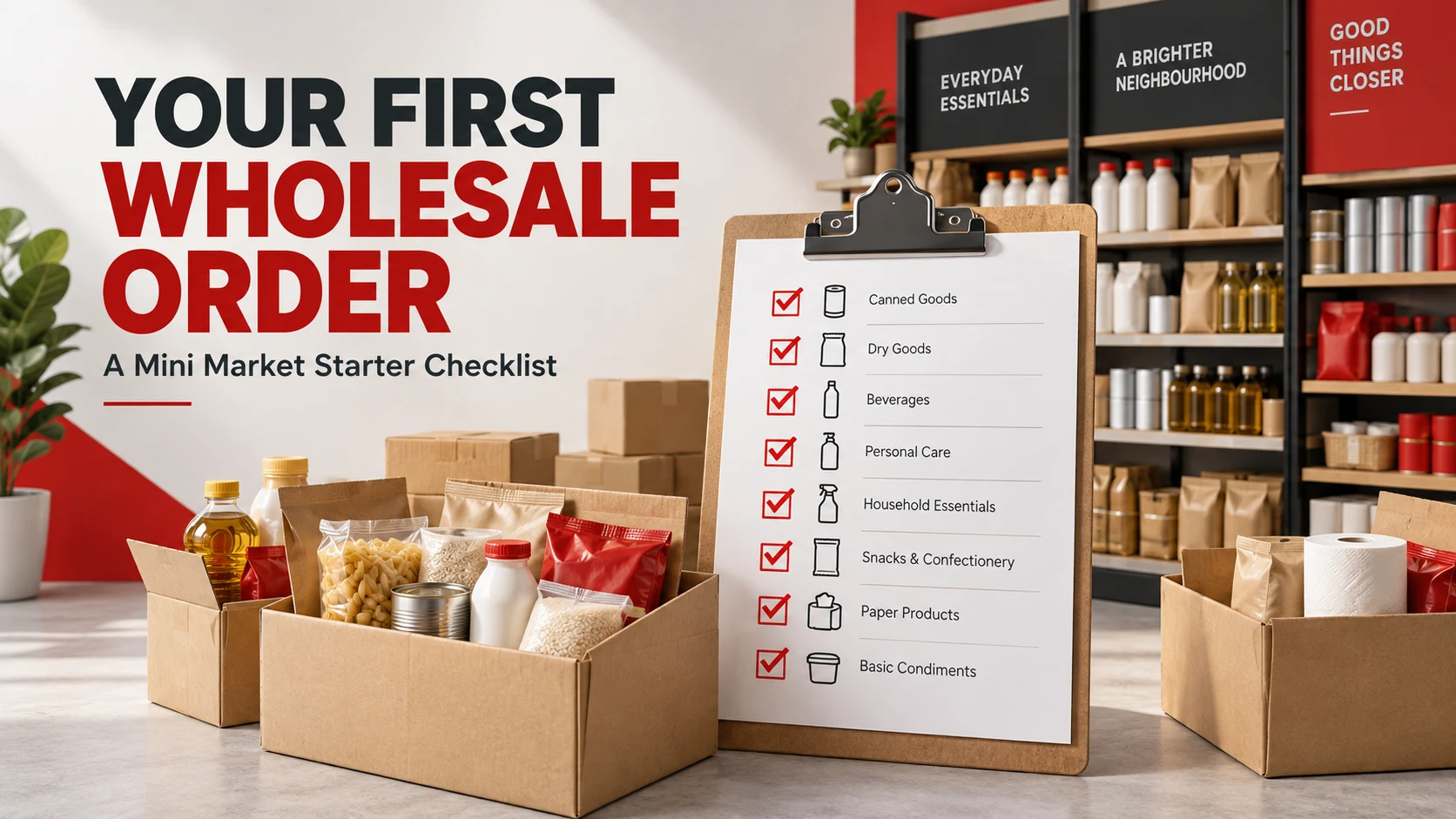
Featured image: AI-generated illustration for Trader Max’s wholesale price comparison guide.


Leave A Comment