
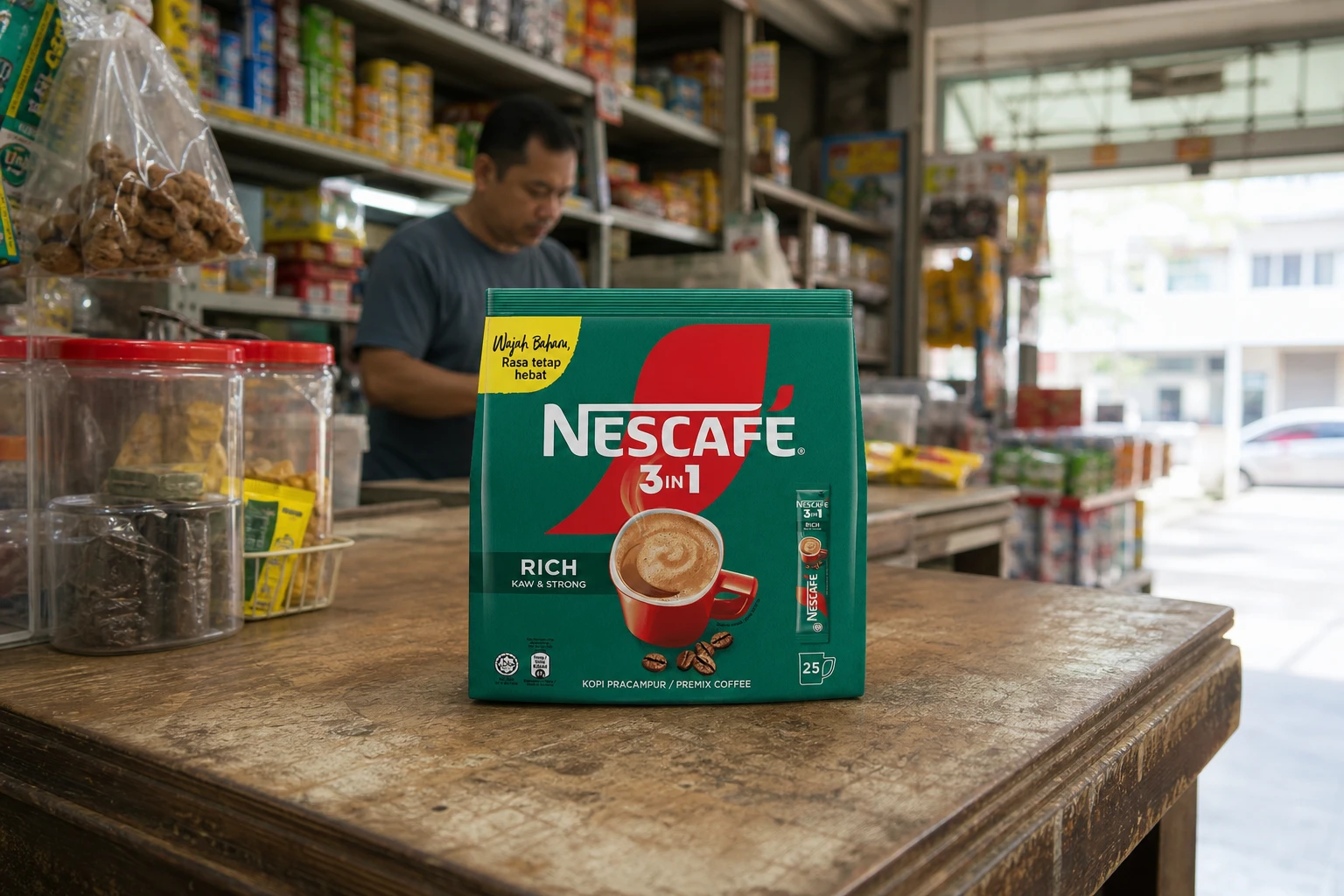
Nescafe wholesale Malaysia buyers can source bulk 3-in-1 sachets and ready-to-drink (RTD) coffee cans for offices, cafés and mini-marts, though exact carton counts, prices and current stock availability are not published facts and must be confirmed directly with a supplier before you commit to an order. What is confirmed is the product range itself: Nescafe’s official Malaysian line-up includes a 3-in-1 sachet range with Original, Mild and Rich variants, and a ready-to-drink range covering Original, Mocha and Latte cans, as listed on Nescafe’s own Malaysian product pages. This gives buyers a reliable starting point for identifying which formats to request, even before pricing or packing details are available.
What the Verified Nescafe Range Actually Covers
According to Nescafe’s official range page for 3-in-1 products, the Malaysian line-up includes Original, Mild and Rich sachet variants (source: nescafe.com/my/coffees/all-range/nescafe-3in1). These are the standard sachet formats most offices and canteens associate with the brand. Separately, Nescafe’s ready-to-drink range page confirms three canned options sold in Malaysia: Original, Mocha and Latte (source: nescafe.com/my/coffees/all-range/ready-to-drink). This RTD range is the one relevant to cafés, convenience outlets or mini-marts that want a chilled, grab-and-go coffee option alongside hot sachet service.
These two source pages confirm that the formats exist and are part of Nescafe’s current Malaysian catalog. They do not confirm which specific SKUs a wholesale supplier carries, what carton sizes are packed, what a per-carton or per-box price looks like, or whether stock is available at any given time. Any buyer discussion should treat the official range as a reference list of “what exists” rather than a guarantee of “what’s in stock.” For sourcing, Trader Max’s product enquiry catalogue functions as the starting point to check against (tradermaxs.com.my/shop), with specific availability confirmed through direct enquiry.
Matching the Format to Your Outlet Type
Before requesting a quote, it helps to be clear on how the coffee will actually be used in your business, since this shapes which format and pack size makes sense.
Office Pantries and Staff Canteens
Offices typically want 3-in-1 sachets for a self-serve pantry station — staff tear open a sachet, add hot water, and that’s it. The appeal for office admins is minimal equipment (just a kettle or hot water dispenser) and no barista skill required. If you’re stocking a shared pantry, you’ll want to think about sachet variant mix (Original, Mild or Rich, per the official range) based on general staff preference, since offices rarely stock just one variant exclusively.
Illustrative merchandising idea only — not a confirmed supplier offer: some admins use a Nescafe restock as a convenient trigger to also review the wider pantry list — items like tea, sugar, creamer or biscuits — in the same purchase order simply to reduce the number of separate deliveries. This is a general planning idea worth raising with whichever supplier you use, not a packaged bundle that Trader Max’s or any other supplier has confirmed as an actual product or discount offer.
Cafés and F&B Outlets
Cafés with refrigeration and chiller display space may be more interested in the RTD cans — Original, Mocha or Latte — as a secondary menu item or grab-and-go option alongside brewed coffee. This format suits outlets with existing cold-chain handling (chillers, display fridges) rather than pantry-only setups, since RTD cans need refrigerated storage and display to sell well.
Mini-Marts and Convenience Retail
Mini-mart operators often want both formats: sachets for a dry-goods shelf and RTD cans for a chiller section. If you’re planning a dual-format order, it’s worth requesting a combined quote covering both product lines in one enquiry, which may simplify delivery scheduling even though the formats sit in different storage categories.
Product Identification: What to Check Before Ordering
When you receive a quote, catalog listing or sample from a supplier, confirm these basic identification points before assuming it matches what you intended to order:
- Variant name — is it listed as Original, Mild or Rich (3-in-1), or Original, Mocha or Latte (RTD)? Variant names should match the official range naming so there’s no ambiguity in your purchase order.
- Format type — sachet box versus canned RTD are fundamentally different storage and handling categories; make sure your enquiry and the supplier’s quote are both referring to the same format.
- Carton or box unit — ask the supplier directly how many sachets or cans are packed per carton, since this is not standardised information available from public sources and varies by product line.
- Label language and market — check that the packaging is labelled for the Malaysian market, since imported or parallel-import stock may carry different language labelling or regulatory markings than locally distributed stock.
- Batch or production date visibility — for RTD cans especially, confirm the can displays a legible production or best-before date before accepting a delivery, since coffee cans without a visible date are harder to verify on receipt.
Label Information Worth Reading Before You Order
Every pack — sachet box or RTD can — carries a label with information that matters for your purchasing decision, separate from pricing. At minimum, check the pack for:
- Product name and variant exactly as described in the quote (so a “Rich” order doesn’t arrive as “Original”)
- Net weight or volume per unit, so you can calculate cost-per-serving once pricing is available
- Storage instruction wording printed on the pack itself (rather than assuming standard shelf storage applies to every variant)
- Country of packing or manufacturing as printed on the label
It’s worth being precise about one distinction here: Nescafe as a brand has its own global origin and background, but that is separate from where any individual carton you receive was actually packed or manufactured. A Malaysian-labelled product can still have been produced at different facilities over time, and the only way to know the manufacturing country for the specific stock you’re buying is to read the printed label on that pack — not to assume it based on the brand’s general background. Because no topic-specific certification, nutrition or production claims have been independently verified for this guide, treat the printed pack label as your primary source of product-specific information at the point of receiving stock.
Decision Checklist Before Requesting a Quote
Use this checklist to prepare a clear, specific enquiry rather than a vague “send me pricing” message, which usually produces a slower and less useful reply:
- Confirm your outlet type — office pantry, café counter, or mini-mart shelf/chiller — since this determines whether you need sachets, RTD cans, or both.
- List exact variants wanted — reference the official range names (3-in-1: Original, Mild, Rich; RTD: Original, Mocha, Latte) so your enquiry is unambiguous.
- Ask for carton/box unit counts — request this explicitly, since it is not public information and differs by format.
- Ask for current carton price (“harga borong”) — use this specific B2B term when requesting a quote, since general retail pricing pages won’t reflect wholesale carton rates.
- Clarify minimum order quantity — ask whether there’s a minimum number of cartons or boxes per order, as this affects your first-trial budget.
- Ask about delivery scheduling — confirm whether delivery timing, frequency or area coverage is something the supplier can commit to in writing, rather than assuming standard delivery terms apply.
- Request stock confirmation in writing — before finalising a purchase order, ask for written confirmation that the specific variant and quantity are currently available, since catalog listings don’t always reflect live stock.
Working through this checklist before contacting a supplier through the enquiry catalogue (tradermaxs.com.my/shop) helps you ask sharper questions and get a quote that’s actually usable for budgeting, rather than a generic price list that doesn’t match your outlet’s real order pattern.
Comparing Sachet Formats Against RTD Cans: Operational Tradeoffs
Choosing between 3-in-1 sachets and RTD cans isn’t purely a taste decision — it’s an operational one. Each format carries different handling requirements, storage demands and staff involvement, and these differences matter more to your bottom line than brand preference alone.
Sachets require almost no equipment beyond a kettle or hot water dispenser, which keeps your upfront setup cost low. They also store at room temperature, so you avoid chiller space constraints and electricity costs tied to refrigeration. The tradeoff is that sachets need someone to prepare each cup — fine for a self-serve office pantry, slower if you’re running a busy café counter where customers expect a ready-to-drink product handed over immediately.
RTD cans solve the preparation-time problem since they’re sold chilled and ready to drink, but they introduce cold-chain dependency. You need working chiller or fridge space, reliable power, and a system for rotating stock so older cans sell before newer ones (a basic first-in-first-out approach, not a certified cold-chain claim). If your outlet doesn’t already have spare chiller capacity, adding RTD cans means either freeing up existing fridge space or budgeting for additional refrigeration — a real cost that’s easy to overlook when comparing per-unit pricing alone.
A third consideration is shelf life perception. Sachets, being a dry powder format, are generally seen by buyers as more forgiving for slower-moving stock, while RTD cans in a chiller are more visible to customers but also more exposed to temperature fluctuations if a fridge is overloaded or power is interrupted. Neither of these points is a certified shelf-life claim — it’s a practical storage consideration worth raising directly with your supplier and checking against the printed pack instructions.
Building a Quotation Comparison Worksheet
When you request quotes from one or more suppliers, it helps to standardise the information you’re collecting so you’re comparing like with like, not just picking the lowest number on a page. Below is a simple worksheet structure you can adapt — the column headers matter more than any specific numbers, since no verified pricing exists for this guide.
- Supplier name — who issued the quote and the date it was given (quotes can expire or change)
- Product variant — exact name matching the official range (e.g., Nescafe 3-in-1 Rich, or Nescafe RTD Mocha)
- Carton/box unit count — how many sachets or cans per carton, as confirmed by the supplier directly
- Carton price (“harga borong”) — the wholesale rate quoted for one carton
- Minimum order quantity — smallest number of cartons the supplier will sell per order
- Delivery terms — whether delivery is included, charged separately, or requires self-collection
- Stock confirmation status — whether the quote reflects live stock or an estimated/catalog price pending confirmation
Filling in this worksheet for two or three suppliers side by side makes it much easier to spot which quote is actually cheaper once delivery and minimum order quantity are factored in, rather than comparing a bare carton price in isolation.
A Worked Example (Hypothetical Numbers Only)
To illustrate how this worksheet functions — and using entirely invented figures for demonstration only, not real prices or pack specifications — imagine two quotes for the same Nescafe 3-in-1 variant. Every figure below is a hypothetical value for illustration, not a confirmed Trader Max’s price:
| Item | Hypothetical Supplier A | Hypothetical Supplier B |
|---|---|---|
| Carton price (hypothetical) | RM120 (hypothetical) | RM100 (hypothetical) |
| Sachets per carton (hypothetical) | 24 (hypothetical) | 20 (hypothetical) |
| Minimum order quantity (hypothetical) | 10 cartons (hypothetical) | 15 cartons (hypothetical) |
| Delivery (hypothetical) | Included (hypothetical) | RM50 flat charge (hypothetical) |
| Cost per sachet (hypothetical calculation) | RM120 ÷ 24 = RM5.00 (hypothetical) | RM100 ÷ 20 = RM5.00 (hypothetical) |
| Total minimum spend (hypothetical calculation) | RM120 × 10 = RM1,200 (hypothetical) | (RM100 × 15) + RM50 = RM1,500 + RM50 = RM1,550 (hypothetical) |
Even though Supplier B’s per-carton price looks lower at first glance (RM100 versus RM120), the hypothetical cost per sachet is identical in this invented example, and the hypothetical total minimum spend is actually higher for Supplier B once the larger minimum order quantity and delivery charge are included. This is exactly the kind of comparison the worksheet is designed to surface — a single headline price doesn’t tell you the full cost until you check unit count, minimum order, and delivery together. Again, these figures are entirely hypothetical and used only to demonstrate the comparison method; they do not reflect any actual Trader Max’s pricing, carton size, or confirmed terms.
Distinct Hypothetical Purchasing Scenarios
The right format and order size depends heavily on your outlet type and how fast you expect to move stock. Below are three clearly labelled hypothetical scenarios — illustrative only, not confirmed orders or guaranteed outcomes — to help you think through your own situation.
Hypothetical Scenario 1: Small Office Pantry
Imagine a 25-person office that wants to stock 3-in-1 sachets for a shared pantry station, replacing an instant coffee jar currently used by staff. Given uncertain demand, a sensible first step would be requesting a small trial order — perhaps testing one or two cartons covering a mix of Original and Mild variants — before committing to a larger standing order. This keeps initial spend low while you observe actual staff consumption over two to four weeks.
Hypothetical Scenario 2: Café Adding RTD to the Menu
Picture a café that already serves brewed coffee but wants to add RTD cans (Original, Mocha, Latte) as a grab-and-go option near the till. Since this requires chiller space the café may not currently have spare, the practical first question isn’t “what’s the carton price” but “do we have room to display and rotate stock without overcrowding the existing chiller.” Only after confirming chiller capacity would it make sense to request a quote and minimum order quantity from a supplier.
Hypothetical Scenario 3: Mini-Mart Stocking Both Formats
Consider a mini-mart operator who wants to stock both 3-in-1 sachets on a dry-goods shelf and RTD cans in a chiller, aiming to serve two different customer habits — one buying coffee to prepare at home or work, another buying a ready-to-drink can on the spot. In this case, requesting a combined quote covering both formats in one enquiry may simplify delivery scheduling, but the worksheet above should still be filled in separately for each format, since carton counts, pricing and minimum order quantities are unlikely to be identical across sachets and cans.
In each scenario, the common thread is the same: confirm variant, carton unit count, carton price, minimum order and delivery terms in writing before placing a purchase order, and treat any number not confirmed directly by the supplier as provisional until it appears on a written quote.
Running a Stock Trial: What to Measure
Once your first order arrives, the real value comes from measuring how it actually performs in your outlet, not just assuming the quantity was right. Set a short trial period — two to four weeks is usually enough for an office pantry or mini-mart shelf to show a pattern — and track a few simple numbers rather than relying on impression alone.
For 3-in-1 sachets, count how many are left at the end of the trial period against how many you started with. This gives you an actual consumption rate per week, which is far more useful for reordering than guessing based on staff headcount. For RTD cans, track both the sell-through rate and any cans pulled from the chiller due to damage, dented packaging, or an approaching best-before date, since this tells you whether your chiller rotation is working or whether stock is sitting too long.
If one variant (say, Rich sachets or Mocha cans) consistently sells slower than the others, that’s useful information before you place a larger reorder — it may mean adjusting the variant mix rather than simply reordering the same split you started with.
Receiving Records: What to Check on Delivery
A clear receiving record protects you if there’s ever a dispute about quantity, condition or variant mismatch. When a delivery arrives, check and note the following before signing off:
- Quantity received versus quantity ordered — count cartons or boxes against the purchase order, not just against the delivery note, since the two can occasionally differ.
- Variant match — confirm the cartons are labelled with the correct variant (Original, Mild, Rich for sachets; Original, Mocha, Latte for RTD) matching what you ordered.
- Carton condition — note any crushed boxes, torn sachet wrapping, or dented cans at the point of receiving, with photos if possible, rather than discovering damage later when stock is already shelved.
- Date codes visible — for RTD cans especially, check that a production or best-before date is legible on each can; for sachet boxes, check the outer carton for a date code if printed.
- Delivery note signed with discrepancies listed — if anything doesn’t match, note it on the delivery note itself before signing, rather than raising it separately afterward.
Keeping a simple receiving log — even a basic spreadsheet with date, supplier, variant, quantity and condition notes — makes reordering and any supplier follow-up significantly faster, since you’re not relying on memory weeks later.
Storage: Follow the Pack Instructions, Not Assumptions
Storage requirements for Nescafe products are governed by what’s printed on the pack itself, not by general assumptions about coffee storage. The practical approach is straightforward: read the storage wording printed on the sachet box or RTD can at the point of receiving, and follow it exactly rather than defaulting to a generic rule.
In practice, this means checking whether a product calls for room-temperature dry storage, refrigeration, or any specific handling note, and setting up your stockroom or chiller accordingly. If your outlet stocks both sachets and RTD cans, these will almost certainly have different storage zones — a dry shelf away from direct heat or moisture for sachets, and a working chiller for cans — so plan shelf and chiller space separately rather than treating the two formats as interchangeable in storage.
If storage wording on the pack is unclear or seems to conflict with how you’re currently storing stock, that’s a direct question worth raising with your supplier before your next reorder, rather than guessing.
Reordering: Setting a Simple Trigger Point
Once your stock trial and receiving records give you a sense of actual consumption, set a reorder trigger point — a stock level at which you place your next order, rather than waiting until shelves or chillers are empty. For a self-serve office pantry, this might mean reordering when you’re down to roughly one week’s worth of sachets based on your measured consumption rate. For a café or mini-mart with RTD cans, the trigger might be tied to chiller space — reordering once a certain row or shelf position is visibly low.
The exact trigger point depends entirely on your own measured consumption, delivery lead time (which you should confirm directly with your supplier), and how much stockroom or chiller space you have to hold a buffer. There’s no universal number here — it’s a calculation specific to your outlet, built from your own receiving and sell-through records rather than a generic rule of thumb.
Staff Handover: Keeping the System Running Without You
If you’re not the only person placing orders or receiving deliveries, a short handover note prevents gaps when you’re away. At minimum, this should cover: which variants are currently stocked, where the receiving log is kept, what the reorder trigger point is, and who the current supplier contact is. For outlets with both sachets and RTD cans, it’s worth noting the different storage zones separately, since a new staff member unfamiliar with the chiller rotation could otherwise let RTD stock sit too long.
A simple one-page handover sheet — updated each time you place an order — is usually enough to keep reordering consistent even if the person normally responsible is on leave or has changed roles.
Scope Note
This guide covers confirmed Nescafe Malaysia product formats — 3-in-1 sachets (Original, Mild, Rich) and RTD cans (Original, Mocha, Latte) — as listed on Nescafe’s official range pages. Carton counts, wholesale pricing, minimum order quantities, delivery terms, stock availability and storage specifics are commercial details that sit outside these official pages and must be confirmed directly with a supplier in writing before you place an order.
Frequently Asked Questions
Can I order a mix of 3-in-1 sachets and RTD cans in one enquiry?
You can request a combined quote covering both formats, but expect carton counts, pricing and minimum order quantities to differ between sachets and cans, since they are separate product lines.
How do I know if a quoted price is actually a wholesale carton rate?
Ask the supplier directly whether the figure quoted is a “harga borong” (wholesale carton price) rather than a retail unit price, and request this in writing as part of your quote.
What should I do if a delivery doesn’t match my purchase order?
Note the discrepancy directly on the delivery note before signing, keep photos if there’s damage, and raise it with your supplier using your receiving log as reference.
Is there a confirmed minimum order quantity for Nescafe products?
No minimum order quantity has been independently verified for this guide. Confirm this directly with your supplier before placing an order.
Where can I check the manufacturing country of a specific carton?
Check the printed label on the pack itself, not brand marketing material. Country of packing or manufacturing is printed directly on the box or can and can vary between batches, so the label on the exact stock you receive is the only reliable reference.
Request a Nescafe Wholesale Quote
To check current availability and request a carton price for Nescafe 3-in-1 sachets or RTD cans, start with Trader Max’s product enquiry catalogue at tradermaxs.com.my/shop, or reach the team directly through the contact page at tradermaxs.com.my/were-here to confirm variant availability, carton unit counts and minimum order quantity for your outlet.



Leave A Comment