
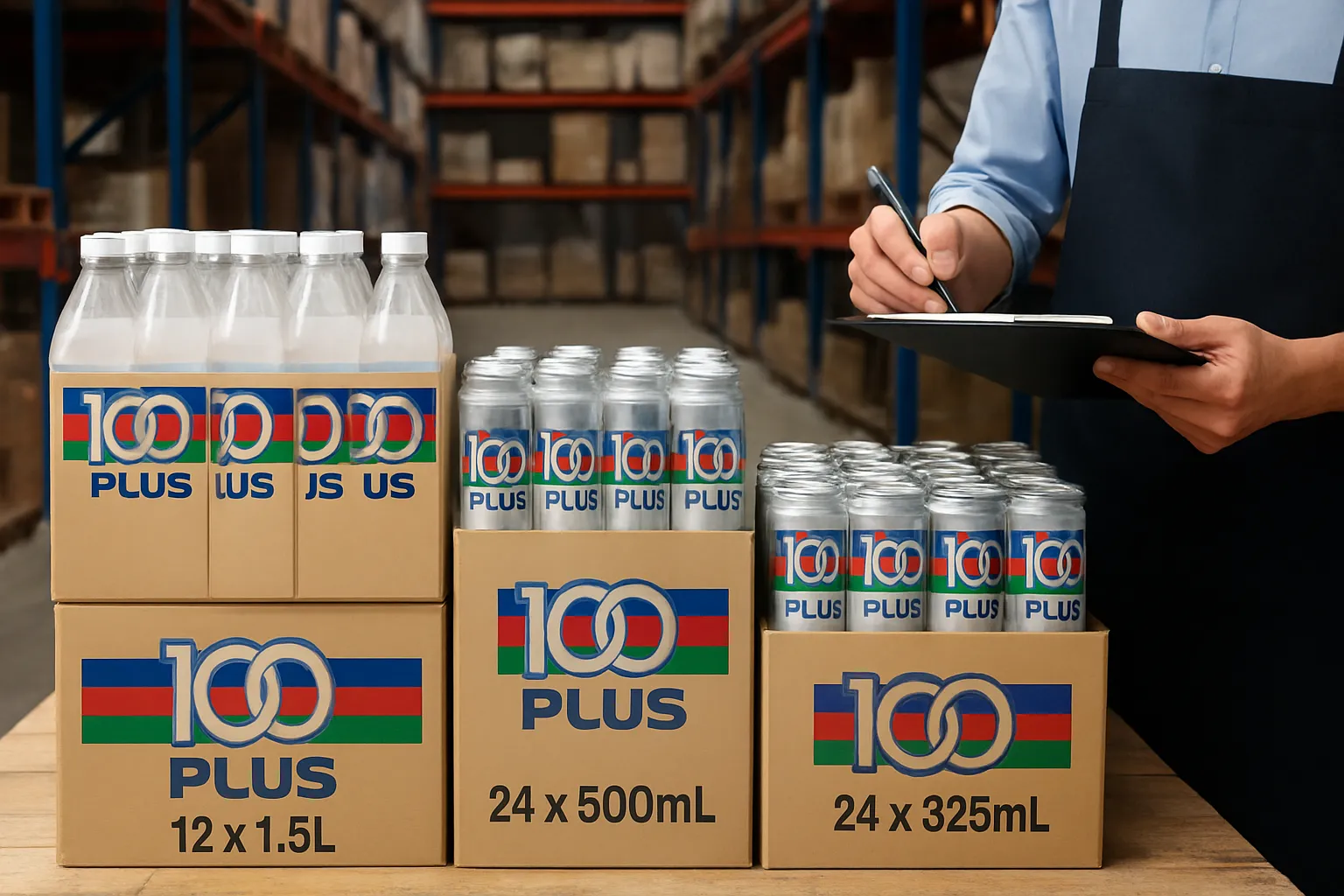
For retailers, cafés and caterers, working out the true 100 Plus wholesale price across different pack formats is an essential step before committing to a bulk order. A quoted carton price on its own does not tell you whether you are getting good value — you need to break it down to cost per unit and cost per litre, and compare that against your own selling price and margin targets. This guide walks through how to do that comparison properly, using clearly labelled hypothetical figures, so you can approach any supplier quotation with confidence.
Why a Single Carton Price Isn’t Enough
Two quotations that look similar at carton level can actually represent very different value once you account for pack size. A carton of small bottles and a carton of large bottles will have different per-unit and per-litre costs even if the carton price looks close. Business buyers need a consistent way to compare across formats before deciding which pack suits their outlet.
It’s also worth remembering that no two supplier quotations are guaranteed to stay valid for long. Prices, availability and minimum order quantities can change, so always ask the supplier to confirm the current pack, price and availability before you finalise an order.
100 Plus Pack Sizes Available Through Trader Max’s
Trader Max’s catalogue lists 100 Plus in three pack formats. Product names confirm the pack sizes below; current pricing and stock availability should always be confirmed directly with the supplier.
Comparing Cost Per Unit Across Pack Sizes
Once you have a quotation for each pack size, divide the carton price by the number of units in that carton. This gives you a like-for-like unit cost regardless of pack format.
Worked Example Using Hypothetical Figures
The figures below are hypothetical examples for illustration only. They are not current Trader Max’s prices and should not be used for budgeting without a confirmed quotation.
- 500ml x 24pcs at a hypothetical carton price of RM60.00: RM60.00 ÷ 24 bottles = RM2.50 per bottle.
- 1.5L x 12pcs at a hypothetical carton price of RM54.00: RM54.00 ÷ 12 bottles = RM4.50 per bottle.
- 325ml can (24+4pcs = 28 cans) at a hypothetical carton price of RM50.00: RM50.00 ÷ 28 cans = approximately RM1.79 per can.
Cost Per Litre: Normalising Different Pack Formats
Unit price alone can be misleading when pack volumes differ. Converting each hypothetical quotation to a cost-per-litre figure makes comparison fairer.
- 500ml x 24pcs: carton volume = 24 × 0.5L = 12L. RM60.00 ÷ 12L = RM5.00 per litre.
- 1.5L x 12pcs: carton volume = 12 × 1.5L = 18L. RM54.00 ÷ 18L = RM3.00 per litre.
- 325ml can (28 cans): carton volume = 28 × 0.325L = 9.1L. RM50.00 ÷ 9.1L = approximately RM5.49 per litre.
In this hypothetical example, the 1.5L pack works out cheaper per litre than the 500ml bottle or the 325ml can — but this is purely illustrative. Your own comparison must use the actual quotations you receive, not these example figures.
Gross Margin vs Markup: Know the Difference
Retailers and caterers often use “margin” and “markup” interchangeably, but they are calculated differently and will give you different percentages from the same numbers.
Hypothetical Margin Calculation
Using the 500ml bottle example above, with a hypothetical cost of RM2.50 per bottle and a hypothetical selling price of RM3.00:
- Markup = (Selling Price − Cost) ÷ Cost = (RM3.00 − RM2.50) ÷ RM2.50 = 20%.
- Gross Margin = (Selling Price − Cost) ÷ Selling Price = (RM3.00 − RM2.50) ÷ RM3.00 = approximately 16.67%.
Both figures come from the same cost and selling price, but they answer different questions — markup tells you how much you added on top of cost, while margin tells you what proportion of the final selling price is profit. Decide which metric your business uses for pricing decisions and apply it consistently when comparing supplier quotations.
Purchasing Quantity Assumptions for Planning Purposes
When budgeting for a bulk order, it can help to work through a hypothetical purchasing scenario — but this should be treated strictly as a planning assumption, not a recommended consumption or hydration guideline.
For example, a caterer planning an order for a single event might assume, purely for budgeting purposes, 3 cartons of 500ml x 24pcs (3 × 24 = 72 bottles) plus 2 cartons of 1.5L x 12pcs (2 × 12 = 24 bottles). This is an arbitrary planning figure to illustrate how quantities scale across cartons; actual order quantities should be based on your own sales data and confirmed against supplier minimum order quantities.
When comparing pack sizes by volume, remember that unit counts and volumes do not automatically match across formats. Two 250ml units are only equivalent to one 500ml unit — matching total volume across different pack sizes always requires recalculating the unit count, not assuming a simple one-to-one swap.
Shipping Weight and Shelving Considerations
The litre figures used above describe nominal liquid volume only. They do not represent the gross shipping weight of a carton, which includes bottles, cans, packaging materials and carton weight, and will differ from the liquid volume alone. Gross weight affects pallet loading, vehicle capacity and how many cartons your storage shelving can safely hold.
Before finalising quantities for delivery or in-store storage, ask Trader Max’s to confirm the gross weight per carton and carton dimensions for each 100 Plus pack size, so you can plan logistics and shelf space accurately.
Enquiry Checklist Before You Order
When requesting or comparing 100 Plus wholesale price quotations, it helps to ask for the same set of details from every supplier:
- Confirmed current price per carton for each pack size you need
- Minimum order quantity, if any
- Carton gross weight and dimensions
- Current stock availability for the pack size and quantity required
- Validity period of the quotation
- Delivery arrangements applicable to your order
- Payment terms
Having this information in writing for each quotation makes it much easier to compare offers on a like-for-like basis rather than relying on carton price alone.
Comparing Multiple Supplier Quotations
Once you have gathered quotations, convert each one to cost per unit and cost per litre using the method above. Line up the figures side by side along with carton gross weight, minimum order quantity and quotation validity. This gives you a clearer basis for deciding which quotation best fits your outlet’s volume needs and storage capacity, rather than comparing headline carton prices in isolation.
Get a Current Quotation from Trader Max’s
If you’re a retailer, café or caterer looking to compare 100 Plus pack options for your business, contact Trader Max’s to enquire about the 1.5L x12pcs, 500ml x24pcs and 325ml can (24+4pcs) formats. Our team can confirm current pack availability and provide a quotation suited to your order quantity — reach out today to start your enquiry.


Leave A Comment