
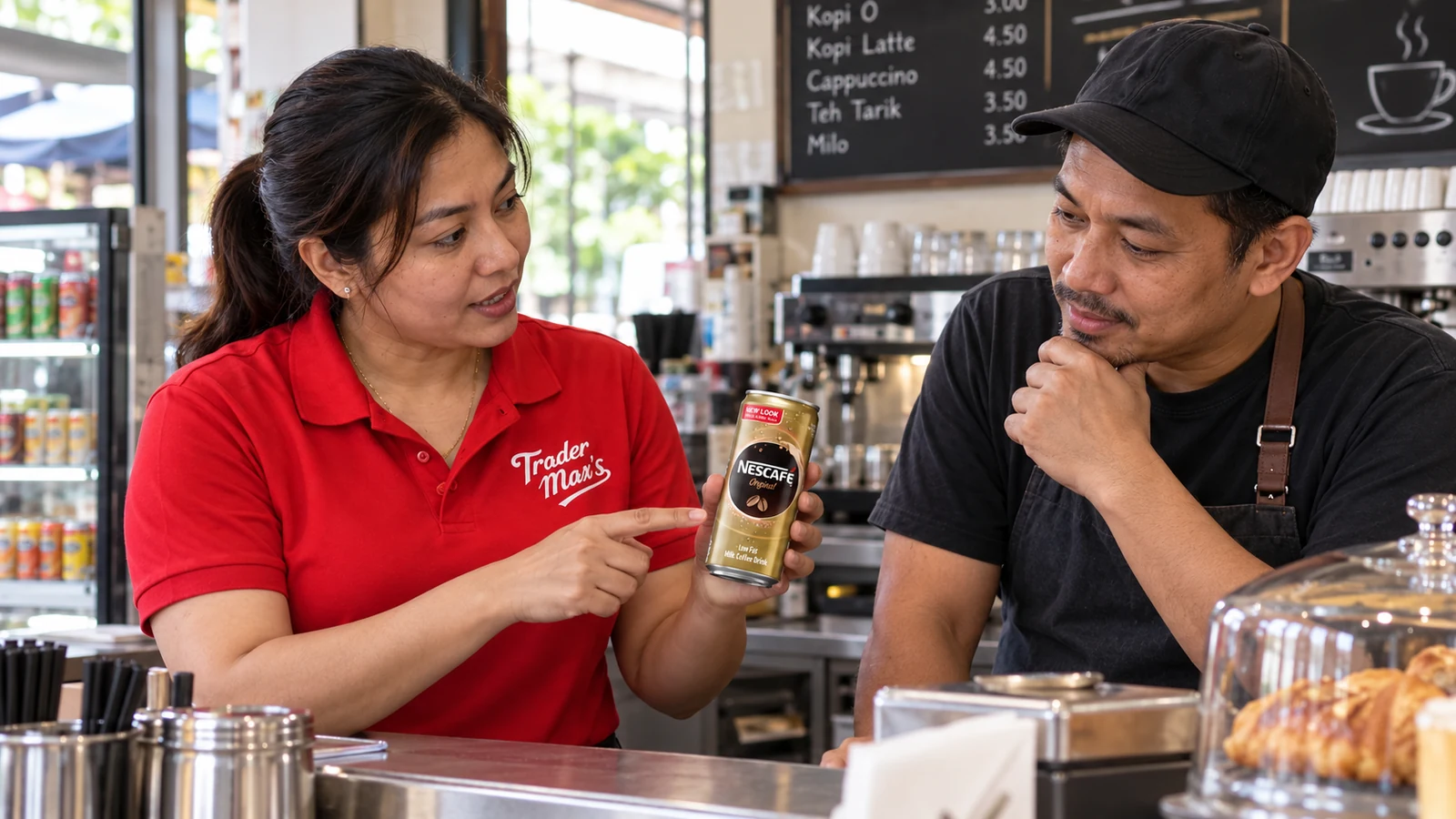
What is Nescafé Malaysia?
Nescafé is Nestlé’s coffee brand. In Malaysia, buyers encounter different product formats, including soluble coffee, premixed sachets and ready-to-drink coffee. They share a brand name, but their ingredients, preparation and purchasing units can differ.
For an ingredients question, identify the exact product first. A jar of plain instant coffee is not the same formulation as a sweetened premix or a canned drink. This guide explains the brand’s history, how soluble coffee is produced and what to check before choosing coffee for a household, shop or office pantry.
When did Nescafé begin?
According to Nescafé’s brand history, Nestlé was asked in 1929 to help preserve surplus Brazilian coffee. Max Morgenthaler and his team worked on a soluble product that retained coffee flavour, and the Nescafé brand was launched in 1938.
That is the history of Nescafé’s launch, not evidence that it was the world’s first instant coffee. It also does not establish the launch date of every product later sold in Malaysia.
A documented Malaysian milestone
In December 2020, Nestlé Malaysia announced Nescafé Classic Kopi Kedah, describing it as its first coffee made entirely with locally grown beans. This is a specific product milestone, not a claim that all Nescafé products sold in Malaysia use Malaysian-grown coffee.
To establish the origin of a particular pack, read its manufacturing details and product information. Brand origin, bean origin and the place where coffee is processed or packed are separate facts.
What’s Inside Nescafe Malaysia? (Ingredients Breakdown)
Understanding what goes into Nescafe Malaysia helps explain why it delivers such a consistent and familiar taste across every cup. While the ingredients may look simple on the surface, each component plays a specific role in flavor, texture, and overall experience.
Coffee beans: check the variant
The Malaysian Nescafé Classic page describes a blend of Arabica and Robusta beans with a medium-dark roast. That description applies to the product presented there; it should not be treated as the bean specification for every Nescafé line.
Use the exact variant name when comparing products. A flavour description, roast description and ingredient declaration answer different questions.
2. Instant Coffee Extract
The signature feature of Nescafe is its instant coffee format, created by brewing real coffee and then removing the water.
What remains is concentrated coffee extract in the form of granules or powder.
This ensures:
- Fast preparation (just add hot water)
- Long shelf life
- Consistent taste in every serving
For pure variants (like Nescafe Classic), this is often the only ingredient—100% real coffee.
3. Sugar (For 3-in-1 Variants)
In popular Malaysian formats like 3-in-1 sachets, sugar is added to create a ready-to-drink balance.
- Enhances taste and reduces bitterness
- Makes the drink more accessible for casual coffee drinkers
- Provides quick energy
However, this also means higher calorie content, which is something to monitor for daily consumption.
4. Creamer / Milk Solids
To achieve that smooth, creamy texture, Nescafe Malaysia often includes:
- Non-dairy creamer (commonly used in 3-in-1)
- Milk solids (in certain variants)
This gives the coffee a richer mouthfeel without needing fresh milk.
It’s one of the key reasons why 3-in-1 coffee is so popular—it’s complete and convenient.
5. Emulsifiers & Stabilizers (In Some Products)
Certain variants may include small amounts of additives such as:
- Emulsifiers (to keep texture smooth)
- Anti-caking agents (to prevent clumping)
These are used in minimal quantities and are common in instant beverage products to maintain quality and shelf stability.
6. Optional Flavor Enhancements
Some modern Nescafe Malaysia products include additional flavor profiles such as:
- Mocha
- Hazelnut
- Latte-style blends
These may contain natural or nature-identical flavoring to enhance the drinking experience.
Simple vs Complete: Choosing the Right Variant
-
Black coffee (e.g. Nescafe Classic)
→ 100% coffee, no sugar, no creamer
-
3-in-1 coffee
→ Coffee + sugar + creamer (all-in-one convenience)
-
Ready-to-drink cans/bottles
→ Pre-mixed for on-the-go consumption
How instant coffee is made
Nescafé’s general production explainer describes the route from beans through roasting, grinding, extraction and drying to soluble coffee. This explains the process category; it is not a production specification for every Malaysian SKU.
From beans to coffee extract
The beans are roasted and ground before coffee is extracted with water. Drying removes water from that extract to make soluble coffee. The result can be prepared again with water according to the directions on the retail pack.
Spray drying and freeze drying
Spray drying uses hot air to dry the extract. Freeze drying removes water from frozen extract through sublimation. These are different production methods, but a general explanation does not establish which method is used for an unnamed product.
Do not infer a universal taste ranking from the drying method alone. The exact coffee, roast, formulation and preparation all belong in a product comparison. Use the manufacturer’s description when a particular process is part of the purchase requirement.
Premixes and ready-to-drink formats
A premix has additional ingredients, so its ingredient list and serving instructions must be checked separately from plain soluble coffee. A ready-to-drink product also has its own storage guidance and nutrition panel. Neither should be represented as simply a different pack size of a jar of black coffee.
For a pantry, decide whether people will measure coffee and additions individually or use a prepared portion. That choice affects your purchasing unit, stock tracking and preparation instructions. It does not establish that one format is nutritionally preferable for everyone.
Caffeine and nutrition: read the exact product
Coffee should not be sold with a blanket promise of weight loss, better exam results or improved physical performance. Nestlé’s Nescafé FAQ says there is no evidence that Nescafé helps someone lose weight. This article therefore does not use a metabolism claim as a reason to buy coffee.
The caffeine in a cup depends on the product and how it is prepared. Nescafé’s caffeine explanation identifies factors including bean type, preparation and serving size. Figures for a product sold in another market should not be assumed to apply to a Malaysian sachet or can.
Compare the finished drink
Check the ingredients and nutrition panel on the exact pack. Plain coffee prepared with water, coffee with added sugar and milk, and a premixed sachet are different drinks. Record the serving basis when comparing energy or total sugars.
A cup count alone is not a precise caffeine measurement. If caffeine content matters to your purchase, ask the manufacturer about the specific product and portion. Personal dietary or medical suitability cannot be established from a general brand article.
Local sourcing and sustainability information
The Kopi Kedah announcement provides a concrete example of Malaysian coffee sourcing. It should be read with its date and product scope intact. It does not prove that the whole range has the same origin, sourcing arrangement or packaging.
For a purchasing decision, distinguish a company target from a completed result. Check current manufacturer reporting before repeating a recycling, sourcing or emissions claim. A broad sustainability programme does not establish whether your local collection service accepts an individual jar, lid or sachet.
Use the disposal guidance on the supplied packaging and the requirements of your local collection service. Keep the product’s practical storage and waste-handling needs in mind when choosing a format for a pantry or shop.
Why Malaysians Love Nescafe
There’s a reason why Nescafe has remained a top choice in Malaysia for decades—it fits seamlessly into the way Malaysians live, work, and socialise.
1. Unmatched Convenience
Malaysians value speed and efficiency, especially during busy mornings or tight work schedules.
Nescafe delivers exactly that:
- Just add hot water → ready instantly
- No brewing equipment needed
- Consistent taste every time
Whether at home, in the office, or even while traveling, it’s one of the easiest ways to get a quick coffee fix.
2. Taste That Matches Local Preference
Malaysia already has a strong kopi culture—bold, rich, and slightly bitter.
Nescafe blends, especially those with Robusta beans, align well with this taste profile:
- Strong enough for heavy coffee drinkers
- Smooth enough for casual consumers
- Adaptable with sugar, milk, or creamer
This balance makes it widely acceptable across different age groups.
3. Affordable for Everyday Consumption
Price matters in a high-frequency product like coffee.
Nescafe is positioned in a way that:
- Fits daily consumption without feeling expensive
- Offers value through sachets and bulk packs
- Is accessible to students, workers, and families alike
This affordability is a key reason it remains a household staple.
4. Widely Available Everywhere
Accessibility is one of Nescafe’s biggest strengths.
You can find it almost anywhere in Malaysia:
- Supermarkets and hypermarkets
- Convenience stores and petrol stations
- Offices, pantries, and vending machines
- Wholesale suppliers such as Trader Max’s for carton enquiries
This constant presence reinforces habit—people choose what’s easy to find.
5. Variety for Different Lifestyles
Nescafe Malaysia has evolved to match modern consumer needs:
- Classic black coffee → for purists
- 3-in-1 mixes → for convenience lovers
- Ready-to-drink cans → for on-the-go lifestyles
- Flavoured options → for younger audiences
This wide range allows consumers to switch based on mood, time, and occasion.
6. Strong Brand Trust Across Generations
Backed by Nestlé, Nescafe has built decades of credibility.
- Parents grew up with it
- Younger generations continue the habit
- It’s seen as reliable, safe, and familiar
That emotional connection is hard to replace, especially in a market filled with alternatives.
7. Fits Malaysian Social Culture
Coffee in Malaysia is rarely just about caffeine—it’s about connection.
Nescafe plays a role in:
- Office bonding moments
- Late-night conversations
- Casual meetups and brainstorming sessions
It’s simple, but it creates shared experiences.
Where to Buy Nescafe Malaysia
Finding Nescafe Malaysia is extremely easy—one of the key reasons it has become such a dominant daily beverage.
Whether you’re a casual drinker or running a business, there are multiple purchasing channels tailored to different needs.
1. Supermarkets & Hypermarkets (Most Common Choice)
For everyday consumers, supermarkets remain the most convenient option.
You can easily find Nescafe in major retail chains across Malaysia, including:
- Lotus’s
- AEON
- Giant
- Jaya Grocer
These stores typically carry a full range—from Nescafe Classic jars to 3-in-1 sachets and ready-to-drink cans
This is ideal for:
- Household consumption
- Small quantity purchases
- Trying different variants
2. Convenience Stores & Mini Markets
For quick, on-the-go purchases, Nescafe is widely available at:
- 99 Speedmart
- KK Mart
- Petrol station stores
These outlets focus on:
- Smaller pack sizes
- Ready-to-drink coffee
- Immediate consumption
Availability varies by outlet and product; check the exact item before travelling or ordering.
3. Online Shopping Platforms
For convenience and variety, online platforms are a growing choice in Malaysia.
You can purchase Nescafe through:
- Lazada
- Shopee
- Online grocery stores
These platforms offer:
- Competitive pricing
- Bundle deals
- Home delivery options
Perfect for:
- Busy professionals
- Bulk home stocking
- Price comparison
4. Wholesale & Bulk Suppliers (Best for Business)
For businesses, offices, cafés or resellers, compare wholesale quotations with other current offers using the same product and purchasing unit.
Options include:
- FMCG distributors
- B2B platforms like Borong or Supplybunny
- Direct Nestlé distribution partners
These suppliers offer:
- Carton pricing
- Current availability confirmed in the quotation
- Delivery coverage confirmed for your postcode
This is especially relevant for:
- Offices with pantry needs
- Restaurants and mamak stalls
- Retailers and mini markets
5. Direct Brand & Official Channels
You can also explore products directly via the official Nescafe Malaysia website, which provides product discovery and purchase guidance
This helps consumers:
- Explore the full product range
- Find nearby retailers
- Stay updated on new releases
Trader Max’s: preparing a coffee enquiry
Browse the Nescafé catalogue and keep the full product name and link beside each quantity. Ask for current pricing, availability, pack breakdown and delivery details rather than assuming a listing reserves stock.
Match the purchasing unit
For jars or tins, confirm the weight per container and containers per carton. For sachets, confirm the sachet weight, sachets per inner pack and packs per outer carton. For canned coffee, record the volume and unit count. Ask the supplier to resolve any mismatch between a title and description before calculating an order.
Compare the same variant on each quotation. A black coffee jar, a premix and a ready-to-drink can have different preparation and serving requirements, so their prices cannot be compared simply by looking at the largest number on the pack.
Estimate pantry usage
Measure actual consumption over a normal period before increasing order quantities. Keep track of the portion used and any separately purchased milk or sugar. When calculating a cost per prepared drink, include the additions you actually use rather than treating the coffee price as the entire cost.
A larger pack may suit a busy pantry, but check storage space and the handling instructions first. Keep containers closed as directed on the pack, use clean utensils and rotate batches by date. Follow the product’s own guidance rather than an assumed shelf life after opening.
Check deliveries against the quotation
At receiving, match the variant, weight or volume, unit count and batch dates. Keep each product as a separate stock line so staff can distinguish an individual selling unit from an inner pack or outer carton.
For a mixed beverage order, use the beverage catalogue and send your requested quantities and delivery postcode through Trader Max’s contact page. Confirm delivery arrangements and any charges before placing the order.
Frequently asked questions
Does every Nescafé product contain only coffee?
No. Plain soluble coffee, premixes and ready-to-drink products have different formulations. Read the full ingredient declaration for the product being purchased.
Is Nescafé made from Malaysian-grown beans?
Nestlé documented locally grown beans for Classic Kopi Kedah in its 2020 announcement. That does not establish the bean origin of every product sold under the brand.
Does a stronger taste mean a known caffeine amount?
Taste descriptions do not provide a measured caffeine quantity. Identify the exact product and portion and consult manufacturer information if that figure is important.
Choose by product, preparation and pack
Start with the exact Nescafé variant, then check its ingredients, preparation instructions and purchasing unit. The brand’s history explains where it began; the current pack and quotation explain what you are buying today.




[…] like Nescafe Malaysia production and ingredients continue to dominate morning routines, while 100PLUS Malaysia hydration […]