
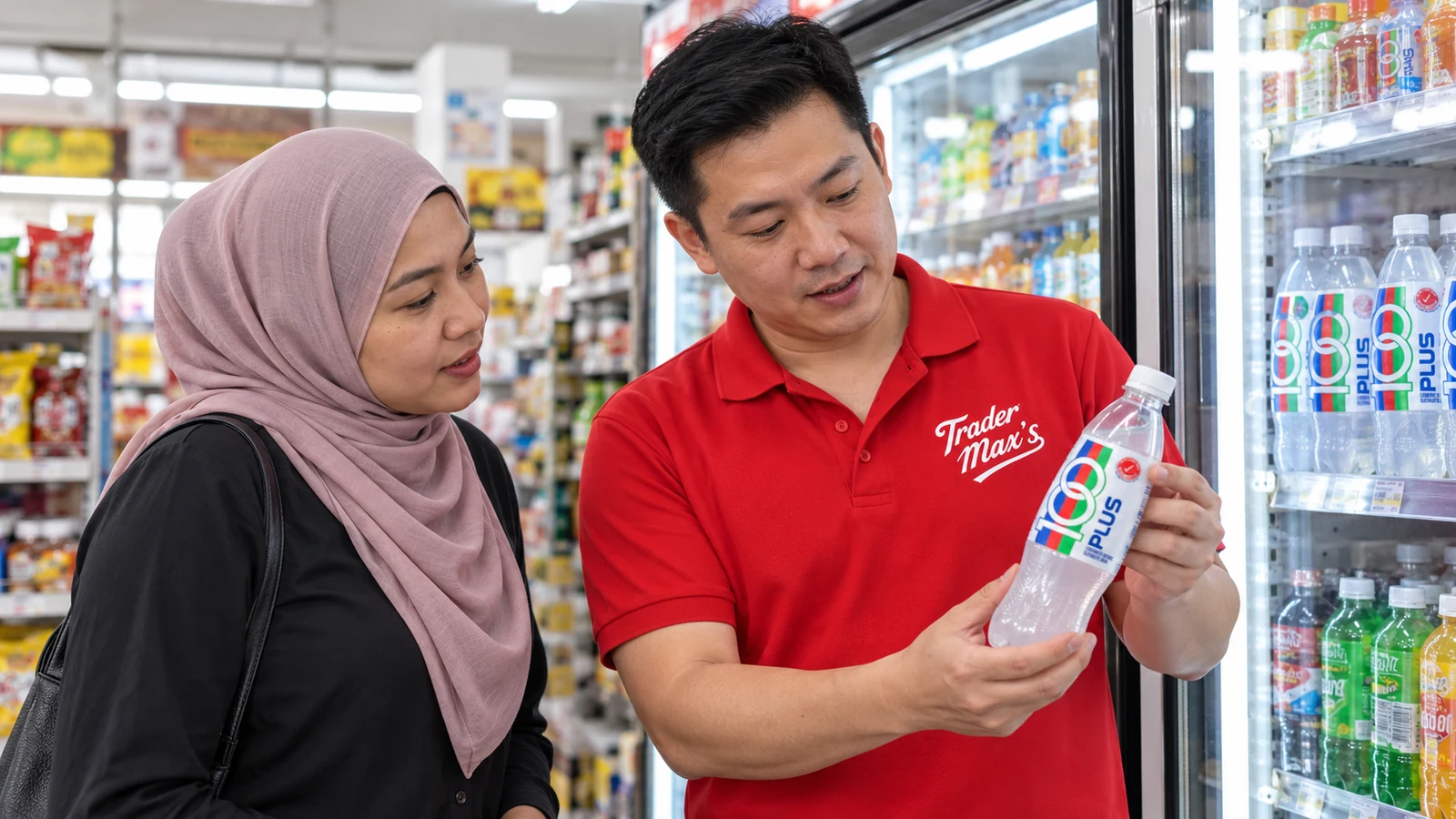
100PLUS Malaysia: choose the exact variant first
100PLUS is F&N’s isotonic beverage brand. For a shopper or retailer, the useful starting point is the exact variant: Original, Reduced Sugar, Zero and Active should not be treated as interchangeable products. Compare the current pack label, serving size and purchasing unit before deciding what to buy.
This guide explains the differences documented by the manufacturer, how to approach a Revive versus 100PLUS comparison and how to prepare a clear wholesale enquiry. It does not rank one drink as the best choice for every person, and it does not treat brand popularity as proof of a health benefit.
What is 100PLUS?
F&N describes 100PLUS as an isotonic drink and lists several carbonated and non-carbonated variants on its official product page. The brand includes products with different sugar profiles and formats. The details of one variant should not be copied to another simply because both carry the 100PLUS name.
F&N’s 2018 company announcement dates the brand’s introduction to 1983. That announcement also discusses market share at the time. Historical figures are useful background, but they are not evidence for a new “number one in 2026” claim.
When customers ask about the product, start with the manufacturer’s description and the actual label. Avoid turning a general hydration message into a promise about concentration, exam performance, fatigue or recovery from illness. A retail product guide cannot establish an individual’s needs.
What about 100PLUS benefits and energy?
F&N positions the brand around hydration and describes its isotonic formulation as combining fluids and electrolytes. That is the manufacturer’s product positioning. It is not a reason to promise better exam focus, relief from illness or improved performance to every customer.
For the question “does 100PLUS give you energy?”, check the energy and carbohydrate figures on the exact pack. Original and Zero are different formulations, so one answer or calorie figure cannot describe both. The word “energy” on a beverage discussion should not be confused with a promise to resolve tiredness.
Retailers can help by making the product and nutrition label easy to identify. If a customer asks which variant fits a medical condition or personal dietary restriction, a shop’s brand comparison is not enough to answer that question. Avoid giving blanket suitability claims based on age, occupation or activity alone.
For business buyers, the practical benefit of a clear specification is simpler ordering: staff can recognise the requested variant, compare the same unit and check the delivery accurately. Those are purchasing decisions that can be verified without making a health claim about the drink.
Original, Reduced Sugar, Zero and Active
The manufacturer separates the range by formulation and carbonation. These distinctions help you ask a more precise question than “Do you have 100PLUS?” They also help receiving staff match the delivery to the quotation.
- Original: listed in F&N’s carbonated range.
- Reduced Sugar: a separate carbonated variant. Its name does not mean sugar-free.
- Zero: described by F&N as zero sugar and zero calories.
- Active: described as non-carbonated, with vitamins B3, B6 and B12.
Use these descriptions to identify the product, then verify the exact pack being supplied. Range availability and pack sizes can change. A manufacturer’s range listing is not confirmation that a particular distributor has every variant in stock.
Do not compare an Original product with a Zero product and present the result as a comparison of two identical drinks. The formulation is part of the choice, alongside flavour preference, carbonation, pack size and price.
How to compare sugar and nutrition labels
Read the nutrition panel on the same basis. A value per 100ml is different from a value per serving or per bottle. If two products use different serving sizes, first convert them to a common volume before comparing the figures.
For a worked example unrelated to a specific brand, a drink labelled 4g of sugar per 100ml contains 20g in a 500ml bottle. The calculation is 4 multiplied by five. This example explains the arithmetic; it is not a nutrition declaration for every 100PLUS product.
Keep total sugars, energy and any sweetener declaration separate. A reduced-sugar statement does not tell you the complete ingredient list. Similarly, a zero-sugar statement alone does not describe the flavour, sodium level or suitability for a particular dietary requirement.
If you prepare shelf information for customers, copy figures from the current product label and include the serving basis. Recheck the label when a new formulation or pack arrives. Do not rely indefinitely on a photograph of an older can or on a nutrition panel from another country.
For personal dietary or medical questions, the relevant product label and individual advice matter more than a general brand comparison. This page does not prescribe how often someone should drink an isotonic beverage or promise a health outcome.
Revive vs 100PLUS: what should you compare?
A useful comparison starts with two exact products, not just two brand names. Write down the variant, country of sale, pack volume and label date for each. Compare a carbonated product with another carbonated product if carbonation is what the customer wants to evaluate.
Etika’s Singapore Revive page describes Revive Original as a grapefruit-flavoured isotonic drink. That is a Singapore-market source, so it should not be used as proof of the ingredient quantities or pack specification of a Malaysian unit. Read the locally supplied Revive label for those details.
F&N’s Malaysian page documents the 100PLUS variants described above. These manufacturer sources establish product positioning, but they do not establish that one brand hydrates every person better than the other. A preference for taste or fizz is also different from a demonstrated performance advantage.
A practical comparison checklist
- Compare the exact variant names and flavour descriptions.
- Check whether each drink is carbonated.
- Record energy and total sugars per 100ml, then per complete container.
- Read the ingredients and any sweetener statement on each local pack.
- Compare the same purchasing unit and include delivery charges.
- Use your own customer requests and sales records when deciding shelf space.
Leave a field blank if you have not verified it. An honest incomplete comparison is more useful for purchasing than filling gaps with assumed nutrition values or claims copied from a different market.
Choosing cans or bottles for a shop, pantry or event
Start with how the drinks will be purchased, stored and handed out. A shop may need individual selling units and clear shelf labels. A pantry may need a format that fits its storage space. An event organiser may need to know the number of containers required for a particular service plan.
The package volume does not tell you the physical carton dimensions. Check the actual carton if shelf height, fridge capacity or vehicle space is tight. Count the reserve stock as well as the units displayed at the front of a chiller.
For an event, decide whether each attendee receives an unopened unit or whether drinks will be served from larger containers. That decision affects the purchasing calculation and handling plan. Confirm quantities against the event’s actual requirements rather than treating a brand’s suggested occasion as an order forecast.
Follow the storage instructions on the supplied packaging. When stock arrives, check the product name, quantity, packaging condition and batch dates against the quotation. Record any discrepancy before assuming that a similarly coloured product is the agreed substitute.
How to compare wholesale quotations
Browse the Trader Max 100PLUS catalogue to identify products for an enquiry. Keep the product link beside each requested quantity so that the supplier can see the intended variant and size.
A quotation should state the number of units in the carton and the volume of each unit. “One carton” is not enough detail when suppliers or product sizes use different packing arrangements. Check the quotation against the actual product listing and ask for clarification if they disagree.
Use a consistent cost calculation
Calculate the cost per selling unit by dividing the quoted carton amount by the confirmed unit count. Allocate any delivery charge consistently across the order before comparing suppliers. If the order contains several products, document how you have allocated that charge instead of silently ignoring it.
A lower carton total is not necessarily a lower unit cost if the carton contains fewer units. Likewise, a larger bottle and a smaller can answer different purchasing needs even when their price per litre is similar. Keep both the cost per unit and the pack specification visible.
Do not assume that a wholesale quotation always beats every retail promotion. Compare the current like-for-like offers, quantities, delivery terms and batch dates. The appropriate choice depends on the actual order, not the label attached to the sales channel.
Confirm terms before placing the order
Ask the supplier to confirm availability, quotation validity, delivery coverage, minimum order requirements and any charges. Include the delivery postcode and preferred delivery date with your enquiry. A requested date is not a confirmed delivery slot until the supplier agrees to it.
Ask about the available batch dates if remaining shelf life matters to your stock plan. Also clarify how to report damaged or incorrect goods. Do not infer a return entitlement or delivery promise from a general product article.
Build a replenishment plan from actual sales
Track each variant separately. Combining Original, Reduced Sugar, Zero and Active into one stock figure can hide which product customers are actually requesting. Record the units sold, the days the product was available and any period when the shelf was empty.
A week with low sales may reflect limited availability rather than low demand. Conversely, a short promotion may produce sales that do not continue at the regular price. Keep those circumstances alongside the numbers when deciding the next order.
Begin with a quantity that fits your storage and review schedule. The purpose of a trial order is to learn what your outlet can sell or use, not to prove that every familiar brand deserves a large allocation. Increase quantities when your own records support the decision.
For a pantry, use consumption records rather than headcount alone. Different teams and service arrangements can use different amounts. Review unopened reserve stock before reordering and rotate batches according to their dates and the manufacturer’s storage guidance.
Receiving checklist for a mixed beverage order
Keep the approved quotation available at receiving. Match each line to the carton rather than checking only the total number of cartons delivered. Similar brand colours can make substitutions easy to miss when several variants arrive together.
- Read the full variant name on the delivered pack.
- Check the volume per unit and the unit count per carton.
- Compare the received quantity with the confirmed order.
- Check the carton and individual packaging for visible damage.
- Record batch dates and any discrepancy requiring supplier follow-up.
Keep receiving records consistent with your stock system. If the purchasing unit is a carton but the selling unit is a can or bottle, make that conversion explicit. Staff should not have to guess whether a quantity of “12” refers to cartons, bottles or inner packs.
Frequently asked questions
Is all 100PLUS sugar-free?
No. The manufacturer distinguishes Original, Reduced Sugar and Zero. Check the exact product rather than applying the Zero claim to the entire brand.
Is 100PLUS Active carbonated?
F&N describes Active as non-carbonated. Confirm that the product on the quotation is Active if that feature matters to your purchase.
Is Revive better than 100PLUS?
That question needs a defined comparison. Taste preference, sugar content, price and the available pack are different criteria. Compare the exact local labels and your intended purchasing requirements; the sources reviewed here do not establish a universal winner.
Can I use an old nutrition image for a new delivery?
Check the new pack first. A change in formulation, market or pack size can make an older image unsuitable as a reference. Keep the variant and serving basis with any figures you publish.
Does a catalogue listing confirm stock or delivery?
No. Confirm availability and delivery arrangements in the current quotation. A catalogue is a useful product reference, not a reservation of stock or a delivery commitment.
Prepare your 100PLUS enquiry
Choose the variant and pack size, list the required quantities and include your delivery postcode. For a mixed order, browse the beverage catalogue and keep every requested item on a separate line.
Use Trader Max’s contact page to request current pricing, availability and delivery details. A clear enquiry helps the supplier quote the right products and gives you a reliable reference when the order arrives.



Leave A Comment