
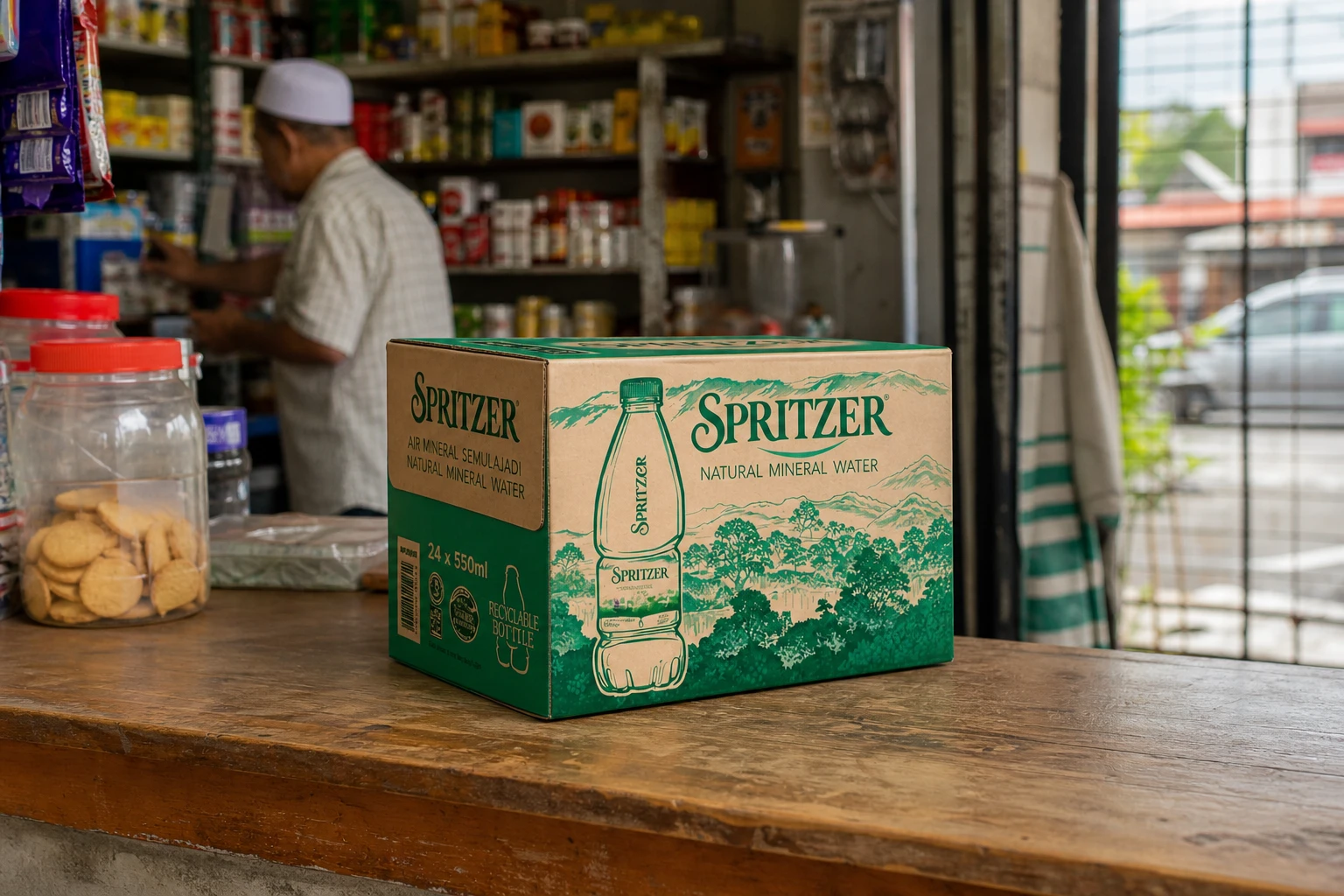
Spritzer 550ml event drinks planning starts with a simple reality for Malaysian office managers, caterers and retailers: no carton count, pricing, or stock availability for this specific bottle format has been independently verified at the time of writing. The practical way forward is to treat this guide as a planning checklist that helps you organise attendance numbers, service windows, storage space and purchasing questions, then confirm the actual bottle size, carton configuration and current availability directly through the product enquiry catalogue or the contact page before you commit to an order. This approach keeps your event planning realistic while avoiding assumptions about specifications that have not been confirmed.
Because no topic-specific facts about this product have been verified, this guide does not state carton quantities, pricing, certifications, shelf life or delivery timelines. Instead, it focuses on what a business buyer can control: clear internal planning, accurate product identification, and a structured set of questions to put to the supplier before finalising any order. This is a more reliable foundation for event planning than relying on assumed figures that may not match current packaging or availability.
Why This Matters for Business Gatherings
Bottled water is one of the simplest line items in an event budget, yet it is also one of the easiest to under-plan or over-order. A shortfall mid-event looks unprofessional in front of clients or staff, while excess unopened stock ties up storage space and petty cash unnecessarily. For a recurring corporate calendar — monthly board meetings, quarterly briefings, product launches, or retail counter stock — getting the quantity and format right the first time reduces repeated last-minute purchasing trips and helps you negotiate more confidently with suppliers once you understand your own consumption pattern.
This is particularly relevant for office managers coordinating multiple meeting rooms, caterers servicing back-to-back events, and retailers who need consistent shelf stock without overcommitting warehouse or chiller space. Each of these buyer types has a different service window and consumption rate, so the planning steps below are structured to apply across all three contexts.
Attendance and Service-Window Worksheet
Before contacting a supplier, it helps to be clear internally about how the water will actually be used. This shapes the questions you ask and the order size you eventually request. A simple worksheet with four columns — expected attendees, service window length, service style, and estimated bottles per attendee — gives you a working figure to bring into any supplier conversation.
Consider whether the water is for:
- Meeting room service, where bottles are placed individually for attendees and consumption is typically light but needs to look presentable on a table.
- Full-day conference or seminar service, where multiple service points may be needed across morning, lunch and afternoon sessions.
- Retail shelf stock, where turnover is continuous rather than tied to a single event date.
- Catering service alongside food and beverage programmes, where water may be served chilled at specific intervals rather than left on tables throughout.
Each of these use cases has a different implied handling requirement — chilled versus room temperature, individual placement versus bulk dispensing, and single-day versus rolling stock. Clarifying this upfront means you can ask the supplier more specific questions about case configuration and whether the product you are enquiring about suits your intended service style, rather than asking generic questions that produce generic answers. Fill in your worksheet numbers before you pick up the phone or send an enquiry, so the conversation starts with your actual requirement rather than a guess made on the spot.
Supplier-Confirmed Bottle and Carton Quantities
Because this guide cannot confirm the exact bottle dimensions, labelling, or carton layout for the 550ml format, product identification becomes your first practical task rather than something to take for granted. When you reach out through the product enquiry catalogue, be ready to ask for and record the following:
- The exact product name and pack description as listed in the current catalogue.
- Whether the 550ml size is available as a standalone case or only as part of a mixed-size offering.
- The confirmed number of bottles per carton, in writing, before you calculate any order quantity.
- Whether the product listing includes a minimum order quantity or is quoted per carton, per pallet, or per unit.
Treat the current catalogue listing as the only reliable reference point for what is actually being sold today, since packaging formats and case configurations can change over time. Asking for written confirmation of these details — even a simple email reply — gives you a record you can compare against what is actually delivered. Spritzer is a Malaysian-origin brand, but the specific manufacturing location printed on any individual carton you receive can vary by batch; the brand’s general origin is not the same thing as the production details on your particular delivery, so check the printed label on your own stock rather than assuming either detail from the brand name alone.
Worked Hypothetical Meeting and Event Scenarios
The following scenarios are entirely hypothetical and are provided to illustrate how an office manager, caterer or retailer might apply a planning worksheet before contacting a supplier. None of the quantities, prices or availability mentioned here are verified facts — they are invented for planning illustration only, and every figure below is clearly labelled hypothetical.
Scenario 1: Office Manager Planning a Half-Day Meeting
Imagine an office manager planning a half-day board meeting for 12 attendees. As a hypothetical planning assumption only, they estimate 2 bottles per attendee across the session, giving a hypothetical total requirement of 24 bottles (12 × 2 = 24). If a supplier’s confirmed carton size turned out to be a hypothetical 24 bottles per case, this would mean ordering exactly one carton. The office manager’s real task is not to guess this number but to confirm the actual carton size through the product enquiry catalogue before finalising the order, and to add a small reserve margin discussed later in this guide rather than ordering the bare minimum.
Scenario 2: Caterer Servicing a Full-Day Conference
Consider a caterer servicing a full-day conference for 80 attendees across morning, lunch and afternoon sessions. Using a hypothetical planning assumption of 3 bottles per attendee across the full day, the estimated requirement would be 80 × 3 = 240 bottles. If the supplier confirms a hypothetical carton size of 24 bottles, the caterer would need 240 ÷ 24 = 10 cartons exactly. In practice, the caterer should request written confirmation of the real carton size and current availability before ordering, since this figure is illustrative only and actual case configurations may differ.
Scenario 3: Retailer Building Rolling Shelf Stock
A retailer stocking a convenience counter does not plan around a single event date but around weekly turnover. As a purely hypothetical example, suppose a retailer estimates selling 15 bottles a day across 7 days, giving an estimated weekly requirement of 105 bottles (15 × 7 = 105). Rounded up to whole cartons at a hypothetical 24 bottles per case, 105 ÷ 24 = 4.375, which rounds up to 5 cartons (120 bottles) to cover the week with a small buffer. Again, the actual carton size, minimum order quantity and current pricing must be confirmed directly with the supplier before this kind of rolling order is placed, since the figures here are for illustration only.
Each of these scenarios shows the same underlying method: estimate your consumption based on your own attendee numbers and service pattern, divide by the supplier-confirmed carton size once you have it in writing, and round up rather than down to avoid a shortfall. The specific numbers used above are invented solely to demonstrate this method and should not be treated as expected pricing, carton sizes or stock levels for any real order.
Building a Quotation Comparison Worksheet
When you request quotations — whether from one supplier for different quantities, or while comparing multiple enquiries — a simple worksheet helps you compare like with like. Because no real pricing or carton data has been verified for this product, the figures below are entirely hypothetical and are labelled as such in every cell. They exist only to demonstrate how to structure a comparison, not to suggest what you should expect to pay or receive.
| Item | Carton A (hypothetical) | Carton B (hypothetical) |
|---|---|---|
| Quoted carton price | Hypothetical RM 36.00 | Hypothetical RM 66.00 |
| Quoted bottles per carton | Hypothetical 24 bottles | Hypothetical 48 bottles |
| Calculated price per bottle | Hypothetical RM 1.50 (36.00 ÷ 24) | Hypothetical RM 1.375 (66.00 ÷ 48) |
On these invented numbers alone, Carton B works out cheaper per bottle — but this is only a demonstration of method. It is useful once the actual carton count and price have been confirmed in writing by the supplier, since the real figures may differ entirely from this illustration.
Your worksheet should capture, for every quotation received: the quoted price, the confirmed carton count, the price per bottle calculated from those two figures, any minimum order quantity stated, and the lead time quoted for that specific order size. Keeping these in a simple spreadsheet means you are comparing actual supplier responses against each other, not comparing a quotation against a figure you assumed in advance. Always divide through to a per-bottle figure before comparing two quotations, and double-check the arithmetic yourself rather than relying solely on a supplier’s summary figure — this avoids a common procurement error of assuming the larger total price automatically means a worse deal, when it may simply reflect a larger carton count.
Reserve Stock and Cooling-Space Planning
A reserve margin protects you against last-minute attendee changes, a warmer-than-expected day, or a session that runs longer than scheduled. There is no universal reserve percentage that applies to every event, since office culture and event type vary, but a reasonable starting approach is to round your calculated bottle requirement up to the next full carton rather than ordering the exact calculated figure, as shown in Scenario 3 above. This gives you a small buffer without committing to a second full carton unnecessarily.
Cooling space is a separate planning question from quantity. If you are holding cartons for a multi-day conference or a week of retail turnover, confirm you have enough chiller or storage space cleared in advance, and that the space is accessible to whichever staff member is responsible for distribution on the event day. For single half-day meetings, room-temperature storage ahead of the event may be sufficient depending on what is printed on the pack, but for events where chilled water is expected on arrival, factor in the lead time your chiller needs to bring a full carton down to a serving temperature — this is a logistics question for your own venue, not a specification this guide can confirm.
When planning reserve stock alongside cooling space, also consider where the reserve cartons will sit if they are not needed on the day. A clearly labelled shelf or chiller section for “next event” stock, separate from stock already earmarked for the current event, avoids reserve bottles being accidentally used up before the event they were set aside for.
Purchase Enquiry Checklist
Before placing any order, work through this checklist. It is designed to surface the questions you need answered, not to assume answers on your behalf.
- Confirm the format you actually need. Decide whether 550ml is the right fit for your event duration and attendee behaviour, or whether a different size might suit the service style better — this is a decision for you to make based on your own event pattern, not a specification this guide can confirm for you.
- Verify current availability. Check the product enquiry catalogue directly rather than relying on previous orders, since listings and availability can change.
- Ask for carton configuration in writing. Request confirmation of how many bottles are in a carton and whether partial cartons can be ordered, rather than assuming a standard figure.
- Clarify lead time expectations. Ask the supplier directly what lead time applies to your order size, since no delivery promises can be assumed here.
- Request a written quotation. A written quotation protects both sides and gives you a document to compare against delivery.
- Confirm payment and collection or delivery terms. These vary by supplier and order size and should be confirmed per enquiry rather than assumed from past experience with other products.
- Check storage and handling guidance printed on the pack. Any instructions printed on the carton or bottle label should take precedence over general assumptions about how bottled water should be stored.
- Record everything for the next event. Keep the quotation, confirmed quantities, and delivery date together so your next planning cycle starts with real data instead of guesswork.
Working through this checklist before every event — not just the first time — keeps your planning grounded in current, confirmed information rather than assumptions carried over from a previous order.
Receiving and Distribution Points
When a carton order arrives, a short receiving check protects you against discrepancies later and builds a useful record for future orders. At minimum, check and note the following at the point of delivery or collection:
- The quantity of cartons received against the quantity confirmed on the written quotation.
- Any visible damage to cartons or bottles, recorded with a photo if possible before the stock is moved into storage.
- The date of receipt, so you have a reference point for how long stock has been held before an event.
- Whether the carton labelling matches what was described in the quotation or catalogue listing, particularly if you ordered from a mixed-size listing.
Keeping this receiving record in a shared file or simple log — even a basic spreadsheet row per order — means that if a discrepancy is spotted later, whether in count or condition, you have a dated record to raise with the supplier rather than relying on memory.
Distribution on the event day is a separate step worth planning deliberately, especially in teams where the person who placed the order is not the same person handing out bottles. Identify in advance where the stock will be staged before the event starts, who carries it to the meeting room or service point, and how leftover sealed bottles are returned to storage afterwards rather than left out. For retailers, the “distribution point” is simply the shelf restocking routine, but the same principle applies: know who restocks, from where, and how often, so gaps on the shelf are caught quickly.
A short handover note is useful for any event you don’t personally run. It should cover where the stock is stored, how many cartons were ordered and received, any special handling noted on the pack, and who to contact if more stock is needed mid-event. For retailers rotating shelf-stocking duties between staff, a simple note on reorder points and the last confirmed carton size helps a new staff member restock accurately without needing to re-ask the office manager or re-contact the supplier for information that has already been confirmed.
Unopened Leftovers and Next-Event Records
If a meeting or event ends with unopened bottles remaining, decide on a simple house rule for where they go rather than leaving them wherever they were last placed. Returning unopened stock to a labelled storage area, and noting the quantity returned against the quantity originally taken out, closes the loop on your receiving record and gives you an accurate count of what was actually consumed at that event.
This consumption figure is the most useful piece of data you can carry into your next planning cycle. Rather than repeating the same estimated bottles-per-attendee figure indefinitely, compare it against what was actually used at the last two or three similar events. If attendees at your board meetings consistently leave more than half their bottle unopened, your per-attendee estimate may be set higher than it needs to be; if bottles run out before the session ends, the opposite adjustment is worth making.
Keep a simple reference file per recurring event type — board meeting, conference, or weekly retail stock — containing the last confirmed carton size, the last quoted price per carton, the attendee or turnover figure used for that order, and the actual consumption recorded afterwards. Before placing a repeat order, confirm with the supplier whether the carton configuration or listing has changed since your last order, since catalogue listings can be updated over time. This single confirmation question is more efficient than re-verifying every detail from scratch, while still protecting you from ordering against outdated assumptions.
Scope Note
This guide has not verified pricing, carton quantities, certifications, delivery timelines or current stock availability for the 550ml format discussed here. All figures used in worked examples and tables throughout this guide are hypothetical and were clearly labelled as such. Before placing any order, confirm current specifications and availability directly through the product enquiry catalogue, and put any quotation or carton configuration in writing with the supplier.
FAQ
How many bottles should I order for a half-day meeting?
There is no fixed figure to apply here, since attendee behaviour varies by office. Use the worksheet approach above to estimate a figure, then measure actual consumption at one event before treating it as your standard order size.
Can I order a partial carton if I only need a small quantity?
This depends entirely on the supplier’s current terms. Ask directly through the product enquiry catalogue and request written confirmation.
What should I do if the delivered quantity doesn’t match my order?
Refer to your receiving record, including any photos taken at delivery, and raise the discrepancy with the supplier promptly through the contact page.
Where can I check the manufacturing details or origin printed on my stock?
Check the printed label on the bottle and carton you actually received. Brand origin and the manufacturing details of a specific pack are not always the same thing, so rely on what is printed on your own stock rather than general brand information.
How do I know how to store the stock correctly before an event?
Follow the instructions printed on the carton or bottle label. If none are visible or clear, ask the supplier directly rather than assuming a general storage rule.
Do I need to reconfirm details every time I reorder?
Not in full, but it is worth confirming whether the carton configuration or listing has changed since your last order, since catalogue listings can be updated over time.
Get in Touch
To confirm current specifications, carton configuration and availability for your next business gathering, browse the product enquiry catalogue at https://www.tradermaxs.com.my/shop/ or reach out directly through https://www.tradermaxs.com.my/were-here/ for a written quotation tailored to your event size and service window.


Leave A Comment